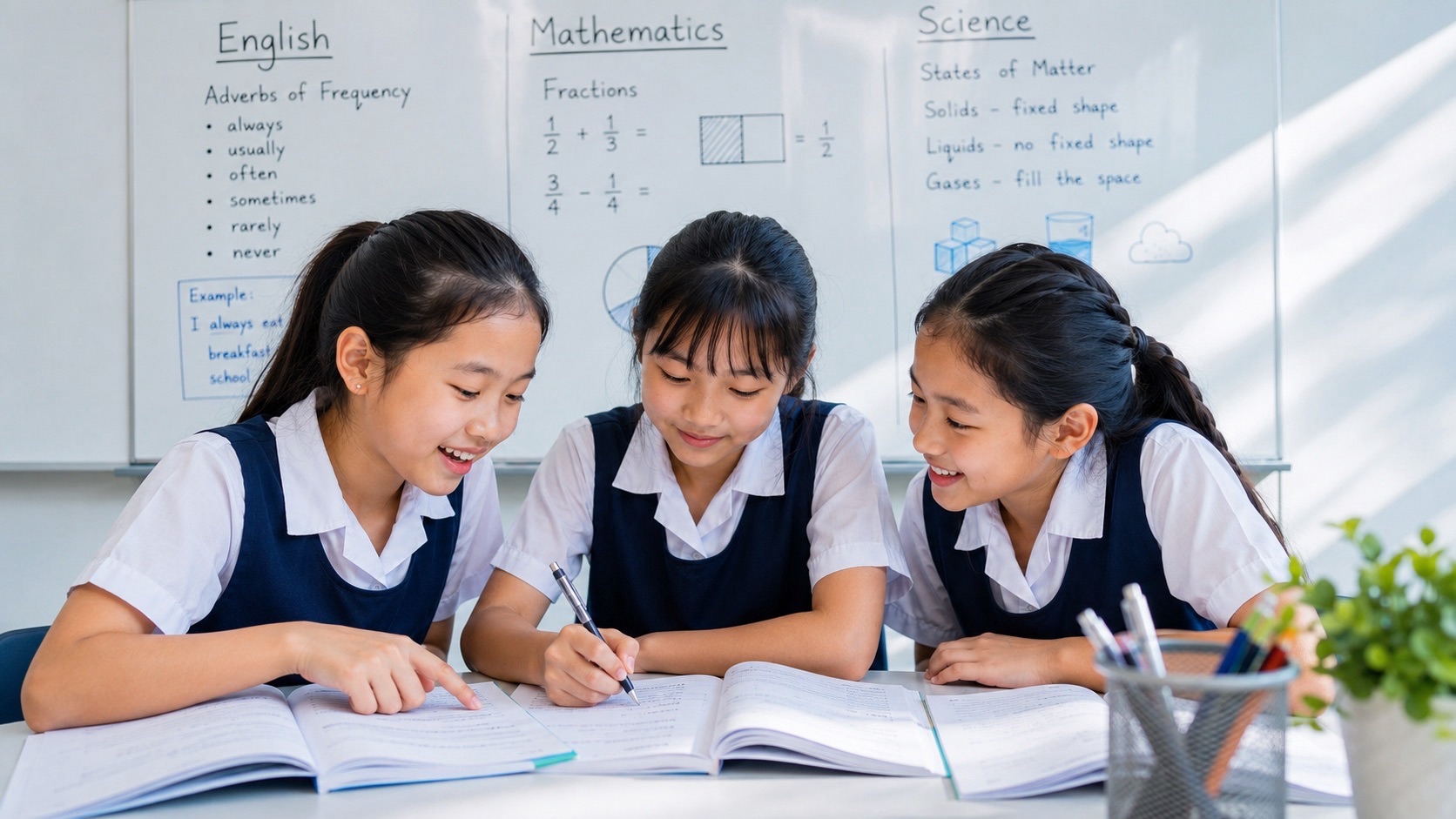
PRIMARY 2 · SCIENCE FOUNDATIONS · JURONG EAST · SMALL-GROUP LEARNING
Primary 2 Science Foundations Jurong East
Primary 2 Science Foundations becomes more useful when a child stops asking only “What crossed the boundary?” and begins asking “What changed when the transfer happened differently?”
A transfer point gives us something unusually valuable for early scientific thinking: a before-state, a boundary, a changed condition and an after-state.
Water may pass more quickly through one opening than another. Light may pass through one material more clearly than another. A toy object may travel differently when the surface changes. A queue may move differently when the number of people joining changes.
Formal Primary Science begins in Primary 3 in Singapore. P2 Science Foundations should therefore not pretend to be the formal subject early. Its role is to strengthen the habits that will later make formal Science more intelligible: prediction, comparison, controlled change, simple measurement, cautious inference and evidence-aware explanation.
Quick Read for Parents
- Formal Primary Science begins in P3. P2 should build inquiry habits rather than accelerate formal content.
- Transfer points create natural comparisons. Children can observe what crosses, how quickly, how much, or under what condition.
- Change one condition at a time where possible.
- Prediction is not evidence. It becomes useful when compared with an observation.
- Simple measurement makes memory less important.
- A conclusion should stay within what the observation supports.
The one-sentence answer
Primary 2 Science Foundations should help children compare transfer points carefully enough to notice how one changed condition may alter what crosses, how it crosses, or what happens next.
From noticing a boundary to testing a difference
At P1, a useful question is: what can cross this boundary?
At P2, we can make the observation more disciplined. What happens if the boundary changes?
For example, a child may compare two safe materials placed in front of the same object. One may allow the object to be seen clearly. Another may make it harder to see.
The child does not need formal optics vocabulary. The scientific job is to compare one visible effect under two conditions.
Prediction: make an idea answerable
Before the comparison, ask the child what they expect to happen.
“I think I will see the object more clearly through this material” is a useful prediction because it can be checked.
“This material is better” is much less useful. Better for what? Better in which property?
Scientific language improves when the child learns to predict a specific observable outcome.
One changed condition: reduce the number of possible explanations
Suppose we want to compare how far the same toy car travels on two surfaces.
If we also change the car, starting point and slope at the same time, the result becomes difficult to interpret. Several things changed.
At P2, we can introduce a simple habit:
“If we want to compare this one thing, what else should we try to keep similar?”
This is age-appropriate preparation for fair-comparison thinking without pretending the child is already doing formal experimental design.
Measurement: let the record carry the observation
Young children often rely on memory: “I think this one went faster.”
A simple record can make the comparison more dependable.
- Which travelled farther?
- Which took longer?
- How many objects passed through?
- How much water remained after a safe demonstration?
- Which material allowed the object to be seen more clearly?
The measurement does not need to be sophisticated. Its job is to reduce dependence on vague recall.
Before and after: what property actually changed?
A child may say “everything changed” when only one visible property changed.
Science Foundations becomes stronger when the learner can separate:
- what changed;
- what stayed the same;
- what was moved;
- what was measured;
- what is still unknown.
This prevents one change from being mistaken for a total transformation.
Observation and explanation: keep the evidence boundary visible
Suppose one material lets more water through than another in a simple safe comparison.
“More water passed through this material” can be an observation.
“This material is always unsuitable for outdoor use” is a much larger conclusion. Other properties may matter.
We teach children to move in a smaller, safer step:
Observation → Comparison → Careful conclusion
This is the beginning of evidence discipline.
A wrong prediction is not a failed activity
One of the most valuable habits a child can learn before formal Science is that a wrong prediction can still produce useful learning.
The prediction records what the learner expected. The observation returns new information. The explanation can then be updated.
This makes Science less about protecting the appearance of being correct and more about responding intelligently to evidence.
Why Jurong East is a useful local anchor
Jurong East is a place where transfer points are part of ordinary life. People move between routes, spaces and destinations; entrances, exits and interchanges shape how movement occurs.
For a P2 learner, this makes a scientific question easy to imagine: two transfer points may perform the same broad job but behave differently because one condition is different.
We use the locality only as an anchor. The child still needs to transfer the habit into unfamiliar objects, materials and classroom investigations.
A simple P2 transfer-point activity
Use the same small toy object with two safe surfaces.
- Choose one property to compare, such as distance travelled.
- Use the same object.
- Use the same starting point where possible.
- Predict which surface will produce the greater distance.
- Observe and measure.
- Repeat once or twice.
- Ask whether the evidence supported the prediction.
- Ask what else should remain similar for the comparison to be useful.
The point is not to teach a formal law of motion. It is to build a fairer comparison.
What weak P2 Science readiness can actually mean
- Prediction: the child states a preference rather than a testable expectation.
- Comparison: the property being compared changes halfway through.
- Control: several conditions change without being noticed.
- Measurement: a number is recorded but not connected to the question.
- Observation: the learner remembers what was expected rather than what happened.
- Inference: one result becomes an “always” rule.
- Revision: the child resists changing an explanation after new evidence appears.
These are useful teaching signals, not judgments about ability.
Why three students matters
Three children can make three different predictions about the same transfer point.
One may focus on speed. Another may focus on distance. A third may notice the surface itself.
The tutor can ask which property each child is actually comparing and what observation would distinguish the ideas. The group remains small enough that every child must still own a prediction and an evidence statement.
What progress should look like
- predictions become more specific and testable;
- comparisons focus on one property more consistently;
- the child notices other conditions that changed;
- simple measurements are recorded more carefully;
- observations are compared back with predictions;
- wrong predictions lead to revision rather than embarrassment;
- conclusions become more cautious and evidence-aware.
What parents can do tonight
- Ask for a prediction before checking.
- Compare one property at a time.
- Ask “What else changed?” after a simple demonstration.
- Use a ruler, timer or count when it improves the observation.
- Ask what stayed the same across the two conditions.
- Celebrate an explanation that changes after new evidence.
A useful parent question is: “Which one condition changed, and what difference did we actually observe?”
Formal Primary Science begins in P3
This page deliberately remains at the Science Foundations layer. Formal Primary Science begins in Primary 3 in Singapore.
When formal Science begins, eduKateSingapore’s Science Learning Library becomes the wider curriculum-facing route. The prediction, comparison, measurement and evidence habits developed here sit underneath it.
Frequently Asked Questions
Is Science formally taught in Primary 2?
No. Formal Primary Science begins in Primary 3. P2 Science Foundations should prepare habits of inquiry rather than present itself as the formal subject.
Should I teach formal experiments early?
There is more value in age-appropriate comparison: make a prediction, change one obvious condition where possible, observe carefully and compare the result with the prediction.
What if my child changes the answer after seeing the result?
That can be a positive scientific habit if the child acknowledges the original prediction and explains how the new evidence changed their thinking.
The deeper idea
A transfer point becomes scientifically interesting when changing one condition changes what happens at the boundary.
The child does not need a complicated theory yet. The important habit is learning to compare carefully enough that the difference means something.
Primary 2 scientific thinking grows when the child learns that a changed outcome is informative only when they can say what changed, what stayed similar, and what the evidence actually showed.