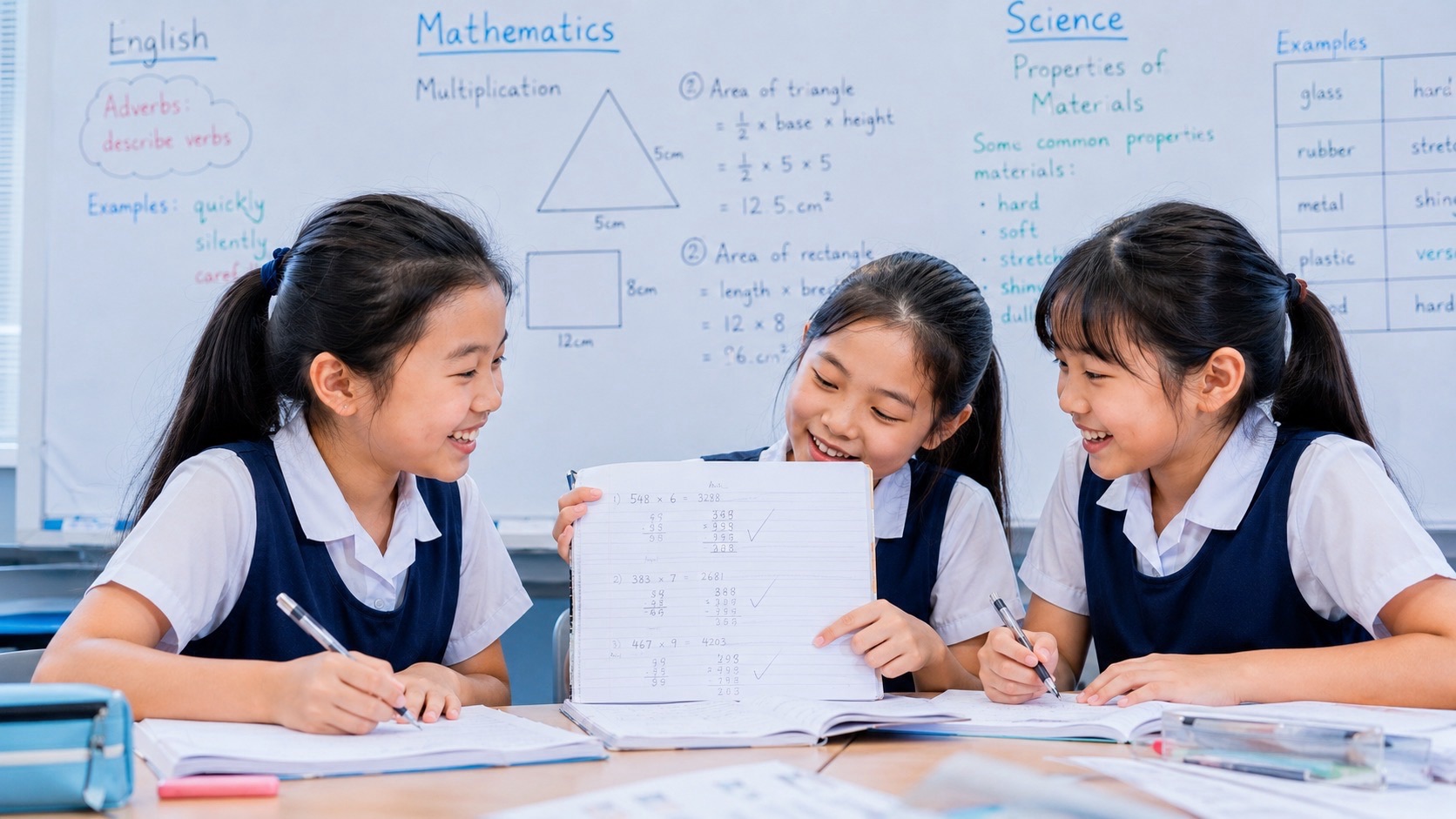
Primary 2 Mathematics is where a child should begin to stop treating every calculation as a brand-new event.
In Primary 1, much of the work is about establishing what numbers and operations mean. By Primary 2, those meanings need to become more flexible. The child should increasingly see that 47 is not merely “four-seven”, but four tens and seven ones; that 38 + 20 can be understood as adding two tens; and that a problem can be represented before a calculation is chosen.
This flexibility is quiet but important. It is what later allows a child to handle larger numbers, regrouping, multiplication, division, fractions and increasingly complex word problems without relying on one memorised procedure for every surface form.
Quick Read for Parents
- Primary 2 should strengthen place value and flexible number relationships.
- Addition and subtraction need to become more fluent without losing meaning.
- Early multiplication and division ideas should be grounded in equal groups and sharing, not just tables.
- Word problems increasingly test whether the child can represent a situation, not merely recognise a keyword.
- A correct answer reached by a brittle method can still signal a future weakness.
- Good tuition should help the child move from concrete and pictorial support toward increasingly efficient mental and symbolic methods.
The One-Sentence Answer
Strong Primary 2 Mathematics tuition should make basic number relationships sufficiently flexible that the child can choose and explain methods instead of rebuilding every answer from counting.
Why Place Value Becomes More Important in Primary 2
Place value is one of those ideas that looks elementary because adults use it automatically. For a young child, it is a major abstraction. The digit 5 does not always mean five objects. In 53, it represents five tens. In 35, it represents five ones.
If that relationship is secure, many calculations become easier to reason about. A child can see 46 + 30 as “four tens and six ones, plus three more tens”. If place value is weak, the child may still obtain correct answers by following a written algorithm, but will struggle to judge whether the answer makes sense or reconstruct the method after forgetting a step.
We therefore teach place value through multiple representations: bundles or base-ten blocks, place-value charts, expanded form, number lines and symbolic notation. The aim is not to keep the child dependent on materials. It is to make the underlying relationship stable enough that the materials can eventually disappear.
Flexible Calculation Is Different From Fast Calculation
Speed becomes useful as basic facts and number relationships become more fluent, but flexibility matters first. Consider 29 + 6. One child may count six steps forward. Another may notice that 29 needs one to become 30, leaving five more, so the answer is 35.
Both can be mathematically legitimate. The second method reveals a stronger relationship with tens. Over time, we want children to collect several sensible strategies and learn when each is efficient.
This fits the MOE Primary Mathematics framework, which places mathematical problem solving at the centre and develops concepts, skills, processes, metacognition and attitudes together. The curriculum is not designed around calculation alone.
Read the current MOE Primary Mathematics Syllabus.
Six Primary 2 Patterns Worth Diagnosing Carefully
1. The child can calculate but cannot estimate
If a child accepts an obviously unreasonable answer without hesitation, the procedure may be disconnected from quantity. Estimation and number sense help the child check whether an answer belongs in the right neighbourhood.
2. Regrouping looks mechanical
A child may learn to “carry” or “borrow” without understanding that ten ones can be regrouped as one ten, or one ten decomposed into ten ones. We prefer to make the place-value exchange visible before compressing it into notation.
3. Word problems trigger random operations
The child may search for a familiar word and choose an operation automatically. This works until the language becomes less predictable. We ask the child to describe the situation first: what is known, what changes, and what must be found?
4. Multiplication is being learned only as chanting
Fluent facts will become useful, but multiplication first needs meaning: equal groups, repeated addition, arrays and the relationship between groups and total. Without that meaning, tables become an isolated memory task.
5. Division is confused with subtraction
Division can represent sharing equally or finding how many equal groups fit into a quantity. Concrete grouping tasks make these meanings visible before symbolic notation is expected to carry them alone.
6. The child freezes when the worksheet layout changes
This can signal overdependence on surface cues. A concept is stronger when the child recognises it across objects, diagrams, number sentences and differently worded situations.
Addition and Subtraction: Build Relationships, Not Rituals
Children benefit from seeing addition and subtraction as related operations. If 8 + 7 = 15, then 15 – 7 = 8 and 15 – 8 = 7. This relationship supports checking and later algebraic thinking.
We also encourage decomposition. A child solving 52 – 9 might subtract 10 and add 1, or split 9 into 2 and 7 to cross a ten. The purpose is not to collect tricks. It is to make number structure available for reasoning.
Multiplication and Division: Build the Idea Before the Table
Multiplication facts become much easier to retain when they sit inside meaningful structures. Arrays show that three groups of four and four groups of three contain the same total. Equal sharing reveals the relationship between multiplication and division.
As understanding stabilises, fluency practice matters. The aim is eventual rapid access to basic facts because effort spent reconstructing every multiplication fact later competes with the reasoning needed in larger problems.
Word Problems: Represent Before You Operate
Primary 2 is a good year to establish a durable problem-solving habit: do not calculate until you know what the quantities are doing.
A quick sketch, part-whole representation, number line or set of objects can turn a sentence into a mathematical structure. Once the structure is visible, the operation is often easier to select and the answer easier to check.
Mathematical Language Matters
Words such as difference, more than, fewer, equal groups, tens and ones are part of Mathematics. A child may understand the quantity relationship but fail to access it because the language is unfamiliar.
We therefore ask students to explain methods aloud. Speaking makes hidden confusion visible and gives mathematical vocabulary a real job.
Why Three Students Is Useful at Primary 2
Young students often arrive at the same answer using different representations. In a three-student class, those differences become teaching material. One child may use a number bond, another a drawing and another mental regrouping.
The tutor can compare methods without turning the lesson into a race. The question becomes, “Which method is clear and efficient here?” rather than “Who finished first?”
What Parents Can Do at Home
- Ask for a second method occasionally. It reveals whether the child sees relationships or only one procedure.
- Estimate before calculating. “Will the answer be more or less than 50?” builds magnitude sense.
- Use money, time and sharing naturally. Everyday quantities provide meaningful practice without another worksheet.
- Let mistakes become checks. Ask what could prove the answer wrong or right.
- Do not remove all visual support too early. A drawing can be evidence of thinking, not immaturity.
Tengah: Keep the Town Story in TengahOS
This tuition page is deliberately narrow. The wider story of Tengah—its planning, districts, transport, green spaces and what the town can teach about Singapore—is better handled by the complementary TengahOS town pillar.
For Primary 2 families, the useful local principle is routine. A developing town can create changing travel and family patterns; the child’s Mathematics benefits from a small number of stable learning habits repeated well.
What Improvement Should Look Like
Good Primary 2 progress looks more flexible than dramatic. The child no longer recounts everything from one. Tens and ones are used to reason. A subtraction answer is checked with addition. Equal groups become visible in multiplication. Word problems are represented before an operation is chosen.
The child also begins to explain why a method works. That is important because explanation is one of the clearest signs that Mathematics is becoming more than a sequence of remembered moves.
Who This Programme Can Help
Primary 2 Mathematics tuition can support children who need stronger place value, more fluent addition and subtraction, clearer multiplication and division foundations, better word-problem representation or more confidence explaining mathematical thinking.
Stronger students can be stretched through multiple methods, pattern finding, explanation and non-routine problems rather than simply accelerating through future content.
Frequently Asked Questions
Should my child memorise multiplication tables in Primary 2?
Fluency with relevant facts becomes useful, but meaning should accompany memory. Equal groups, arrays and repeated addition help the child understand what the facts represent.
Why does my child make regrouping mistakes?
The written procedure may be outrunning place-value understanding, or the child may simply need more fluent execution. Ask the child to explain what is being exchanged between tens and ones; the explanation helps locate the issue.
Should speed drills be used?
Short fluency practice can be useful once concepts are secure. Speed should reflect increasing automaticity, not replace understanding or turn every calculation into a race.
What if my child uses a different method from school?
If the method is mathematically valid and the child can explain it, it can be valuable. The child should also understand the school’s taught methods so classroom work remains accessible.
The Quiet Achievement of Primary 2 Mathematics
Primary 2 is successful when numbers begin to feel less like isolated objects and more like a connected system.
The child sees tens inside larger numbers, inverse relationships between operations, groups inside multiplication and structure inside word problems. Calculation becomes increasingly fluent because understanding has given it somewhere to stand.
That flexibility will matter far beyond this year.