Legacy/support locality route. This is an alternate Primary 2 Mathematics Jurong West article retained for its existing material and search history. The canonical location × level owner is Primary 2 Mathematics Tuition Jurong West. New links, updates and locality ownership should resolve to the unsuffixed canonical owner rather than creating another duplicate.
Primary 2 Mathematics is where early number sense begins to carry a larger load.
Numbers become larger. Addition and subtraction require more deliberate place-value thinking. Multiplication and division begin emerging as relationships rather than isolated facts. Word problems ask children to decide what the situation means before calculating.
The important work is flexibility. A child should gradually have more than one way to see a number and more than one sensible route into a problem.
Quick Read for Parents
- Primary 2 extends number sense into larger quantities and more complex operations.
- Place value remains central to written and mental calculation.
- Multiplication should begin as equal groups and repeated relationships, not only tables.
- Division should connect sharing and grouping.
- Word problems need representation before operation selection.
- Fluency should grow without replacing understanding.
The One-Sentence Answer
Strong Primary 2 Mathematics tuition should turn early number relationships into flexible strategies that a child can explain, represent and use independently.
Place Value Still Does More Work Than It Appears To
When children add or subtract larger numbers, place value determines why digits align and why regrouping works. We therefore teach the meaning underneath the written algorithm rather than presenting carrying or borrowing as mysterious movement.
Six Primary 2 Mathematics Patterns Worth Diagnosing
1. Written algorithms work but mental number sense is weak
The child may need decomposition: seeing 38 as 30 and 8, or 49 as one less than 50. Flexible decomposition later supports estimation and algebraic thinking.
2. Regrouping is performed without understanding
We reconnect the notation to tens and ones so the child can explain what was regrouped and why the quantity did not change.
3. Multiplication facts are learned before equal groups make sense
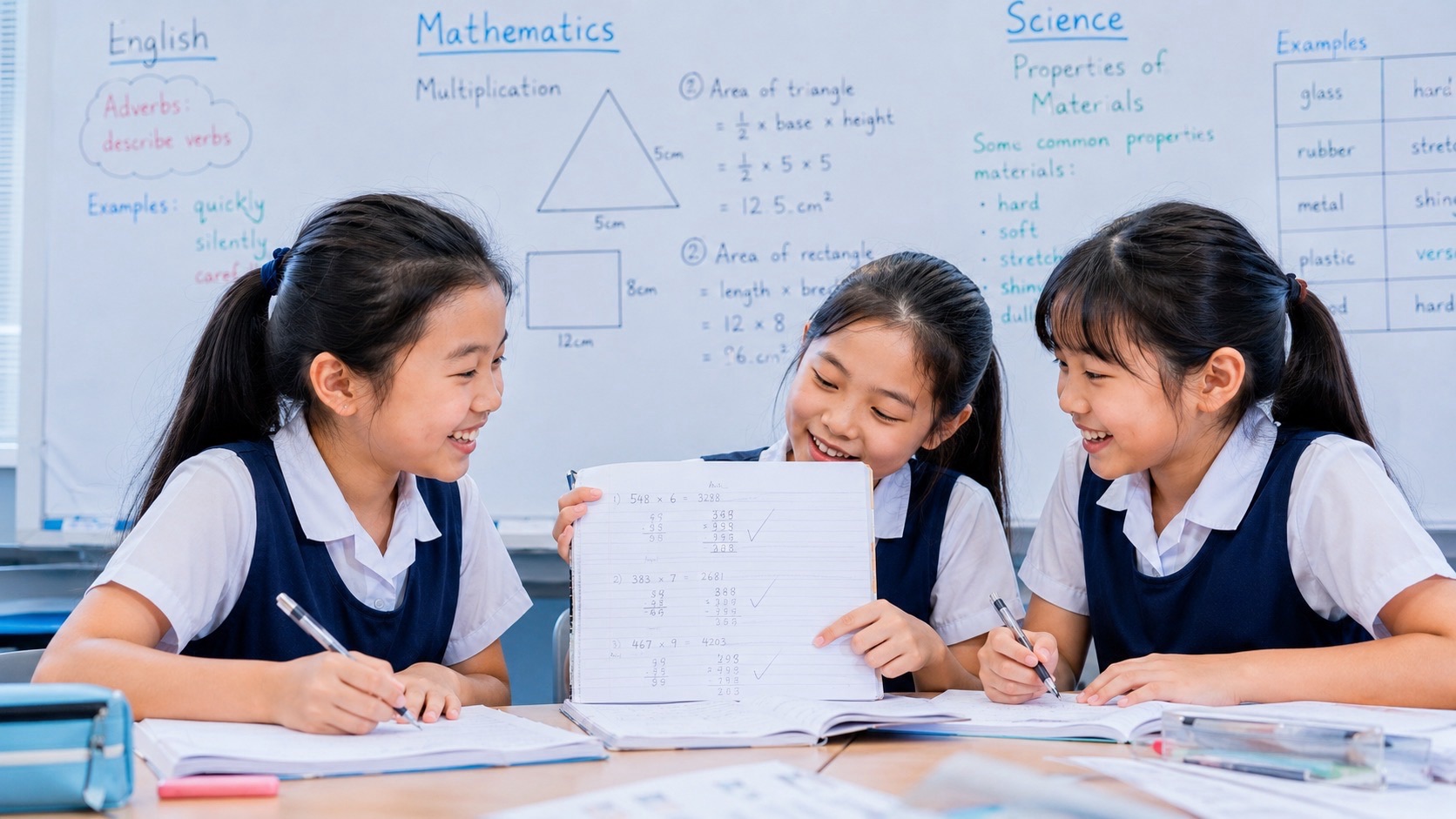
Arrays, groups and repeated addition help the child see what multiplication describes before fluency is accelerated.
4. Division feels unrelated to multiplication
We connect division to multiplication and to two useful meanings: sharing a quantity equally and finding how many groups fit.
5. Word problems trigger keyword hunting
Words can be clues, but relationships decide the Mathematics. We ask what quantities are known, what changed and what is unknown.
6. Answers are rarely checked
Estimation, inverse relationships and simple reasonableness checks can already become routine in Primary 2.
Multiplication: See Equal Groups Before Memorising Tables
Multiplication tables matter because fluency releases attention for harder work. But memory becomes more robust when it rests on structure.
Three groups of four, four groups of three and a rectangular array all provide ways to see relationships rather than hear facts as an unrelated chant.
Division: Sharing and Grouping
Twelve objects shared among three children asks how many each receives. Twelve objects arranged in groups of three asks how many groups there are. The arithmetic is related, but the situations are not identical.
Word Problems: Represent Before Calculating
A quick sketch, part-whole diagram or organised list can reduce language load and make the mathematical relationship visible. Representation is not decoration; it is a thinking tool.
Why Three Students Works Well in Primary 2 Mathematics
Three students can solve the same problem differently and explain their routes. The group remains small enough for the tutor to inspect whether each method is understood, efficient and transferable.
What Parents Can Do at Home
- Ask for another way.
- Use arrays and groups.
- Estimate first.
- Ask what the problem is asking.
- Practise useful facts briefly and regularly.
- Notice self-correction.
Jurong WestOS Carries Place; This Page Carries Primary 2 Mathematics
The broader town story belongs in Jurong WestOS. This page stays focused on the mathematical transition itself.
What Improvement Should Look Like
Improvement should look like greater flexibility: less counting from one, clearer regrouping, stronger multiplication and division relationships, better diagrams and more frequent reasonableness checks.
Primary 2 Mathematics Is Where Relationships Become Strategies
A child who sees number relationships does not need a separate trick for every question. The same structures can be reused, adapted and checked. That is the beginning of mathematical independence.
Continue through the tuition network: Tuition Programmes Directory · Programmes & Locations · West Singapore Tuition Directory · eduKateSingapore Hub.