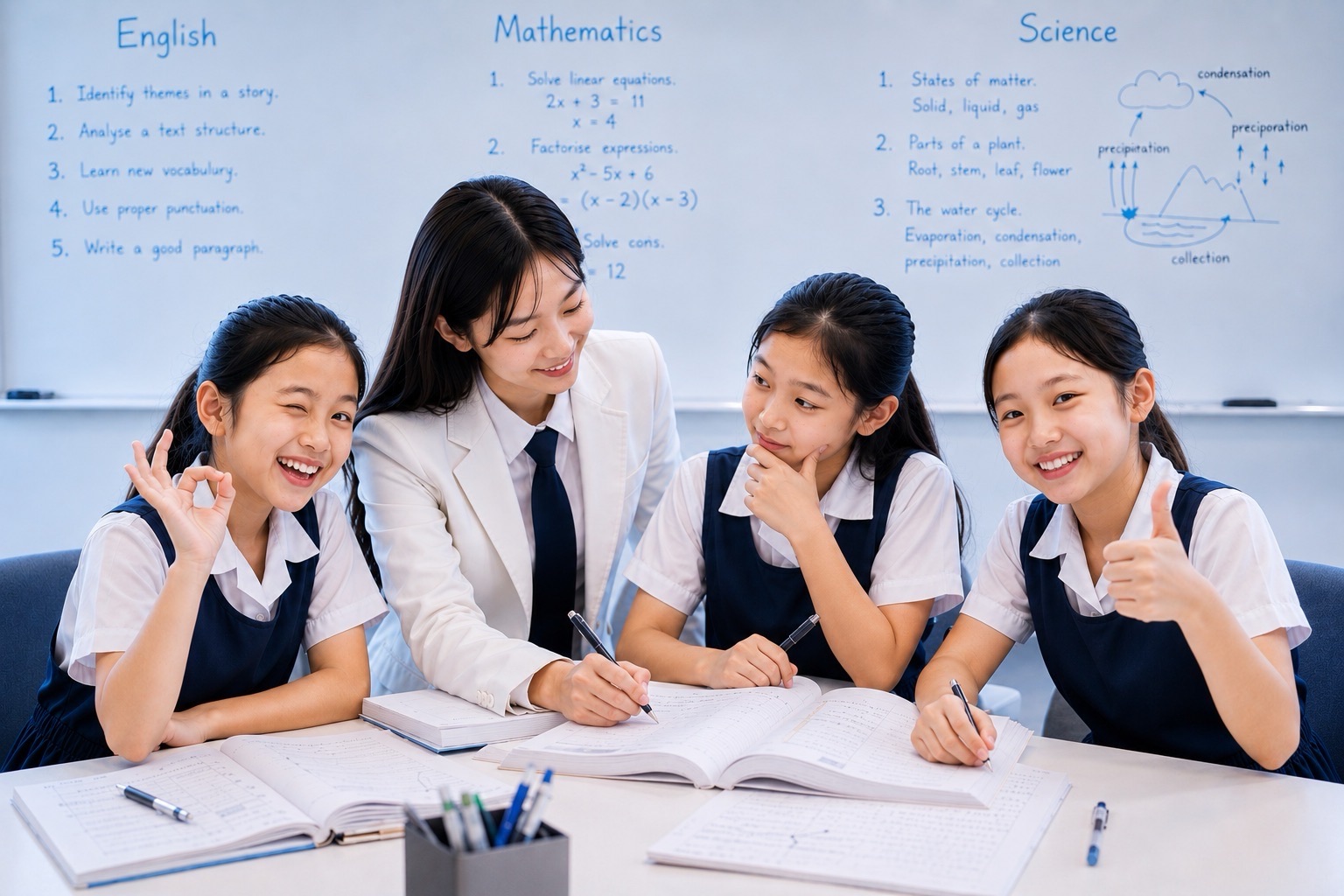
Primary 2 English Tuition in Small Groups at Punggol
Summary
Primary 2 English is the year where the child’s early English foundation must become steadier, clearer and more independent.
Primary 1 introduces the child to formal school English.
Primary 2 strengthens that engine.
At Primary 2, children are no longer completely new to primary school. They understand classroom routines better. They can follow more instructions. They can read more words. They can write longer sentences. They can answer more questions.
But this is also the year where hidden gaps begin to show.
Some children can read aloud but do not fully understand the passage.
Some can spell weekly words but cannot use them in sentences.
Some can speak naturally but write very little.
Some can answer simple questions but become confused when questions require thinking.
Some children appear to be coping, but their English system is not yet strong enough for the Primary 3 jump.
At eduKate Punggol, Primary 2 English Tuition in small groups helps children stabilise their reading, vocabulary, grammar, comprehension, oral expression and early writing skills before the curriculum becomes heavier.
The aim is simple.
We help the child become clearer, calmer and more confident with English.
Primary 2 Is the Stabilising Year
Primary 2 is not Primary 1 repeated.
It is the year of stabilisation.
In Primary 1, the child learns how school English works.
In Primary 2, the child must start using English with more control.
The sentences become longer.
The reading passages become denser.
The vocabulary becomes wider.
The grammar rules become more visible.
The writing expectations become more structured.
The child is expected to listen better, answer more clearly, read with better understanding and write with better accuracy.
This is why Primary 2 matters.
It sits between two important stages.
Behind the child is Primary 1, where school learning began.
Ahead of the child is Primary 3, where the academic load becomes heavier and Science enters the school timetable.
So Primary 2 is the bridge year.
It is the year to check whether the child’s English engine is really working.
Not just moving.
Working.
Why Primary 2 English Gaps Can Be Dangerous
Primary 2 English gaps are often quiet.
They do not always look serious at first.
A child may still pass spelling.
A child may still complete homework.
A child may still read simple books.
A child may still say, “I know.”
But when we look closely, the gaps may already be forming.
The child may not know how to answer in full sentences.
The child may not know why a sentence sounds wrong.
The child may guess comprehension answers.
The child may use the same simple words again and again.
The child may avoid writing because writing feels tiring.
The child may read every word but miss the meaning.
The child may confuse tenses, plurals, pronouns and punctuation.
The child may copy well but cannot create.
These are small cracks.
But if they are left alone, they can widen in Primary 3 and Primary 4.
This is why Primary 2 English tuition should not wait until the child is badly struggling.
A good Primary 2 small-group class catches the gaps early, names them clearly and fixes them patiently.
The Purpose of Primary 2 English Tuition
Primary 2 English tuition should not simply give more worksheets.
More work is not always better.
Better teaching is better.
The purpose of Primary 2 English tuition is to help the child build control.
Control over reading.
Control over sentences.
Control over grammar.
Control over vocabulary.
Control over comprehension.
Control over early writing.
Control over oral expression.
A Primary 2 child does not need to be frightened into learning.
The child needs to be taught how English works.
When the child understands how words join into sentences, how sentences carry meaning, how questions ask for answers, and how stories move from beginning to middle to end, English becomes less random.
That is when confidence grows.
The Primary 2 English Engine
At eduKate Punggol, we see Primary 2 English as an engine with several connected parts.
| English Area | What Primary 2 Children Need to Build | Why It Matters |
|---|---|---|
| Reading Fluency | Read with smoother pace, accuracy and expression | Helps the child understand passages better |
| Vocabulary | Learn more words and use them correctly | Improves speaking, writing and comprehension |
| Grammar | Understand sentence patterns, tenses, plurals, pronouns and connectors | Reduces careless language errors |
| Sentence Writing | Write complete, meaningful and accurate sentences | Prepares the child for paragraph writing |
| Comprehension | Understand questions, locate clues and infer simple meaning | Builds exam and school readiness |
| Oral Expression | Speak in complete answers and explain ideas clearly | Improves confidence and communication |
| Listening | Follow longer instructions and understand spoken information | Supports classroom learning |
| Early Composition | Sequence ideas and describe people, places, actions and feelings | Prepares for upper-primary writing |
These parts are connected.
A child who reads more learns more words.
A child with more words writes better sentences.
A child who writes better sentences answers comprehension more clearly.
A child who speaks clearly becomes more willing to explain ideas.
A child who understands grammar makes fewer repeated mistakes.
That is how English improves.
Not as isolated worksheets.
As a connected system.
Small Groups Help Primary 2 Children Learn Better
Primary 2 children still need closeness.
They are young.
They need guidance, encouragement and correction.
But they also need interaction.
This is why small-group tuition works well.
In a small group, the child can listen to others, answer questions, read aloud, compare ideas and learn from shared mistakes.
A small group gives the child a real learning table.
Not a large classroom where the child disappears.
Not a silent worksheet corner where the child works alone.
The tutor can still see the child’s work closely.
The tutor can hear how the child reads.
The tutor can notice hesitation.
The tutor can correct the sentence immediately.
The tutor can ask the child to explain.
The tutor can encourage the quieter child to speak.
The tutor can stretch the stronger child without neglecting the weaker one.
Small-group English tuition gives Primary 2 children two important things at the same time:
Attention and interaction.
Both are necessary.
What Happens in a Primary 2 English Small-Group Lesson
A strong Primary 2 English lesson should be structured, warm and purposeful.
The child should feel safe, but the lesson should not be loose.
Every part of the lesson should build the English engine.
1. Speaking Warm-Up
The tutor may begin with simple oral questions.
What happened in school today?
What do you see in this picture?
Can you describe this character?
Why do you think she is happy?
Can you answer in a full sentence?
This trains the child to speak clearly and think before answering.
Primary 2 oral confidence is important because many children can speak casually but struggle to answer in proper school English.
The tutor helps the child move from fragments into complete responses.
Instead of:
“Because he sad.”
The child learns:
“He is sad because he lost his favourite toy.”
That is a real improvement.
2. Reading Practice
The child reads short passages, stories, sentences or vocabulary groups.
The tutor listens carefully.
Is the child guessing?
Is the child skipping words?
Is the child reading too quickly?
Is the child reading word by word without understanding?
Is the child using expression?
Reading aloud reveals many things.
A child’s voice shows whether the child understands the sentence.
When reading becomes smoother, comprehension usually improves too.
3. Vocabulary Building
Primary 2 vocabulary should grow beyond basic words.
Children should begin to learn more precise words.
Instead of always using “nice”, they can learn “kind”, “helpful”, “cheerful”, “friendly” or “pleasant”.
Instead of always using “said”, they can learn “asked”, “replied”, “shouted”, “whispered” or “explained”.
Instead of always using “walked”, they can learn “strolled”, “rushed”, “marched” or “crept”.
Vocabulary gives the child better thinking tools.
A child with more words can describe the world more clearly.
4. Grammar and Sentence Control
Primary 2 grammar is not just about rules.
It is about control.
The child must begin to notice how sentences are built.
For example:
I go to school.
I went to school.
She likes apples.
They like apples.
This is my bag.
These are my books.
The tutor helps the child hear, see and use correct grammar repeatedly.
Young children often need many examples before grammar becomes natural.
A good tutor does not only mark the error.
A good tutor explains the pattern.
5. Comprehension Skills
Primary 2 comprehension is where many hidden gaps appear.
Some children can read the passage but cannot answer the question properly.
They may copy too much.
They may answer too little.
They may miss the clue.
They may not understand question words such as who, what, where, when, why and how.
They may not know how to infer simple meaning.
So the tutor teaches the child how to slow down.
Read the question.
Understand what it asks.
Look for the clue.
Answer in a proper sentence.
Check if the answer makes sense.
This is the beginning of examination thinking.
Not pressure.
Training.
6. Sentence and Paragraph Writing
Primary 2 writing should move beyond one-word or very short answers.
Children should learn to write complete sentences with clearer meaning.
Then they can begin to combine sentences into short paragraphs.
For example:
The boy was walking home.
He saw a small kitten under a tree.
The kitten looked hungry and afraid.
The boy carried it gently.
He brought it home and gave it some milk.
This is not yet advanced composition.
But it is the beginning of composition thinking.
The child learns sequence, action, description and feeling.
That is important.
The Primary 2 Learning Loop
At eduKate Punggol, Primary 2 English should follow a steady learning loop:
Read.
Understand.
Speak.
Write.
Check.
Correct.
Use again.
This loop matters because English is not mastered by doing something once.
A word learnt in vocabulary must return in writing.
A grammar point corrected in one sentence must return in the next worksheet.
A comprehension mistake must be named and corrected.
A speaking answer must become a writing sentence.
A reading passage must become a thinking exercise.
The child must not only complete work.
The child must learn from the work.
That is the difference between tuition that fills time and tuition that builds ability.
The Three Types of Primary 2 English Students
Most Primary 2 children come to tuition for one of three reasons.
1. The Child Who Needs to Catch Up
This child may still have weak phonics, weak spelling, slow reading or poor sentence control.
The child may not like English because English feels confusing.
For this child, the tutor must rebuild patiently.
The child needs short, clear steps.
Sound to word.
Word to sentence.
Sentence to meaning.
Meaning to answer.
Answer to correction.
The goal is to reduce fear and create small wins.
A child who catches up in Primary 2 has a much better chance of entering Primary 3 with confidence.
2. The Child Who Needs to Keep Up
This child is not failing.
But the child is not secure.
Homework may be completed, but there are repeated mistakes.
The child may understand lessons in school but forget quickly.
The child may do well sometimes and poorly at other times.
For this child, tuition provides rhythm.
Regular reading.
Regular writing.
Regular correction.
Regular vocabulary.
Regular grammar practice.
This keeps the child stable.
Stability is important because Primary 2 is the last year before the Primary 3 load increases.
3. The Child Who Is Ready to Move Ahead
This child may read well, speak well or enjoy stories.
But a strong Primary 2 child still needs careful development.
Moving ahead does not mean rushing into upper-primary pressure.
It means building richer language.
Better sentence variety.
More expressive vocabulary.
Clearer story sequencing.
More thoughtful comprehension answers.
Stronger oral responses.
This child should be stretched intelligently.
A strong learner should not merely be given harder worksheets.
The child should be taught to think, express and write with more maturity.
Why Primary 2 Comes Before the Primary 3 Jump
Primary 3 is a major shift.
The child becomes older, but the school load also becomes heavier.
There are more subjects, more expectations, more reading, more homework and more independent learning.
English becomes even more important because it supports learning across the curriculum.
A child who enters Primary 3 with weak English foundations may struggle not only in English, but also in understanding instructions, explaining answers and processing information.
That is why Primary 2 is a strategic year.
It is the time to ask:
Can my child read independently?
Can my child understand questions?
Can my child write complete sentences?
Can my child use grammar accurately?
Can my child explain ideas aloud?
Can my child correct mistakes calmly?
Can my child handle longer passages?
Can my child sequence events?
If the answer is not yet, Primary 2 is the right time to strengthen the base.
Common Primary 2 English Problems
Here are common issues that parents may notice.
| What Parents See | What May Be Happening |
|---|---|
| Child reads but cannot explain the story | Reading comprehension is weak |
| Child knows spelling but cannot use the word | Vocabulary is memorised, not understood |
| Child writes very short sentences | Sentence construction needs support |
| Child uses wrong tenses | Grammar control is not stable |
| Child avoids writing | Writing confidence may be low |
| Child answers comprehension wrongly despite reading the passage | Question analysis is weak |
| Child uses repeated simple words | Vocabulary range is limited |
| Child speaks well but writes poorly | Spoken language is not transferring into written English |
| Child forgets punctuation | Writing habits need correction |
| Child rushes through work | Checking habits are not formed |
These are not character problems.
They are learning signals.
A good tutor reads these signals and teaches from there.
What Parents Can Do at Home
Parents can help Primary 2 English without turning the home into a classroom.
The best support is simple and consistent.
Read with the child for a short time each day.
Ask the child to retell the story.
Ask one “why” question.
Ask the child to describe a picture.
Encourage full-sentence answers.
Let the child keep a small word bank.
Ask the child to write one or two sentences about the day.
Praise correction, not only perfection.
This last point is important.
A child who is praised only for being correct may fear mistakes.
A child who is praised for correcting mistakes learns resilience.
That is a better learner.
What Primary 2 Tuition Should Not Do
Primary 2 English tuition should not overload children.
It should not make English feel like punishment.
It should not rely only on memorisation.
It should not shame mistakes.
It should not rush children into advanced work before the sentence foundation is ready.
It should not ignore oral confidence.
It should not treat every child as if they have the same problem.
At Primary 2, children are still young.
They need a tutor who can teach clearly, correct patiently and encourage honestly.
The goal is not to frighten the child into performance.
The goal is to build the child into a better learner.
The eduKate Punggol Small-Group Method
At eduKate Punggol, small-group Primary 2 English tuition is designed to help children catch up, keep up and move ahead.
The tutor works close enough to see the child’s mistakes.
The group is small enough for each child to speak, read and write.
The lesson is structured enough to build real progress.
The environment is calm enough for children to try.
We focus on the whole English system.
Reading.
Vocabulary.
Grammar.
Comprehension.
Writing.
Speaking.
Listening.
Correction.
Confidence.
Each part supports the others.
When the system improves, the child becomes more independent.
That is the real aim.
The Parent, Tutor and Child Working Together
A Primary 2 child improves best when the adults around the child work together.
School provides the main curriculum.
Parents provide daily support, encouragement and routine.
Tuition provides close guidance, targeted correction and structured practice.
When these three parts work together, the child does not feel lost.
The child knows there is help.
The child knows mistakes can be fixed.
The child knows improvement is possible.
This is important because young learners need emotional safety.
They need to believe they can learn.
Once that belief is in place, English becomes less frightening.
What Progress Looks Like in Primary 2
Progress in Primary 2 English may look like small changes at first.
The child reads more smoothly.
The child writes longer sentences.
The child uses a new word correctly.
The child remembers full stops.
The child answers in a full sentence.
The child explains why a character feels sad.
The child corrects a tense mistake.
The child checks work before submitting.
The child says, “I can do this.”
These are not small achievements.
They are signs that the English engine is becoming stronger.
A child who can write a good sentence today can write a good paragraph later.
A child who can understand a short passage today can handle longer comprehension later.
A child who can speak clearly today can present ideas better later.
This is how foundations become future strength.
Why Punggol Parents Start in Primary 2
Many Punggol parents do not want to wait until the child is overwhelmed.
They know that Primary 2 is still early enough to fix weak habits.
It is also early enough to stretch a strong child properly.
Small-group tuition gives parents a practical middle path.
Not panic.
Not neglect.
Just steady, intelligent support.
The child receives guided practice.
The tutor catches errors early.
Parents understand what needs attention.
The child grows more confident before Primary 3.
That is the value of starting at Primary 2.
The Bigger Purpose of Primary 2 English
English is more than marks.
It is how a child understands instructions, stories, people, ideas and the world.
A child with stronger English can ask better questions.
A child with stronger English can explain feelings better.
A child with stronger English can read more widely.
A child with stronger English can write more clearly.
A child with stronger English can think with better structure.
That is why Primary 2 English matters.
It is not only preparation for the next test.
It is preparation for the next stage of learning.
Conclusion: Strengthen Before the Jump
Primary 2 English Tuition in Small Groups at Punggol helps children stabilise their English foundation before the academic climb becomes steeper.
It helps the child who is falling behind.
It supports the child who is trying to keep up.
It stretches the child who is ready to move ahead.
At eduKate Punggol, we teach Primary 2 English with patience, structure and care.
We help children read better, speak better, write better, understand better and correct mistakes with more confidence.
Primary 2 is the right year to strengthen the engine.
Because when the English foundation is steady, Primary 3 becomes less frightening.
School becomes clearer.
Learning becomes calmer.
And the child becomes more ready for the future.
For Primary 2 English Tuition in Small Groups at Punggol, parents may contact eduKate Punggol to find out how our small-group tutorials can help their child build stronger English foundations before the Primary 3 jump.
Contact Us Today
Ready to embark on this exciting learning journey with us? Reach out for more information or to schedule a consultation:
- Phone: +65 88231234
- Email: admin@edukatesingapore.com
Build a strong foundation!
Visit our website at edukatesingapore.com to learn more about our programs and how we can support your child’s educational journey.
At eduKate Singapore, we are committed to nurturing young minds and fostering a love for learning. Join us and let us help your child build a strong foundation for a bright future.
