Canonical local owner: start with Primary 2 English Tuition Choa Chu Kang for the current location × year × subject route. This page is retained as supporting material with its original explanatory angle.
Primary 2 English is where early literacy begins to reveal whether it has become a system or is still a collection of supported tasks.
A child may read familiar books smoothly but slow down sharply when vocabulary changes. Another may write correct short sentences but struggle to connect them. Another may understand a story yet answer comprehension questions with one vague phrase.
These are useful signals. Primary 2 is an excellent year to strengthen the foundations before middle-primary texts, writing and Science place heavier demands on language.
Quick Read for Parents
- Primary 2 should turn early reading into increasingly fluent reading with understanding.
- Writing moves from isolated sentences toward connected ideas and simple sequencing.
- Grammar becomes useful when children can apply it while writing, not only recognise it in exercises.
- Vocabulary needs depth: meaning, use, word relationships and context.
- Comprehension should train evidence habits before upper-primary answering demands arrive.
- Good tuition identifies which literacy process remains dependent on prompting.
The One-Sentence Answer
Strong Primary 2 English tuition should make reading, vocabulary, grammar, speaking and writing sufficiently connected that the child can understand and express increasingly complex ideas with less adult support.
Primary 2 Is a Consolidation Year—but Consolidation Is Active
Consolidation means making early skills more automatic while extending them. Reading becomes smoother so attention can move toward meaning. Sentences become more varied so writing can carry relationships. Vocabulary becomes retrievable enough to support comprehension and expression.
Seven Primary 2 English Patterns Worth Diagnosing
- Reading is accurate but painfully slow.
- Reading is fast but meaning is shallow.
- Written sentences all have the same shape.
- Grammar is correct in exercises but disappears in composition.
- Vocabulary is recognised but not used.
- Comprehension answers are too short to show understanding.
- The child depends on adult confirmation after every line.
Reading Fluency Should Release Attention for Meaning
Fluent reading is valuable because the mechanics become less expensive. When common words and patterns are recognised efficiently, the child can think about character, sequence, cause, motive and implication.
Comprehension: Begin the Evidence Habit Early
Primary 2 is a good age to teach a simple discipline: point to the part of the text that helped you answer. The child does not need upper-secondary terminology. The habit itself is enough.
Writing: Connect Sentences Into Thought
At this stage, writing begins to move beyond a row of independent sentences. The child learns that ideas can be ordered, expanded and connected.
Grammar: A Tool for Meaning
Tense tells the reader about time. Pronouns maintain reference. Conjunctions connect ideas. Punctuation helps the reader see boundaries and emphasis.
Vocabulary: Depth Before Display
A useful word is one the child understands well enough to recognise in a new sentence and eventually use appropriately. We explore examples, opposites, related words and contexts rather than rewarding unusual vocabulary simply because it sounds impressive.
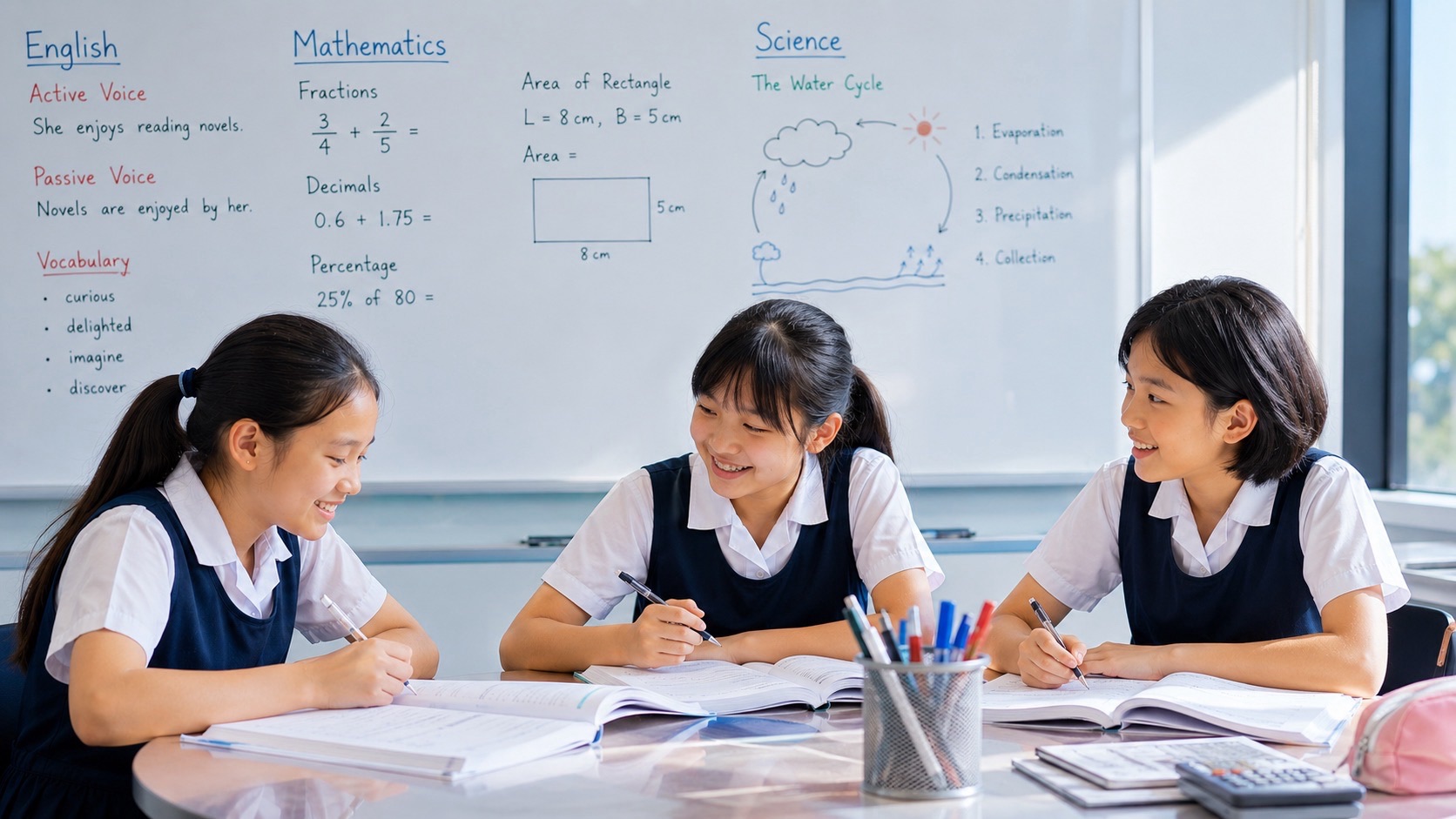
Why Three Students Works Well in Primary 2 English
Primary 2 learners still need frequent turns, but they also begin benefiting from hearing how another child understood the same story or expressed the same idea. Three students provides comparison without letting anyone disappear into the group.
What Parents Can Do at Home
- Keep reading aloud and independently.
- Ask for retelling.
- Ask “Which words told you that?”
- Use new words in ordinary conversation.
- Let the child revise one or two sentences.
- Delay confirmation briefly so self-checking can begin.
Choa Chu KangOS Carries Place; This Page Carries Primary 2 English
The larger local story belongs in Choa Chu KangOS. This page remains deliberately focused on the Primary 2 language system.
What Improvement Should Look Like
Primary 2 improvement should look like less friction. Reading becomes smoother without losing meaning. Answers become more complete. Sentences begin to connect. Grammar survives outside worksheets. Vocabulary becomes available in conversation and writing.
Continue through the tuition network: Tuition Programmes Directory · Programmes & Locations · West Singapore Tuition Directory · eduKateSingapore Hub.