PRIMARY 1 · SCIENCE FOUNDATIONS · CHOA CHU KANG · SMALL-GROUP LEARNING
Primary 1 Science Foundations Choa Chu Kang
A mature town changes slowly enough for a child to notice what stays the same—and quickly enough for the child to notice what does not.
Primary 1 is not formally a Science syllabus year in Singapore. MOE’s formal Primary Science syllabus begins in Primary 3. That means a strong P1 Science Foundations programme should not pretend the child needs an accelerated P3 course.
The better preparation is quieter: learn to observe carefully, compare the same property, classify using a clear rule, describe change, ask answerable questions and separate what was seen from what was guessed.
Choa Chu Kang is useful because it is a living heartland. Parks, paths, transport, shops, homes and neighbourhood spaces create repeated opportunities to notice continuity and change without turning the town itself into the curriculum.
Quick Read for Parents
- Formal Primary Science begins in P3. P1 Science Foundations should build readiness rather than race ahead.
- The first scientific habit is observation. Children learn to describe before they explain.
- Change is a powerful P1 idea. Wet to dry, light to shade, young leaf to older leaf, moving to still—children can observe processes without needing advanced theory.
- Classification needs a rule. Grouping by colour is different from grouping by material or shape.
- Curiosity should become more disciplined, not less joyful. The child learns that a question can be investigated rather than merely answered by an adult.
The one-sentence answer
Primary 1 Science Foundations should help a child become a more careful observer of change so that later formal Science begins with strong habits of comparison, classification, language and evidence.
Why change is such a useful early Science idea
Children notice change naturally. Ice melts. Clothes dry. Leaves fall. Shadows move. Puddles disappear. Food changes during cooking.
The scientific habit is not simply noticing that something changed. It is becoming more precise:
- What was it like before?
- What is it like now?
- What exactly changed?
- What stayed the same?
- How long did the change take?
- What do we think caused it?
- Which parts are observations and which are explanations?
Those questions create a bridge from childhood curiosity to later scientific inquiry.
Observation first, explanation second
Suppose a child sees a patch of wet ground beneath a sheltered area.
“The ground is wet” is an observation. “Someone washed it” is an explanation. The explanation may be correct, but it is not the same type of statement.
Teaching children this distinction early gives them one of the most useful habits in Science: do not claim more than the evidence currently supports.
Comparison: same property, two examples
Comparison becomes meaningful only when the child compares the same property.
Two leaves can be compared by size, colour, texture or shape. Two surfaces can be compared by roughness, temperature or how quickly water disappears from them. The question determines which property matters.
This habit also supports Mathematics and English because the learner must identify the relationship precisely rather than say simply, “This one is different.”
Classification: the rule controls the groups
Young learners often enjoy sorting. The deeper Science idea is that a classification depends on a criterion.
Objects grouped by material will produce different groups from the same objects grouped by colour. Leaves grouped by shape will produce different groups from leaves grouped by size.
The child begins learning that a useful classification is not merely “things that look similar to me”. It uses a rule that another person can understand and repeat.
Vocabulary: words sharpen attention
Words such as rough, smooth, flexible, transparent, living, non-living, observe, compare and change are useful because they help a child notice distinctions.
We do not teach the words only as definitions. We ask the child to use them against real objects and new examples. A word becomes scientifically useful when it changes what the learner can see and describe.
How Choa Chu KangOS helps
Choa Chu KangOS keeps one familiar heartland available as a recurring learning world.
A P1 learner does not need to study town planning. The child can notice a shaded path and a sunny path, compare two playground surfaces, observe leaves after rain, look at different building materials, listen to changes in sound near a road or notice how a familiar space changes during renewal.
The town gives Science somewhere real to land. The teaching remains age-appropriate.
A simple investigation: what dries first?
After rain, find two small wet areas that are safe to observe. One may be more shaded than the other.
Ask the child:
- Which one looks wetter now?
- What should we check later?
- What do you predict?
- What did we actually observe?
- Did the result match the prediction?
At P1, we do not need a perfect controlled experiment. The important habit is returning to the world to see what happened rather than treating the first guess as the answer.
A wrong prediction is not a failed lesson
Children sometimes think Science is another school activity where the aim is to guess correctly.
We teach the opposite. A prediction is an idea about what may happen. The evidence tells us what actually happened. If the prediction is wrong, the next question becomes interesting: what did we overlook?
This protects curiosity from becoming performance anxiety.
What weak Science readiness can look like
- the child rushes to an explanation without describing the observation;
- vague words such as “thing”, “nice” or “weird” replace properties;
- the grouping rule changes halfway through a classification;
- a single example is treated as proof of an “always” statement;
- the child believes a wrong prediction means they are bad at Science;
- answers are copied from adults but cannot be applied to a new object.
These are teachable habits, not labels for the child.
Why three students matters
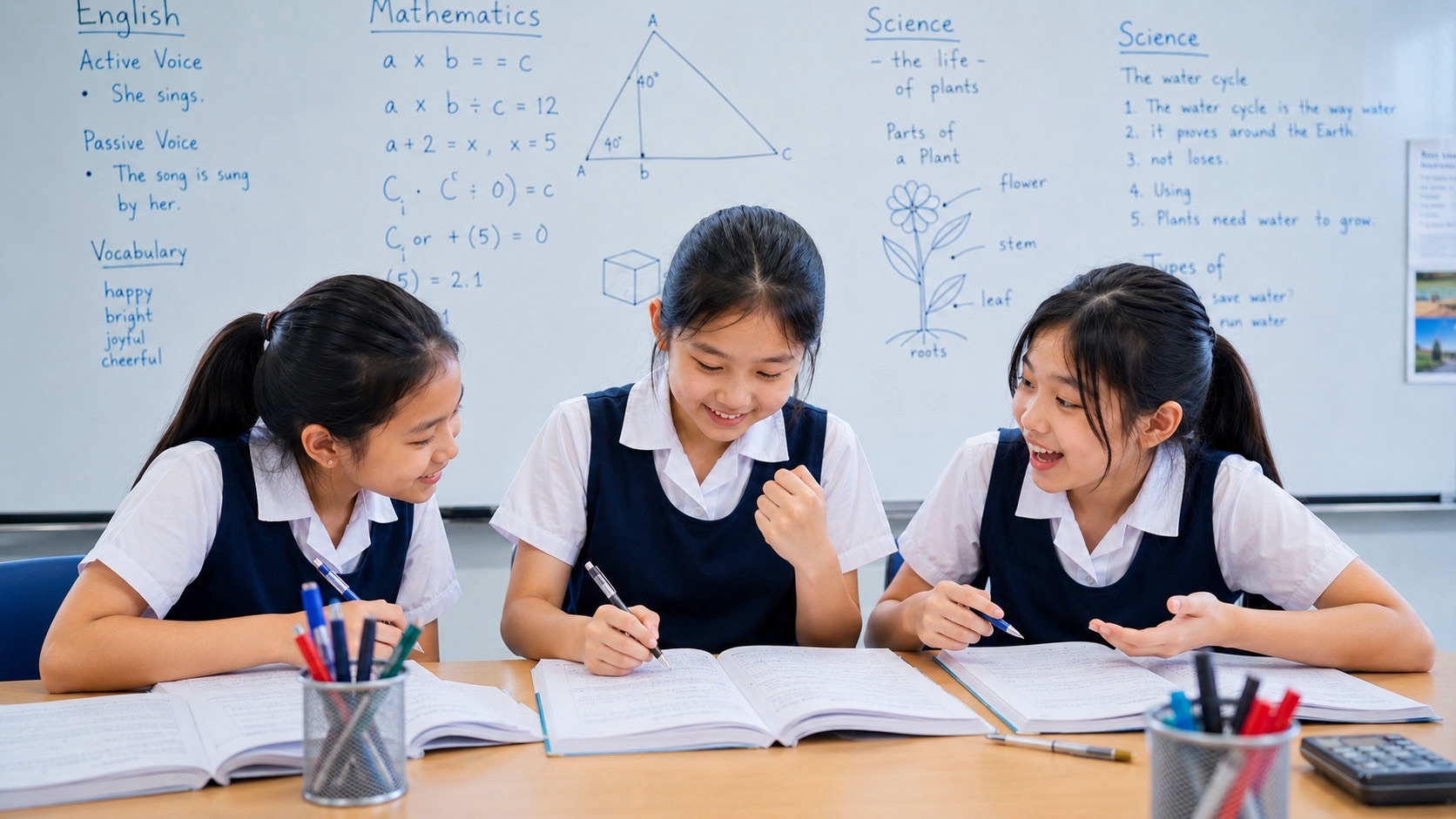
Three learners can look at the same object and notice different features.
That gives the tutor useful material. Why did one child notice colour while another noticed texture? Which observations are factual? Which statements are interpretations?
The group remains small enough that each child still has to explain their own thinking rather than hide inside a chorus of answers.
What progress should look like
- observations become more specific;
- comparison uses the same property on both sides;
- classification rules are stated more clearly;
- vocabulary becomes more precise;
- the child is comfortable saying “I am not sure yet”;
- predictions are checked against later observations;
- the learner can explain what changed and what stayed the same.
What parents can do at home
- Ask “What did you notice?” before “Why did that happen?”
- Compare two ordinary objects using one property at a time.
- Ask the child to create a sorting rule, then test whether every object fits.
- Observe one small change over time—melting, drying, growing, cooling.
- When your child predicts incorrectly, respond with “What did the evidence show?”
- Model uncertainty openly: “I’m not sure. Let’s check.”
Formal Science begins later
MOE’s formal Primary Science syllabus begins in Primary 3. That is why this page uses the term Science Foundations deliberately.
When formal Science begins, eduKateSingapore’s Science Learning Library becomes the curriculum-facing route. The deeper habits developed here—observation, comparison, classification and careful explanation—are the preparation underneath it.
Frequently Asked Questions
Does Primary 1 have formal Science in Singapore?
No. Formal Primary Science begins in P3, so P1 work should focus on foundations rather than pretending to be the P3 syllabus early.
Should my child memorise Science facts now?
Some facts will naturally be learned, but the stronger goal is to build observation, vocabulary, comparison and evidence habits that make later facts easier to organise.
Why use Choa Chu Kang examples?
A familiar environment reduces unnecessary novelty. The child can focus on the scientific relationship and then transfer the same habit to unfamiliar contexts.
The deeper idea
A mature heartland teaches a young child something Science will keep teaching for years: the world is not frozen.
Things grow, dry, move, weather, age and renew. The scientific habit is to notice those changes carefully enough that our explanations remain answerable to what actually happened.
At Primary 1, Science begins not with knowing more answers, but with becoming more careful about what changed.