PRIMARY 1 · SCIENCE FOUNDATIONS · BUKIT PANJANG · SMALL-GROUP LEARNING
Primary 1 Science Foundations Bukit Panjang
Bukit Panjang gives a young child something unusually useful to notice: the boundary between a built town and a living natural world is not a single line.
A path can run beside vegetation. A drain can carry rainwater through an estate. Birds can use trees near buildings. Shade from plants and shade from structures can feel similar while coming from different sources. Roads connect people while also separating spaces.
Primary 1 is not formally a Science syllabus year in Singapore. MOE’s formal Primary Science begins in Primary 3. So the aim here is not to accelerate children into later content. It is to sharpen the habits formal Science will eventually depend on: observe, compare, classify, describe change, ask careful questions and distinguish what was seen from what was inferred.
Quick Read for Parents
- Formal Primary Science begins in P3. P1 Science Foundations should prepare habits rather than race ahead.
- Observation comes first. Children learn to describe accurately before explaining.
- Built and natural are useful categories—but not always simple ones. A park path, planted verge or drain can contain both human-made and natural elements.
- Classification needs a rule. Children should know why something belongs in a group.
- Questions should remain answerable to evidence. “I think” and “I observed” are different statements.
The one-sentence answer
Primary 1 Science Foundations should help children notice the meeting point between built and natural worlds carefully enough that later Science begins with strong habits of observation, classification and evidence.
Observation first: what is actually there?
A child standing beside a neighbourhood path may notice a tree, railing, drain, leaf litter, lamp post and insects.
The first scientific job is not to explain everything. It is to describe accurately.
- What can you see?
- What can you hear?
- What looks wet or dry?
- What is moving?
- Which parts appear living?
- Which parts were made by people?
Good observation slows the rush toward explanation.
Built and natural: categories help, but reality can be mixed
A concrete path is human-made. A growing tree is living. But what about a planted garden? It contains living organisms arranged through human design.
This is useful for a child because classification becomes a question about criteria rather than labels alone.
We can ask: “Are we grouping by whether something is living, or by whether people made or placed it?” The same object can belong differently depending on the rule.
Comparison: choose one property at a time
A shaded path and a sunny path can be compared by brightness, temperature, wetness or how quickly a puddle disappears.
The important habit is to keep the property consistent. Saying one path is “better” does not tell us which feature changed. Saying one feels cooler is a more precise observation.
Observation and inference are not the same
Suppose a child sees many dry leaves under a tree.
“There are many dry leaves on the ground” is an observation. “The tree is dying” is an inference. The inference may or may not be correct.
Teaching that distinction early gives the child one of Science’s most important disciplines: do not claim more than the evidence currently supports.
Change: what happened over time?
Young children naturally notice change: a wet path dries, a shadow moves, a leaf changes colour, a puddle shrinks.
We can make that noticing more precise by asking:
- What was it like before?
- What is it like now?
- What changed?
- What stayed the same?
- What do you think might have caused the change?
The final question is deliberately phrased as a possibility. The child is learning that explanation comes after observation.
Vocabulary sharpens what children can notice
Words such as rough, smooth, shaded, exposed, living, non-living, natural, human-made, compare and observe help children describe distinctions more precisely.
We do not teach vocabulary only as definitions. The word should change what the child can recognise in a new example.
How Bukit PanjangOS helps
Bukit PanjangOS is especially useful at the Science Foundations level because the town sits beside major natural areas and contains many visible interfaces between urban infrastructure and greenery.
A P1 learner does not need to study ecology formally. The child can simply notice where vegetation meets paths, where water moves after rain, how shade changes a surface, which organisms appear near human-made structures and how roads or fences change movement through space.
The town provides reality. The scientific habit is learning to look at that reality carefully.
A simple P1 activity: one metre of boundary
Choose a safe short stretch where a path meets grass or planted greenery. Look only at that small boundary for a minute.
- What living things can you notice?
- What non-living things are present?
- Which parts are clearly human-made?
- What colours and textures appear?
- What is moving?
- What did you notice after thirty seconds that you missed at first?
The activity teaches that observation improves when attention is sustained.
A wrong guess is not failed Science
A child may predict that an insect will remain on a leaf and then watch it fly away. That does not mean the child “got Science wrong”.
The prediction was a claim about what might happen. The observation returned new information. The learner can now update the explanation.
This protects curiosity from becoming a performance contest.
What weak Science readiness can look like
- the child gives explanations before describing observations;
- classification rules change midway;
- vague words replace observable properties;
- one example becomes an “always” statement;
- a guess is treated as a fact;
- the child copies an adult explanation but cannot apply the idea elsewhere;
- wrong predictions create embarrassment rather than curiosity.
These are teachable habits, not labels for the learner.
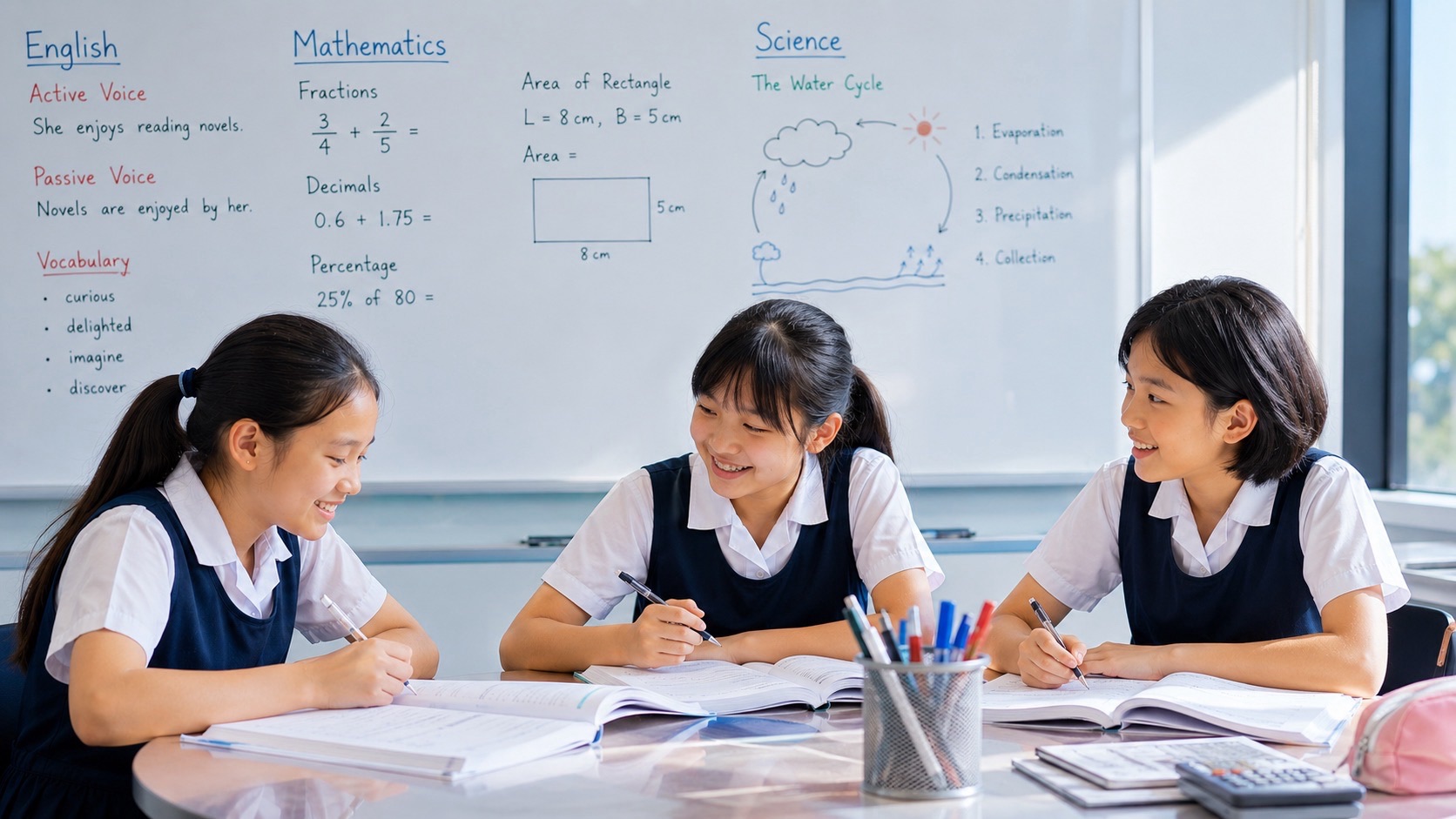
Why three students matters
Three children looking at the same boundary may notice completely different features.
One sees an insect. Another notices the drain. Another notices that one surface is wet. The tutor can ask which statements are observations, which are comparisons and which have already become explanations.
The group is large enough for perceptual variety and small enough that every child must explain their own thinking.
What progress should look like
- observations become more specific;
- built, natural, living and non-living categories are used more carefully;
- comparison keeps one property consistent;
- observation and inference are separated more reliably;
- change is described using before-and-after evidence;
- vocabulary becomes more precise;
- the child becomes comfortable saying, “I’m not sure yet.”
What parents can do at home
- Ask “What did you notice?” before “Why did that happen?”
- Compare a built object and a natural object using one property.
- Ask your child to invent a sorting rule, then test it.
- Observe one small change over time.
- When the child makes a causal claim, ask what evidence supports it.
- Model uncertainty: “I’m not sure. Let’s look again.”
Formal Science begins in Primary 3
MOE’s formal Primary Science syllabus begins in Primary 3. That is why this page uses the term Science Foundations deliberately.
When formal Science begins, eduKateSingapore’s Science Learning Library provides the curriculum-facing route. The habits built here—observation, comparison, classification and evidence-aware explanation—are the preparation underneath it.
Frequently Asked Questions
Does Primary 1 have formal Science in Singapore?
No. Formal Primary Science begins in P3, so P1 work should focus on foundations rather than imitate the later syllabus.
Why focus on built and natural environments?
They give children easy-to-observe differences and useful classification questions while staying grounded in everyday reality.
Should my child memorise Science facts now?
Some facts will naturally be learned, but observation, vocabulary, comparison and evidence habits are stronger preparation for formal Science.
The deeper idea
Bukit Panjang shows a child that “town” and “nature” are not two separate worlds that never meet.
Science begins by noticing the meeting points carefully enough to ask better questions about what is living, what is built, what changes and what the evidence actually shows.
At Primary 1, scientific thinking begins when the child learns to look at a boundary long enough to see that it contains more than two sides.