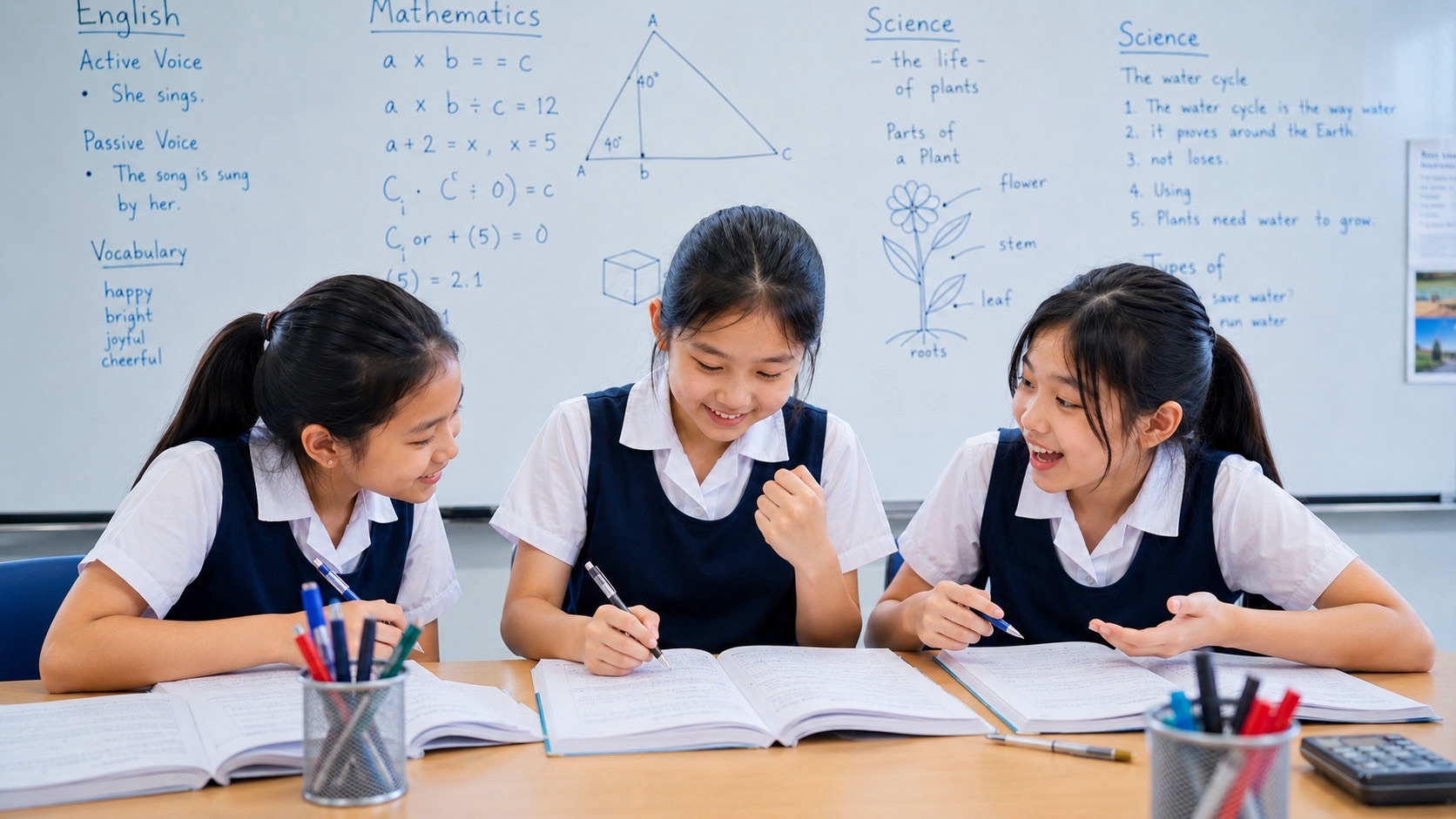
Primary 1 Mathematics tuition in Marine Parade is often searched by parents who want a confident beginning in number sense, addition, subtraction, place value, shapes, measurement and word problems without turning the first year of primary school into a race through worksheets. Around Marine Parade, Parkway Parade, Parkway Centre, Katong and the East Coast, families can choose from Mathematics tuition centres, enrichment classes, small-group tuition and school-readiness programmes. The more useful question is not which class reaches the hardest worksheet first. It is which teaching arrangement helps a six- or seven-year-old understand what numbers mean and how mathematical relationships fit together.
A strong Primary 1 Mathematics programme should connect number sense, place value, addition and subtraction, comparison, part-whole relationships, simple measurement, geometry, patterns and early problem solving. These are not separate boxes. A child who understands that 8 can be decomposed into 5 and 3 is building the same part-whole reasoning that later supports subtraction, number bonds, bar models, fractions and algebraic thinking. A learner who understands quantity before memorising procedures is more likely to recover when a familiar worksheet format changes.
At eduKate Singapore, 3-pax Primary 1 Mathematics tuition is built around making the child’s thinking visible. The tutor can watch whether a learner counts every object one by one, recognises groups, confuses digit symbols with quantities, reverses comparison signs, or performs an addition procedure without understanding what has been combined. In a very small group, each child can explain, manipulate, draw and check. The aim is not speed for its own sake. It is a reliable mathematical model the child can use independently.
Primary 1 Mathematics Is About Meaning Before Speed
Many young children can recite number sequences long before they understand the quantities those number words represent. They may recognise “12” but not immediately understand that it is one ten and two ones. They may know that 7 + 3 = 10 because they memorised the fact, but be unable to show why with counters, a number line or a drawing.
This distinction matters because Primary Mathematics becomes progressively more abstract. A memorised answer works only when the child recognises the exact pattern. Conceptual understanding gives the learner several routes. If 7 + 3 is forgotten, the child can count on, make ten, decompose the numbers or represent the situation visually. Good foundations provide recovery routes.
Concrete experience → Visual representation → Mathematical language → Symbolic procedure
Number Sense: More Than Counting Correctly
Number sense is the child’s intuitive and explicit understanding of quantity and relationships. A learner with growing number sense can estimate, compare, decompose and recombine quantities. The child notices that 9 is one less than 10, that 6 can be 3 + 3 or 4 + 2, and that adding zero does not change the quantity.
We look for flexibility rather than one memorised route. If the child is asked to make 8, can several combinations be produced? Can the learner explain why 9 is greater than 6 without simply saying “because it comes later”? Can the child identify which of two groups contains more before counting every item?
These simple tasks reveal whether the child sees numbers as meaningful quantities or as isolated symbols.
Subitising: Seeing Small Quantities Without Counting One by One
Subitising is the ability to recognise a small quantity quickly without counting each object individually. Dice patterns are a familiar example. This capability reduces cognitive load and supports later number bonds.
We may briefly show a small arrangement of dots and ask what the child saw. A learner might say, “I saw 3 and 2, so 5.” That response is useful because it shows decomposition. The child is beginning to see structure inside quantity.
Place Value: One Ten Is Not Ten Separate Facts
Place value is one of the most important Primary 1 ideas because later arithmetic depends on it. The digit 2 means something different in 23 and 32 because position changes value. Children need to understand tens and ones as grouped quantities, not simply columns to fill in.
We use bundled objects, ten frames, drawings and decompositions. A number such as 14 can be seen as ten and four, twelve and two, seven and seven, or one more than thirteen. These representations make the structure visible and support future regrouping in addition and subtraction.
Addition: Combine, Increase and Find the Whole
Primary 1 addition should begin with meaning. Sometimes two groups are combined. Sometimes an existing quantity increases. Sometimes two parts are known and the whole is unknown. These situations look similar symbolically but help the child understand what the operation represents.
We move between stories, objects, drawings and number sentences. If the learner sees that 5 + 3 can mean five objects joined by three more, the equation stops being an arbitrary instruction. Later mental strategies become easier to justify.
Subtraction: More Than “Take Away”
Young children often first meet subtraction as taking objects away. That is useful but incomplete. Subtraction can also represent comparison or finding a missing part. “Ali has 8 marbles and gives away 3” is different in story structure from “Ali has 8 marbles and Ben has 5; how many more does Ali have?” Both can involve 8 − 5 or 8 − 3 relationships.
Showing multiple meanings prevents the child from learning that every subtraction question must contain words such as “left” or “gave away”. It also supports later problem solving, where operation choice becomes more subtle.
Number Bonds: A Small Idea With Long-Term Value
Number bonds help children see a whole and its parts. If 10 is decomposed into 6 and 4, the learner can derive 6 + 4 = 10, 4 + 6 = 10, 10 − 6 = 4 and 10 − 4 = 6. One relationship produces several facts.
This reduces memorisation because the child learns families of relationships. Later, the same thinking appears in bar models, fractions and algebraic equations where a whole is related to unknown parts.
Mental Calculation: Build From Relationships
Mental Mathematics should not become a speed contest. We want the child to notice useful structures. To solve 8 + 5, one child might make ten: 8 + 2 + 3 = 13. Another might know 5 + 5 = 10 and adjust. These strategies are valuable because they are based on relationships.
Automatic recall is useful, but understanding should come with it. A learner who knows only memorised facts can become stuck when stress interrupts recall. A learner who also understands structure has more than one route.
Comparison: Greater Than, Less Than and Equal To
Comparison symbols can become a source of confusion if they are taught as pictures to memorise. We first establish the relationship verbally: 9 is greater than 6 because it represents a larger quantity. Then the symbol records that relationship.
We also compare expressions, not only single numbers. Is 5 + 2 greater than, less than or equal to 8? This encourages the child to think about values rather than visual size of the written expression.
Early Word Problems: Understand the Situation Before Choosing an Operation
Primary 1 word problems introduce one of the most important habits in Mathematics: the operation should be chosen from the relationship, not from a keyword. Words such as “more” can appear in both addition and subtraction contexts.
We ask children to tell the story in their own words, identify what is known, state what is unknown and draw a simple representation. Only then do we choose the number sentence. This slows impulsive calculation and gives the child a repeatable problem-solving route.
Understand the story → Represent the quantities → Choose the relationship → Calculate → Check
Drawing Is Not a Crutch
Some children resist drawing because they believe Mathematics should be solved mentally. In Primary 1, drawing is a legitimate mathematical tool. A quick sketch can make part-whole relationships, comparison and sequence visible.
External representations reduce working-memory demand. The child does not have to hold every quantity mentally while deciding what to do. This is one reason visual models are so useful in Singapore Mathematics.
Measurement: Connect Numbers to the Physical World
Measurement gives numbers a physical meaning. Length, mass, time and money require the child to compare quantities and use units. Errors often come from ignoring the unit or applying a procedure without considering what is being measured.
We ask children to estimate before measuring. Which object is likely to be longer? About how many units? Estimation builds magnitude sense and helps the child notice impossible answers later.
Shapes and Spatial Reasoning
Geometry at Primary 1 should be more than naming shapes. Children can compare properties, rotate shapes mentally, identify parts and notice how shapes combine. Spatial reasoning supports later geometry, measurement and diagram interpretation.
We may ask whether a shape remains the same when turned, how two smaller shapes can form a larger one, or which property distinguishes one figure from another. This develops reasoning beyond labels.
Patterns: The Beginning of Generalisation
Pattern tasks teach children to look for regularity. A child who sees that a sequence increases by two each time is doing early generalisation. The learner identifies what remains consistent and uses it to predict what comes next.
We ask not only for the next item but for the rule. “How do you know?” turns a pattern exercise into reasoning.
Common Primary 1 Mathematics Problems Need Different Repairs
“My child can count but still gets simple sums wrong.”
The issue may be weak quantity relationships, not counting knowledge. We check whether the child understands part-whole structure, can count on from a number rather than restart at one, and can decompose quantities flexibly.
“My child memorises answers but freezes when the question looks different.”
This suggests format dependence. We vary representation: objects, pictures, number lines, equations and stories. The same relationship should survive surface changes.
“My child is fast but careless.”
Sometimes speed is masking weak checking. We teach a simple verification habit: estimate, solve, then ask whether the answer matches the story and magnitude. The goal is not to make the child slower permanently, but to build control before speed.
“My child is slow at every question.”
Slowness can come from several causes: weak number facts, counting every object, uncertainty about operation choice, handwriting effort or fear of mistakes. The repair depends on the mechanism. Generic timed drills may help one child and harm another.
Why Three Students Helps at Primary 1
Young learners reveal Mathematics through talk and action. In a three-student class, the tutor can watch how each child counts, groups, draws and explains. Peers provide alternative strategies without creating a large-class hiding place.
- every child manipulates and explains;
- misconceptions can be corrected immediately;
- the tutor can ask follow-up questions instead of accepting a lucky answer;
- students hear more than one strategy;
- stronger learners can be extended through reasoning rather than older worksheets;
- slower learners can receive scaffolding without losing the lesson;
- independent attempts can be observed closely.
A Useful Primary 1 Mathematics Lesson Loop
- Retrieve: bring back a small earlier number relationship.
- Represent: use objects, drawings or a number line.
- Explain: ask the child what the representation means.
- Symbolise: connect the representation to the number sentence.
- Practise: solve a few carefully chosen variations.
- Transfer: change the story or visual form.
- Check: ask how the child knows the answer is sensible.
This sequence keeps procedures attached to meaning.
Catch Up, Keep Up or Move Ahead
- Catch up: stabilise counting, quantity, number bonds, place value and operation meaning.
- Keep up: consolidate school learning and improve flexible calculation and word-problem routines.
- Move ahead: deepen reasoning, pattern generalisation, multiple solution routes and explanation rather than simply jumping to Primary 2 worksheets.
Strong young mathematicians benefit from depth. Asking “Can you solve it another way?” or “What would change if this number increased by one?” develops more useful flexibility than simply moving to older material.
Marine Parade Families: How to Compare Primary Mathematics Tuition
Marine Parade, Parkway Parade, Parkway Centre and Katong offer many Primary Mathematics tuition and enrichment options. Parents will see programmes emphasising Singapore Math, problem solving, number sense, heuristics, bar models, mental calculation, enrichment and small-group teaching. These categories are useful, but the teaching response to error is more important than the label.
Ask what happens when a child gets the correct answer using an unreliable method. Ask whether concrete and visual representations are used to repair weak understanding. Ask how the tutor distinguishes a calculation error from a concept error. Ask whether strong students are pushed to explain and generalise rather than simply work ahead.
For wider eduKateSingapore navigation, see the Tuition Programmes Directory and the Central Singapore Tuition Directory.
What Parents Can Do at Home
- Ask how the child knows. Explanation reveals whether an answer was guessed.
- Use everyday quantities. Money, fruit, stairs and toys provide natural number relationships.
- Play with number decomposition. “How many ways can we make 10?”
- Estimate before measuring. This builds magnitude sense.
- Let the child draw word problems. Representation is part of thinking.
- Avoid correcting too quickly. An imperfect attempt exposes the mechanism.
- Keep some Mathematics playful. Curiosity supports persistence.
How We Know Primary 1 Mathematics Is Improving
- the child recognises small quantities with less one-by-one counting;
- number bonds become more flexible;
- place value is explained using tens and ones;
- addition and subtraction are chosen from the story relationship;
- mental strategies become more varied;
- word problems trigger drawings or representations rather than random operations;
- the learner checks whether answers are sensible;
- new question formats cause less confusion.
Frequently Asked Questions
Should Primary 1 Mathematics tuition focus on speed?
Accuracy and fluency matter, but speed should grow from understanding and practice. Timed work is less useful if the child is still relying on fragile procedures or counting every item from one.
Is the bar model necessary in Primary 1?
Simple visual models can help represent part-whole and comparison relationships. The important goal is not drawing a particular format perfectly but understanding what the parts and whole represent.
Why does my child know number facts but struggle with word problems?
Calculation and operation selection are different skills. The child may need stronger story interpretation and visual representation rather than more arithmetic drills.
What if my child is already far ahead?
Extend through reasoning, multiple methods, explanation, patterns and generalisation. Depth often produces stronger long-term mathematics than accelerating through levels without conceptual consolidation.
The Real Goal: A Child Who Understands What the Numbers Are Doing
A strong Primary 1 Mathematics year is not defined by how early a child can perform complicated procedures. It is defined by whether the learner understands quantity, sees relationships, represents problems and can recover when a familiar format changes.
Number sense makes calculation more flexible. Place value makes later regrouping meaningful. Part-whole relationships prepare the ground for bar models and fractions. Drawings reduce working-memory load. Explanation turns lucky answers into visible reasoning.
That is the purpose of Primary 1 Mathematics tuition for Marine Parade families: build the mathematical meaning first, so procedures later have something solid to sit on.