Primary 1 Mathematics begins before the child writes a single equation.
It begins with quantity: knowing that seven is more than five, that ten can be composed in several ways, that a number remains the same quantity even when objects are rearranged, and that addition and subtraction describe relationships rather than merely worksheet symbols.
When these foundations are secure, later Mathematics has somewhere to stand. When they are fragile, children can still learn procedures, but every new chapter becomes more expensive.
Quick Read for Parents
- Primary 1 Mathematics should build number sense before speed.
- Place value is a foundational idea, not merely a chapter.
- Addition and subtraction should be understood as relationships between quantities.
- Word problems require translation from language into a mathematical representation.
- Concrete objects, drawings and symbols should gradually connect rather than compete.
- Good tuition finds the earliest unstable idea instead of making the child repeat everything.
The One-Sentence Answer
Strong Primary 1 Mathematics tuition should help a child understand what numbers and operations mean well enough that later calculation becomes an expression of understanding rather than a memorised performance.
Number Sense Comes Before Number Tricks
A child with number sense can compare quantities, break a number apart and rebuild it, recognise useful combinations and estimate whether an answer is sensible.
Place Value: Why Position Changes Meaning
Place value is one of the quiet foundations of school Mathematics. The digit 2 does not mean the same quantity in 2, 20 and 200. Children need to understand grouping in tens rather than simply recite digit names.
Six Primary 1 Mathematics Patterns Worth Diagnosing
- The child counts everything from one.
- Addition facts are memorised but quantities are not understood.
- Subtraction always means “take away”.
- The child knows the arithmetic but cannot solve the story problem.
- Symbols are copied without meaning.
- Speed is mistaken for ability.
Concrete → Pictorial → Abstract
Young learners often understand a relationship first through objects, then through drawings or diagrams, and eventually through mathematical notation. The important point is that these representations connect.
Word Problems: Mathematics Hidden Inside Language
A word problem asks the child to translate. Who or what is involved? What quantities are known? What changed? What is unknown? Which relationship connects them?
Why Three Students Works Well in Primary 1 Mathematics
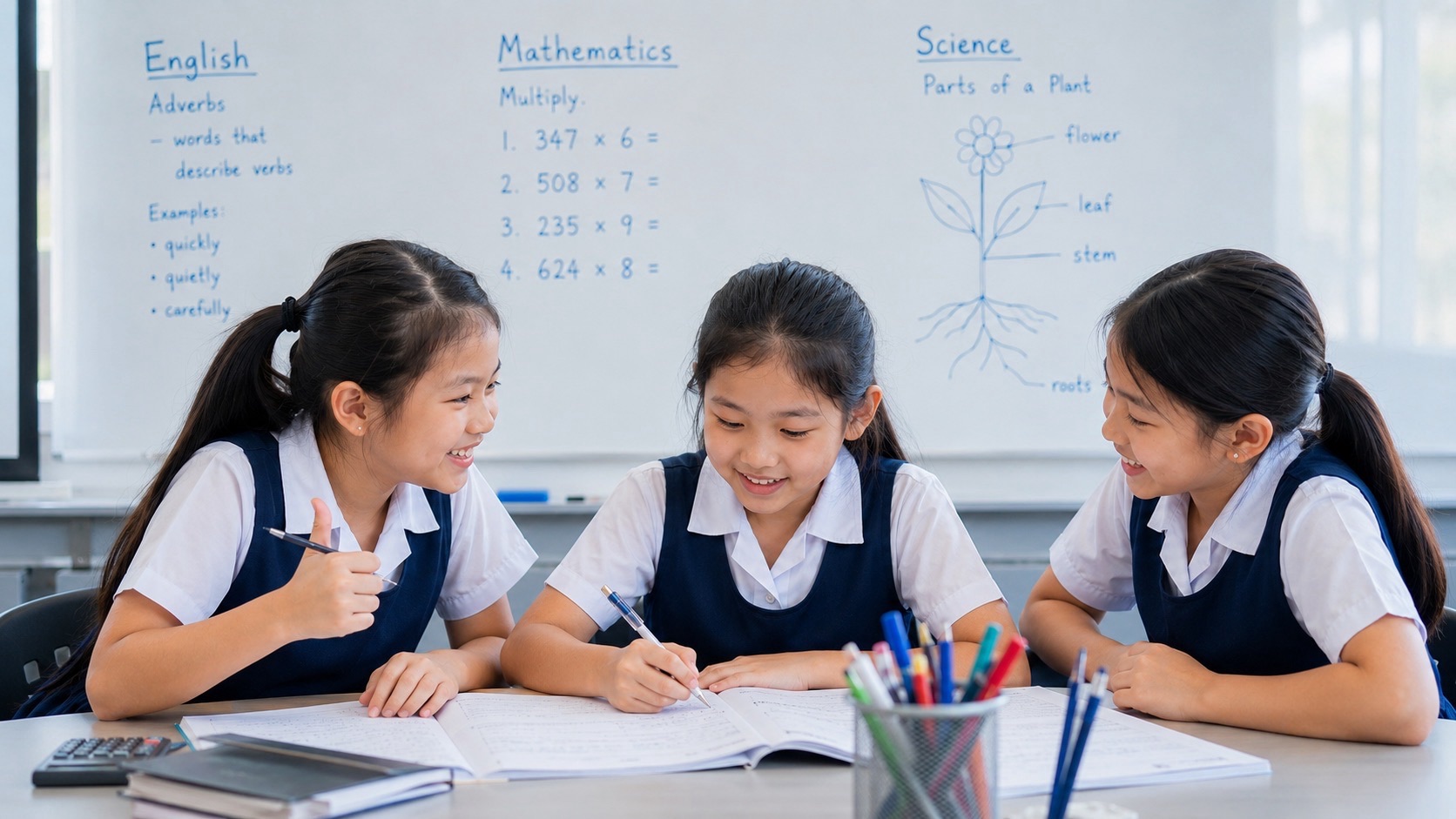
Early Mathematics needs observation. In a three-student group, the tutor can see whether a child counts, groups, draws, guesses or understands. Each learner gets enough turns to explain how an answer was found rather than merely show the answer.
What Parents Can Do at Home
- Use ordinary quantities.
- Ask “How do you know?”
- Play with number bonds.
- Let the child draw.
- Estimate before calculating.
- Do not race unnecessarily.
Choa Chu KangOS Carries the Town Story
The wider local context belongs in Choa Chu KangOS. This page remains focused on the Primary 1 Mathematics learner and the first mathematical foundations.
What Improvement Should Look Like
Primary 1 improvement should look like less dependence on counting every object, stronger part-whole thinking, clearer place-value understanding and better translation of simple stories into mathematical relationships.
Continue through the tuition network: Tuition Programmes Directory · Programmes & Locations · West Singapore Tuition Directory · eduKateSingapore Hub.