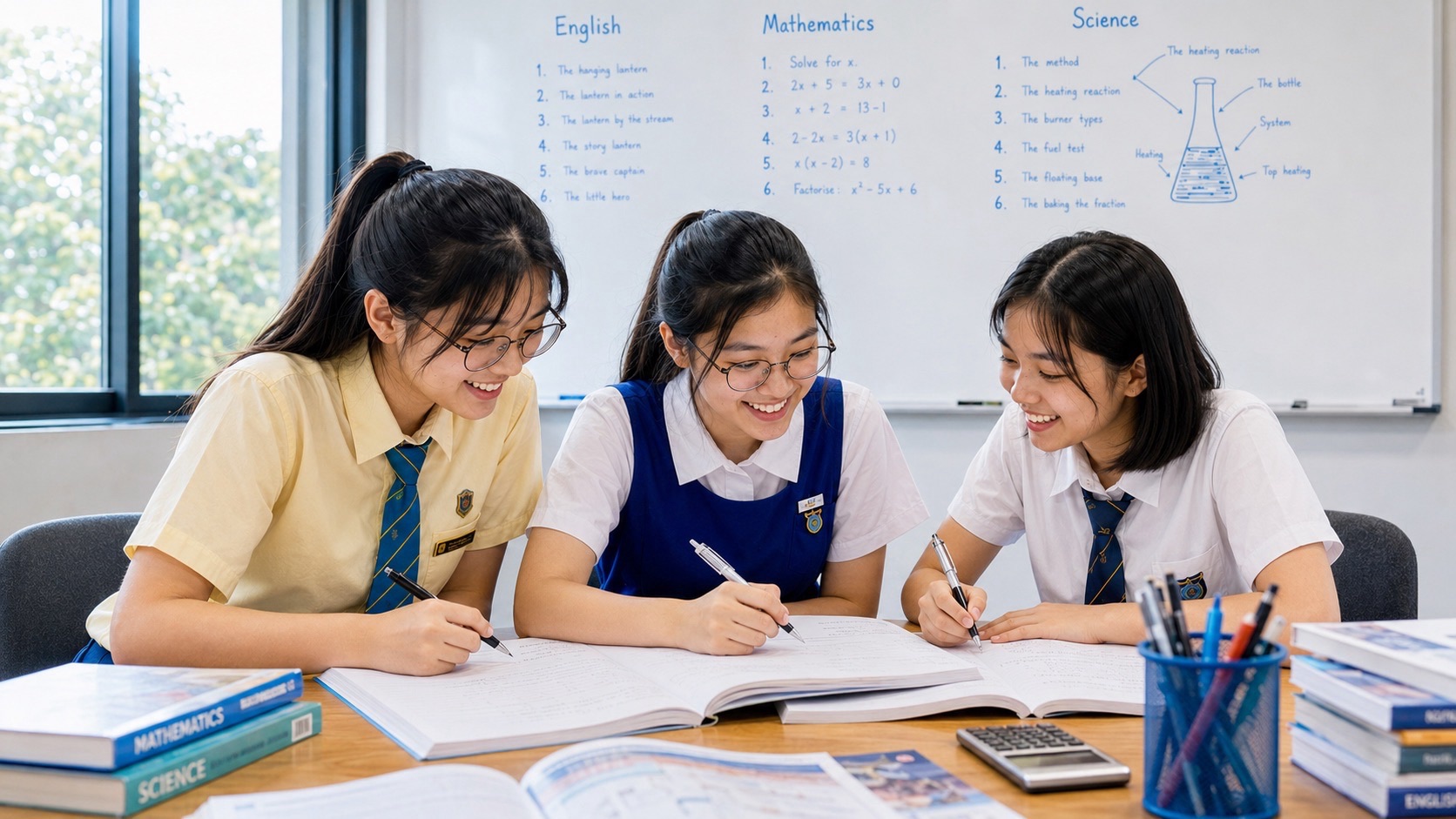
Lower Secondary Science in Singapore is the two-year bridge from Primary Science into upper-secondary disciplinary Physics, Chemistry and Biology. Students and parents searching lower secondary science, Sec 1 Science topics, Sec 2 Science topics, G2 Science, G3 Science or what is examined in Secondary 1 and 2 should begin with the official structure: the current MOE G2/G3 syllabus is organised through Scientific Endeavour, Diversity, Models, Interactions and Systems.
The exact teaching order can vary by school. MOE’s syllabus gives a planned curriculum and explicitly allows schools to design meaningful school-based programmes around it. So this page maps the national content spine without pretending that every Secondary 1 class studies every topic in the same month or that every school uses an identical assessment calendar.
Lower Secondary Science is not a national terminal examination. School-based tests and weighted assessments vary, and MOE removed mid-year examinations at secondary levels from 2025. The durable goal is readiness for upper-secondary subject choices and the 2027 SEC environment under Full Subject-Based Banding, where students offer subjects at G1, G2 or G3 according to their learning needs and strengths.
F1 INSTITUTIONAL RECEIPT · verified 27 September 2026. MOE has fully implemented Full Subject-Based Banding from the 2024 Secondary 1 cohort, with subjects offered at G1, G2 and G3 levels according to the learner’s strengths and needs. The current MOE G2/G3 Lower Secondary Science syllabus remains the official curriculum frame for this route. MOE Full SBB overview · MOE G2/G3 Lower Secondary Science syllabus.
Scope: the Full SBB framework and Lower Secondary Science curriculum are F1 institutional claims. School-specific teaching order, weighted-assessment schedules and local test design are not one national examination format and should be treated as school/programme-level information when stated. Refresh trigger: recheck when MOE revises the Lower Secondary Science syllabus or Full SBB framework, and otherwise within the F1 review interval.
The five G2/G3 Lower Secondary Science themes
- Scientific Endeavour
- Diversity
- Models
- Interactions
- Systems
1. Scientific Endeavour
This is the operating layer underneath every topic: observation, measurement, evidence, experimental design, data analysis, evaluation, scientific models, safety, ethics and the relationship between science, technology, society and environment.
Students who treat this as a one-off ‘scientific method chapter’ usually struggle later because the same skills reappear in practical work across Physics, Chemistry and Biology.
2. Diversity
- Exploring Diversity of Matter by its Physical Properties
- Exploring Diversity of Matter by its Chemical Composition
- Exploring Diversity of Matter using Separation Techniques
This theme teaches classification by evidence: substances can be distinguished by measurable physical properties, composition and how mixtures can be separated.
3. Models
- Ray Model of Light
- Model of Cells — the Basic Unit of Life
- Model of Matter — the Particulate Nature of Matter
- Model of Matter — Atoms and Molecules
The key skill is understanding what a model explains and where it has limits. A ray is not literally a visible line in space; it is a representation that helps us reason about light. Particle diagrams are not photographs of matter; they are models of structure and behaviour.
4. Interactions
- Application of Forces and Transfer of Energy
- Transfer of Heat Energy and its Effects
- Chemical Changes
- Interactions within Ecosystems
These topics train students to ask what changes when systems interact: motion, energy distribution, chemical identity or ecological relationships.
5. Systems
- Electrical Systems
- Human Digestive System
- Transport Systems in Living Things
- Human Sexual Reproductive System
Systems thinking means identifying parts, flows, interactions and functions rather than memorising isolated labels.
G1 Lower Secondary Science is a different route
Under Full Subject-Based Banding, G1 Lower Secondary Science uses a more applied modular structure, including laboratory measurements/procedures, Machines Around Us, Our Environment, and Our Body and Health. Do not assume the G2/G3 topic list is the exact G1 syllabus.
Students may also adjust subject levels at appropriate junctures, so the correct reference is the level actually being offered.
What schools can examine
School assessments can sample knowledge, application, data interpretation, calculations, practical skills and scientific explanation from the content already taught. Because assessment is school-based at Lower Secondary, the exact test scope should be confirmed from the school’s own scheme of work and revision notice.
What remains national is the curriculum framework and learning outcomes—not one universal Sec 1 or Sec 2 exam paper.
Practical science
Lower Secondary Science should build competence in measurement, apparatus, variables, fair testing, observation, data tables, graphing, errors, safety and evidence-based conclusions.
These skills become formal assessment targets in upper-secondary Pure and Combined Science practical components.
The transition into upper-secondary Science
By the end of Secondary 2, students should be able to move from integrated themes into disciplinary thinking:
- Physics: quantities, forces, motion, energy, heat, waves, electricity.
- Chemistry: particles, atoms, molecules, composition, reactions and separation.
- Biology: cells, body systems, transport, reproduction and ecosystems.
The dependency map
- Particles → atomic structure → bonding → chemical reactions.
- Forces/energy → kinematics/dynamics → work and energy.
- Ray model → upper-secondary light and waves.
- Cells → movement of substances → tissues/organs → transport and respiration.
- Electrical systems → current, voltage, resistance and circuits.
- Ecosystems → upper-secondary ecology and environmental reasoning.
How to diagnose a Lower Secondary Science error
- Vocabulary: does not know the technical term.
- Concept: recalls term but does not understand the relationship.
- Model: misreads particle/cell/ray/circuit diagrams.
- Calculation: formula, unit or arithmetic error.
- Evidence: conclusion not supported by results.
- Practical: variables, apparatus or method flawed.
- Explanation: states observation without mechanism.
A repair routine
- Name the topic.
- Find the first broken concept.
- Explain the mechanism in words.
- Represent it with a diagram/model/table.
- Do one direct question.
- Do one changed-context question.
- Retest after a delay.
Science World handoff
When a student asks “why does this happen?” rather than “what chapter is this?”, move from this syllabus map into Science World. The world-level mechanism pages are designed for that deeper layer.
The How Secondary Science Works owner gives the broader learning runtime.
Upper-secondary routes
Frequently asked questions
Is there one national Sec 1 or Sec 2 Science exam?
No. Lower-secondary assessments are school-based; schools can differ in timing, sequencing and exact tested scope.
What are the G2/G3 themes?
Scientific Endeavour, Diversity, Models, Interactions and Systems.
Is G1 Science the same syllabus?
No. G1 uses a distinct, more applied modular syllabus.
Why does topic order differ between schools?
The national syllabus provides the content framework while schools can design their own teaching sequence and school-based programme.
What should a Sec 2 student be ready for?
Disciplinary Physics, Chemistry and Biology concepts, practical science, data interpretation and scientific explanation.
Where does this sit in Atlas?
This is the canonical Lower Secondary Science topic-map owner under the Secondary Science Shelf.
The final Lower Secondary Science rule
Do not revise Lower Secondary Science as sixteen disconnected chapters. Learn the five themes, the scientific practices underneath them, and the dependency routes that lead into upper-secondary Physics, Chemistry and Biology.