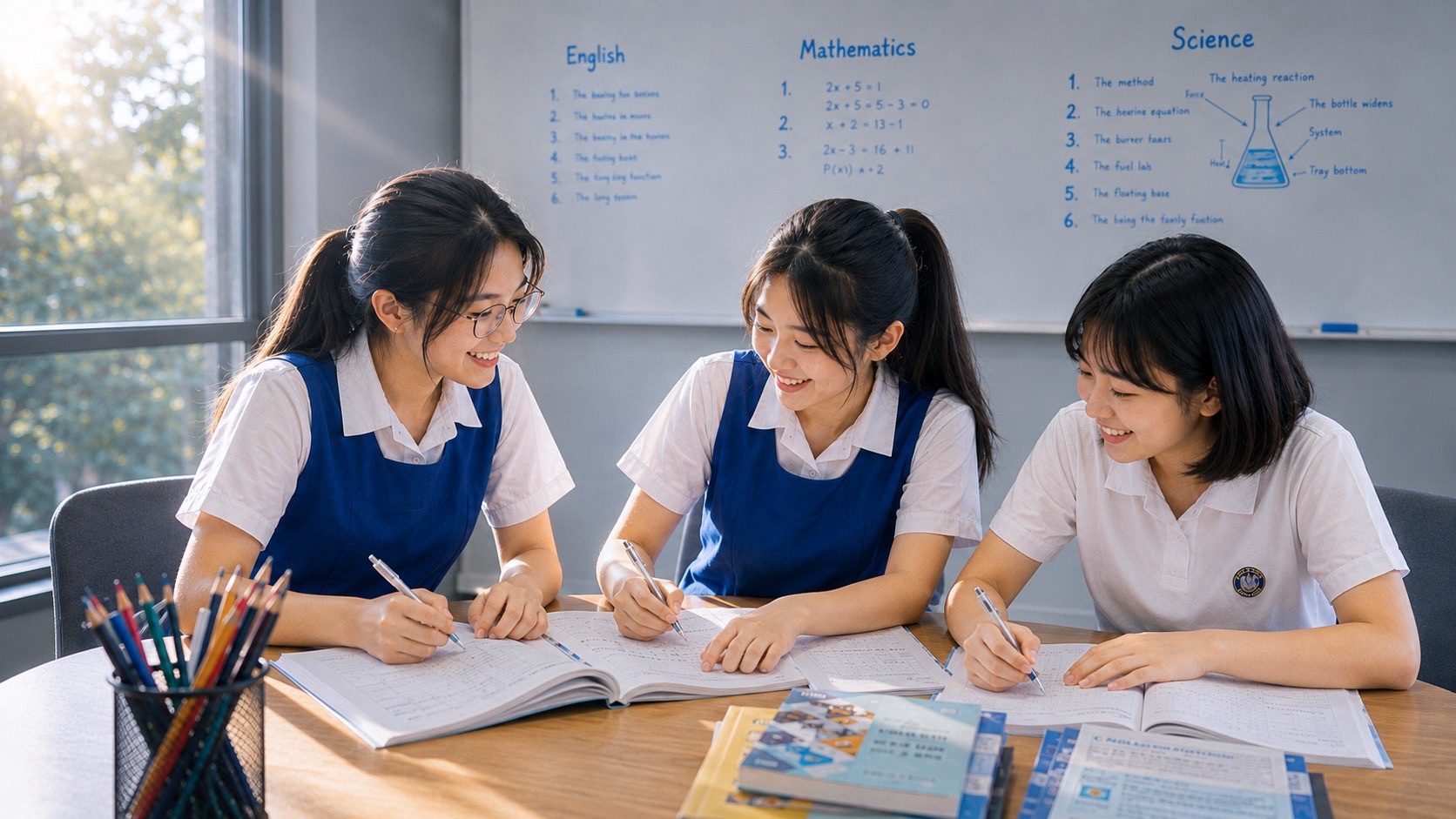
Three students sit around open books and worksheets at a classroom table, reading, writing and discussing the work together.

Katong IP Math Tuition | Build Strong Foundations

Katong IP Math Tuition | Build Strong Foundations


Build a Strong IP Math Foundation with eduKate Singapore in Katong

Transitioning into IP Mathematics at Secondary 1 (Year 1) is a major milestone for students. Unlike primary math, the IP syllabus introduces advanced concepts earlier, requiring sharper logical thinking, problem-solving, and abstract reasoning. At eduKate Singapore’s Katong tuition center, we provide structured, small-group classes (3-pax) designed to help students thrive from the start.

Our Sec 1 Year 1 IP Math tuition in Katong focuses on:

  • Step-by-step conceptual teaching to build clarity and confidence.
  • Strong algebraic foundations to support future topics like functions, trigonometry, and calculus.
  • IP-aligned problem-solving strategies with emphasis on reasoning and proofs.
  • Past-year paper exposure to prepare students for the rigour of the IP pathway.

With our small class sizes, students benefit from personalised attention while learning in a supportive environment that encourages active participation.


Why Choose eduKate Singapore’s IP Math Tuition in Katong?

  • Experienced IP Math Tutors: Specialists in the MOE-IP curriculum with proven track records.
  • Structured Notes & Worked Solutions: Comprehensive, exam-ready materials provided for every lesson.
  • 3-Pax Small Group Classes: Optimal balance of individual focus and collaborative learning.
  • Progress Monitoring: Regular reviews and feedback for parents to ensure steady improvement.
  • Long-Term Academic Strategy: Foundation building for IP, A-Math, and eventually JC H2 Math.

Our mission is to make sure students not only excel in IP Math but also enjoy the learning process, building resilience and confidence to tackle challenges.


Topics Covered in Sec 1 IP Math Tuition

We cover all core topics in the IP curriculum, with emphasis on problem-solving techniques:

  • Number Patterns & Sequences
  • Algebraic Manipulation & Expansion
  • Linear Equations & Inequalities
  • Functions & Graphs
  • Geometry & Proofs
  • Trigonometry Basics
  • Statistics & Probability

Every lesson incorporates concept explanation, worked examples, and practice drills to reinforce mastery.

Build a strong foundation!


Explore the connected learning guides

Choose the question that brought you here. Open one useful guide, try a small task, and stop when you have what you need.

Take one question further

The same learning habit can travel across subjects, while each subject keeps its own methods. These routes help you notice a difficulty, understand one part of it, and return to something you can do.

A word is familiar, but using it is difficult.

Move from recognising a word to retrieving it in a new context. Understand vocabulary plateaus.

Try it without the guide: Choose one word you already know. Close the guide and use it in a new sentence. Explain why it fits; try another context tomorrow.

A piece of writing has ideas, but the reader loses the thread.

Make the order of events and the links between sentences clear. Explore composition writing.

Try it without the guide: Choose one short paragraph. Read the relevant explanation, close it, and revise the paragraph. Ask someone to tell you what happened and why.

The Mathematics seems familiar, but marks still disappear.

Find the first point where the working stops being reliable. Find Secondary 4 A-Math mark leakage.

Try it without the guide: For a Secondary 4 A-Math question you have attempted, locate the first uncertain line. Repair that step, then try a comparable question without the worked answer.

A Science fact is remembered, but the explanation is incomplete.

Connect the evidence to a scientific idea and the resulting change. Follow the Primary Science learning route.

Try it without the guide: Choose a familiar Primary Science example. Explain the evidence, the idea and the result without notes. Then change one condition and explain your prediction.

Two accounts of the world seem to disagree.

Check the question, source, date and evidence before combining claims. Explore the World Knowledge research library.

Try it without the guide: Take one claim. Find the source best placed to support it, note its date, and state what remains uncertain. Return to your original question.

There is plenty of help, but independence is hard to see.

Check what the learner can understand and do after support is removed. Understand how education works.

Try it without the guide: Choose one small task the child has practised. Agree on a calm, brief attempt without prompts. Use what happens to choose one next step, then stop.

For the structure behind these connections, read the eduKateSingapore runtime manifest and the eduKate ecosystem boot contract. The reader map describes public navigation; those manifests preserve the wider ownership and return rules.