Sengkang Additional Mathematics Tuition
Current ownership boundary · 28 September 2026. This eduKateSingapore page is a retained Sengkang Additional Mathematics learning-journey and reference route; it is not the current local Sengkang A-Math programme owner. For the live S3–S4 Sengkang learning system, use eduKateSengkang · Additional Mathematics Tuition Sengkang | S3–S4 Learning System. For specialist Additional Mathematics depth and the wider Mathematics estate, use Bukit Timah Tutor · Additional Mathematics Knowledge Map or the World Mathematics Atlas. This page continues below as a public explanation of the Secondary 3 → Secondary 4 A-Math journey.
Secondary 3 and Secondary 4 Additional Mathematics are not two separate problems.
They are one learning journey with a change in emphasis halfway through.
Secondary 3 builds the mathematical machine. Secondary 4 tests whether that machine can run reliably under examination conditions.
The Two-Year A-Math Journey
A useful way to understand the journey is:
Secondary 3: Foundation → Fluency → Connection
Secondary 4: Integration → Stress-Test → Examination Readiness
The earlier stage is about building enough mathematical structure that later work has something stable to stand on. The later stage is about making that structure portable, fast and reliable.
Secondary 3: Build the Foundation
Many students enter Secondary 3 believing A-Math will simply be a harder version of lower-secondary Mathematics. The surprise is that the subject is not only harder. It is more interconnected.
Algebra appears everywhere. A small weakness in manipulation can affect functions, logarithms, trigonometry and calculus later. That is why Secondary 3 should not be treated merely as “finish the chapters”.
- Strengthen algebraic manipulation.
- Understand the meaning behind new methods.
- Build accurate working habits.
- Retrieve methods without copying examples.
- Learn to recognise the structure of a question.
- Connect new ideas to mathematics already learned.
Why Algebra Is the Gate
A-Math students often appear to have many different weaknesses when one upstream weakness is actually producing several downstream symptoms.
A student may understand differentiation but fail because the expression is manipulated incorrectly. A student may know logarithmic laws but struggle because indices are insecure. A student may understand trigonometric identities but become lost in the algebra needed to transform them.
That is why we pay close attention to the algebra underneath the topic being taught.
From Understanding to Retrieval
“I understand when the tutor explains it” is a good beginning, but it is not yet independent capability.
The student must still be able to close the notes, retrieve the method, solve a similar problem, solve a changed problem and recognise the concept when nobody tells them which chapter is being tested.
The progression is:
See → Understand → Retrieve → Apply → Transfer.
Secondary 3: Correct Errors Before They Become Habits
Secondary 3 gives students something valuable: time.
A weak sign habit, incomplete working, dependence on answer keys or poor algebraic discipline can still be corrected before examination pressure becomes intense.
That is why early mistakes should be treated as diagnostic information rather than evidence that the student “cannot do A-Math”.
Secondary 4: The Job Changes
By Secondary 4, the question gradually changes from “Can you learn this?” to “Can you use everything you have learned accurately, independently and under pressure?”
That shift changes the training.
- Topics are mixed more often.
- Question recognition becomes important.
- Route selection matters.
- Recurring errors are compressed into patterns.
- Timed work becomes more useful.
- Full papers become diagnostic instruments.
- Checking and recovery under pressure become part of the craft.
Integration: Stop Seeing Chapters as Separate Folders
A strong Secondary 4 student no longer needs every problem labelled by chapter.
The student begins to see relationships: algebra inside calculus, functions inside graphs, transformation inside trigonometry, and geometric information translated into symbolic form.
This is where mixed practice becomes valuable. It forces the student to decide what mathematics is relevant instead of simply applying the technique printed at the top of the worksheet.
Stress-Test: Make the Knowledge Travel
Once a student can solve a familiar question, change something.
- Remove the obvious cue.
- Mix in another topic.
- Change the representation.
- Ask for a different route.
- Reverse the direction of the problem.
- Add time pressure after the method is stable.
The purpose is to discover whether the student owns the mathematical capability or merely recognises one familiar template.
Examination Readiness Is More Than Knowing the Syllabus
A student can know the syllabus and still lose marks through poor execution.
Examination readiness includes:
- retrieving methods without warm-up;
- reading conditions accurately;
- choosing efficient routes;
- showing sufficient working;
- protecting easy marks;
- knowing when to move on;
- recovering after a difficult question;
- maintaining accuracy later in the paper; and
- using checking strategically.
Past Papers Are Sensors
A completed paper should produce more than a score.
It should tell us where time accumulated, which question structures slowed recognition, which errors repeated, whether accuracy fell under fatigue and whether checking actually recovered marks.
That information determines the next training cycle.
What If the Student Is Behind?
Do not respond by trying to repair everything at once.
First identify the missing capability that affects the most current work. A short repair in the right place can sometimes unlock several topics together.
The goal is to restore forward movement without overwhelming the student.
What If the Student Is Already Strong?
Strong students need a different path.
Once routine questions are comfortable, improvement may come from harder transfer, tighter algebra, alternative methods, better question recognition, error compression and full-paper consistency rather than simply more volume.
The aim becomes to raise the ceiling while reducing mark leakage.
Why 3-Pax Tuition Helps Across the Journey
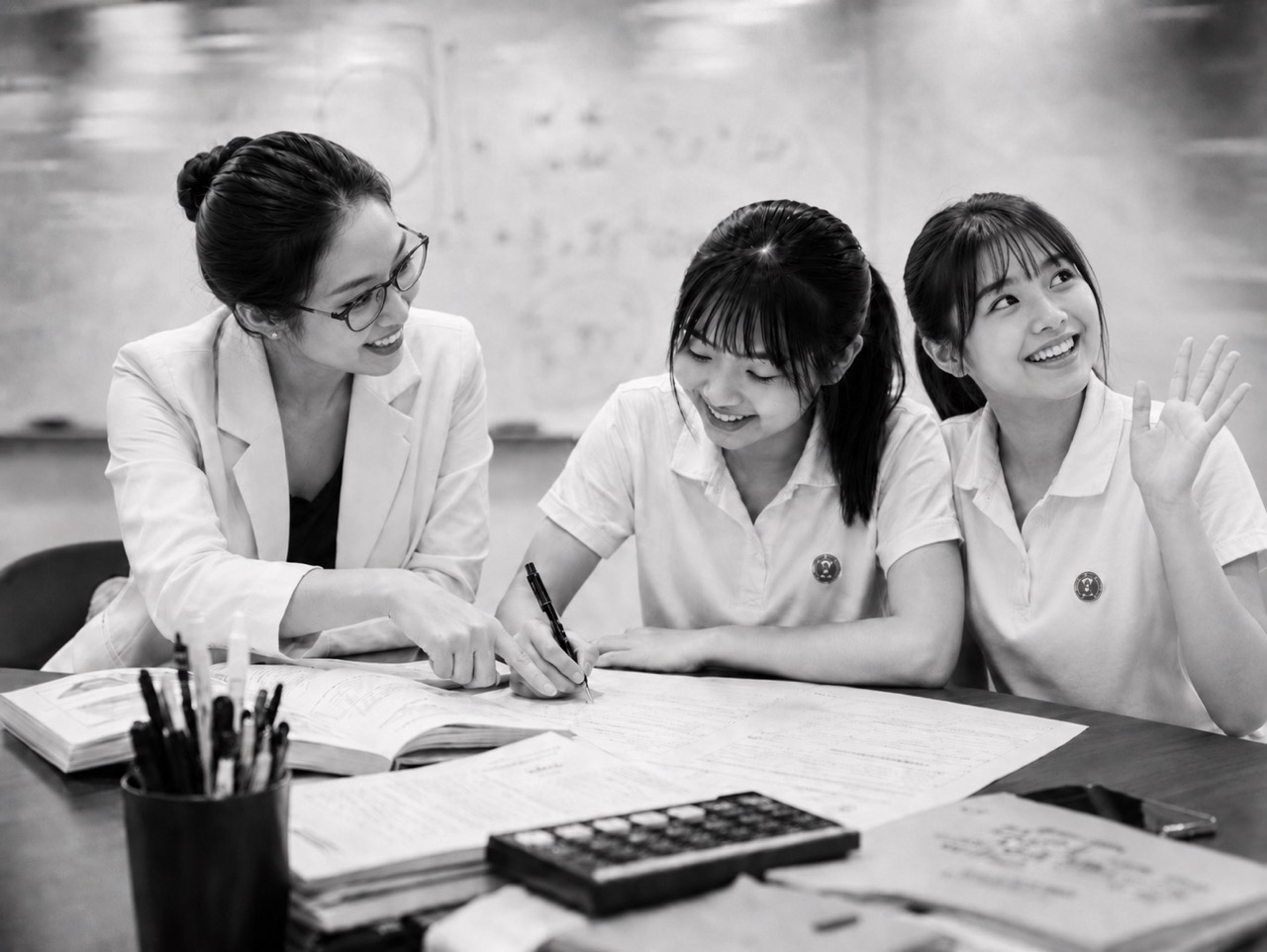
In a group of up to three students, the tutor can remain close enough to inspect individual working while preserving the useful presence of other learners.
Students can see alternative approaches, hear different questions and learn that the same mathematical problem can be entered through more than one valid route.
At the same time, the tutor can distinguish whether a student’s failure comes from concept, retrieval, recognition, connection, execution or examination control.
The Journey Should Reduce Dependence
The endpoint of good tuition is not a student who becomes excellent only when a tutor is beside them.
Over time, the tutor’s questions should become the student’s own:
- What do I know?
- What structure is present?
- Which method is justified?
- Where might the error be?
- Can I find a cleaner route?
- Does the answer make sense?
That is the complete Sengkang A-Math journey:
Secondary 3 Foundation → Fluency → Connection → Secondary 4 Integration → Stress-Test → Examination Readiness → Independence.
For families considering Additional Mathematics tuition in Sengkang, the first useful question is not how many worksheets a programme provides. It is where the student is now, what is preventing the next step, and what kind of work will move the student forward.