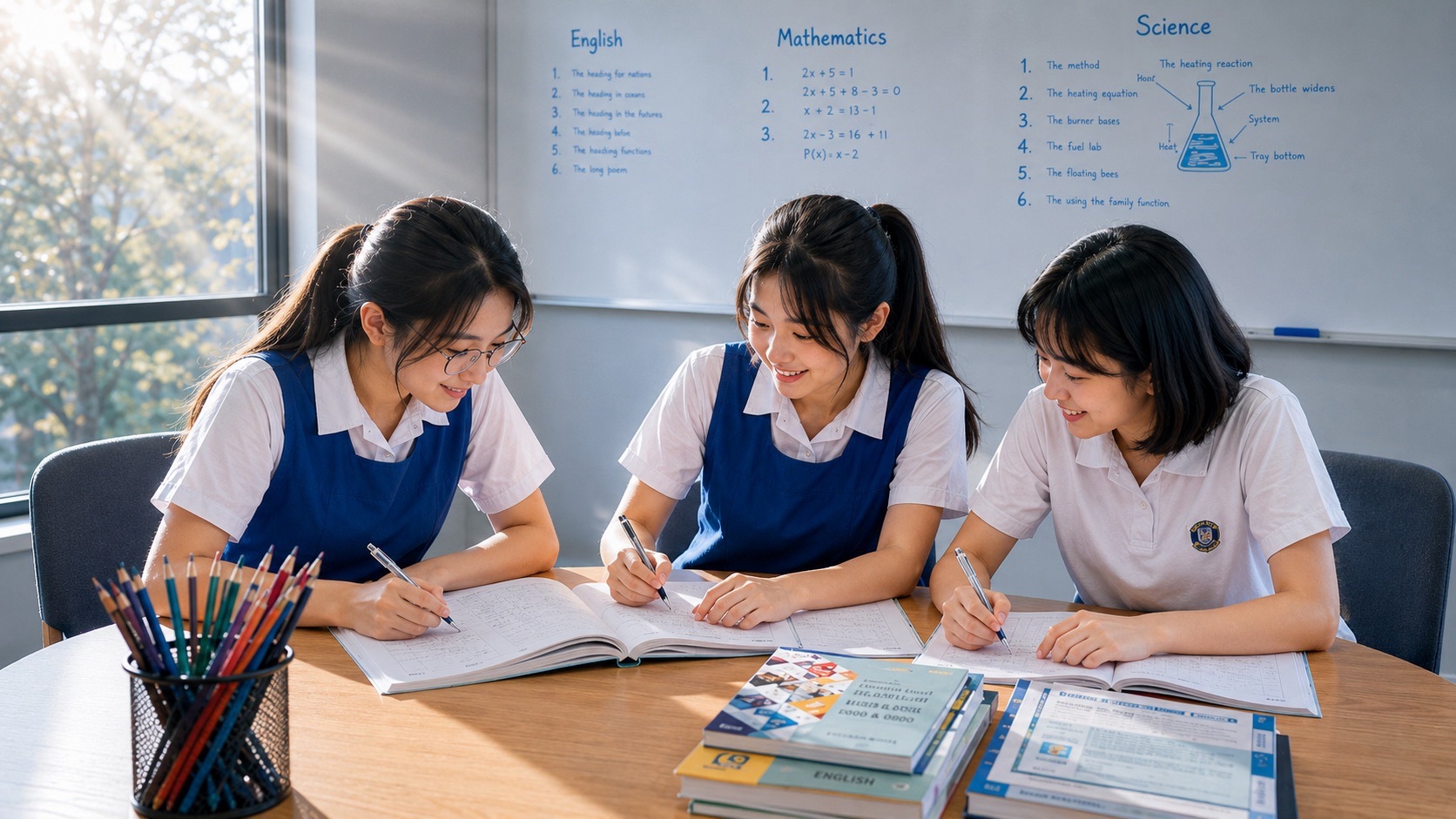
Three students sit around open books and worksheets at a classroom table, reading, writing and discussing the work together.

Primary 6 Raffles SA2 Prelim Paper 2020 Teaching Guide and Study Plan

Parents, Tutors and Teacher’s English Resource. Primary 6 Raffles SA2 Prelim Paper 2020 Teaching Guide and Study Plan to be used in conjunction with past year examination papers.

Question 16-20 Trading in modern times with computers instead of writing
Question 29-38 Take a nap to rejuvenate
Question 39-50 Koalas licked trees to drink water
Question 71-80. Apple Orchards with people picking some

Videos for Questions 16-20. Passage on Summerians Mesopotamia (now northern Iraq).

The rise and fall of Mesopotamia. A short history of the Summerians.
Our language now came from a vast network of knowledge and cultures.

Videos for Question 21-28. How we can help in animal conservation.

We all can be part of the conservation of wildlife.
Even in Singapore, we can do something to help wildlife to thrive.

Videos for Question 29-38. Taking naps, yay or nay?

Sleep expert gives advice on whether you should nap or not. Customise sleep to your life.

Videos for Questions 39-50 Koalas needs our help too.

An introduction to Koalas and their life in Australia.
When the environment becomes too hot, Koalas have to be saved during wildfires.

Question 51-65 Honey Badgers can ruin your day if you cross their path, even if you are a lion.

Honey badgers are tough cookies and they are built like tanks.

Question 71-80. Apple and Pear Orchards in Australia

Singaporean goes on a trip to Australia and visits an apple orchard
A quick tour of Melbourne, Australia.
How a weather balloon can fly that high.
How you can get back to earth from the edge of space using a balloon.

Class discussions:

  • Why do we need diversity in languages and cultures on Earth? Would a single universal language be better or worse?
  • Are zoos actually good for animals and wildlife conservation? Can we do without zoos? What other alternatives can you think of?
  • Napping, do we need to nap? Why do we sleep? How much sleep do we need to be able to do all the things we have to do in school and achieve excellent results?
  • The Earth is getting warmer and Australia have been having heatwaves that causes forest fires that devastate the wildlife and towns/cities. What can we do in Singapore to help them?
  • If a weather balloon can reach the edge of space, why can’t we get astronauts into space with weather balloons? What is the science that is stopping us from doing that? (hint: google angular velocity to escape earth’s gravity)

Enrichment Score: 80%

Difficulty Level: Moderate

Information and Study Programme for Pri 6 Raffles SA2 Prelim Paper 2020.

Vocabulary List to be learnt before attempting this paper.

  1. hollered
  2. excessively
  3. renovation
  4. assignment
  5. rehearsal
  6. tolerant
  7. measures
  8. implement
  9. fell off
  10. fell down
  11. fell behind
  12. fell through
  13. fictitious
  14. romantic
  15. counterfeit
  16. worthy
  17. reckless
  18. undaunted
  19. fervently
  20. longingly
  21. incessantly
  22. monotonously
  23. flourished
  24. expanses
  25. pictographs
  26. assisted
  27. destination
  28. impressed
  29. stylus
  30. concepts
  31. complex
  32. financial
  33. transactions
  34. elaborate
  35. phonograms
  36. convey
  37. precise
  38. thrived
  39. aided
  40. stalled
  41. yielded
  42. marked
  43. labelled
  44. chiselled
  45. competent
  46. mounting
  47. endangered
  48. extinct
  49. dwindling
  50. captivity
  51. resemble
  52. sanctuaries
  53. established
  54. depleting
  55. sustainable
  56. regulations
  57. policies
  58. conservation
  59. contribute
  60. ambassadors
  61. unleash
  62. artistes
  63. artists
  64. volunteer
  65. overwhelming
  66. productive
  67. cognitive
  68. reaction
  69. motor learning
  70. pathways
  71. significantly
  72. rejuvenated
  73. heatwave
  74. conservation
  75. attitude
  76. invasive
  77. foremost
  78. derived
  79. hibernating
  80. settlements
  81. nocturnal
  82. crevices
  83. tenacity
  84. vigilance
  85. suburb
  86. roaming
  87. interference
  88. patrolling
  89. revelled
  90. authority
  91. wandering
  92. enthralled
  93. inspection
  94. remnants
  95. bureau
  96. meteorology
  97. souvenir
  98. accompanied
  99. disinterested
  100. possession
  101. phenomenal

Parents and Teacher’s Resource

Use this page as a teaching guide and study plan with vocabulary words, enrichment videos and images that will give preliminary understanding and visual cues to help students to be well prepared when they attempt the question paper.

Answers are found here:

Explore the connected learning guides

Choose the question that brought you here. Open one useful guide, try a small task, and stop when you have what you need.

Take one question further

The same learning habit can travel across subjects, while each subject keeps its own methods. These routes help you notice a difficulty, understand one part of it, and return to something you can do.

A word is familiar, but using it is difficult.

Move from recognising a word to retrieving it in a new context. Understand vocabulary plateaus.

Try it without the guide: Choose one word you already know. Close the guide and use it in a new sentence. Explain why it fits; try another context tomorrow.

A piece of writing has ideas, but the reader loses the thread.

Make the order of events and the links between sentences clear. Explore composition writing.

Try it without the guide: Choose one short paragraph. Read the relevant explanation, close it, and revise the paragraph. Ask someone to tell you what happened and why.

The Mathematics seems familiar, but marks still disappear.

Find the first point where the working stops being reliable. Find Secondary 4 A-Math mark leakage.

Try it without the guide: For a Secondary 4 A-Math question you have attempted, locate the first uncertain line. Repair that step, then try a comparable question without the worked answer.

A Science fact is remembered, but the explanation is incomplete.

Connect the evidence to a scientific idea and the resulting change. Follow the Primary Science learning route.

Try it without the guide: Choose a familiar Primary Science example. Explain the evidence, the idea and the result without notes. Then change one condition and explain your prediction.

Two accounts of the world seem to disagree.

Check the question, source, date and evidence before combining claims. Explore the World Knowledge research library.

Try it without the guide: Take one claim. Find the source best placed to support it, note its date, and state what remains uncertain. Return to your original question.

There is plenty of help, but independence is hard to see.

Check what the learner can understand and do after support is removed. Understand how education works.

Try it without the guide: Choose one small task the child has practised. Agree on a calm, brief attempt without prompts. Use what happens to choose one next step, then stop.

For the structure behind these connections, read the eduKateSingapore runtime manifest and the eduKate ecosystem boot contract. The reader map describes public navigation; those manifests preserve the wider ownership and return rules.

Discover more from eduKate SG

Subscribe now to keep reading and get access to the full archive.

Continue reading