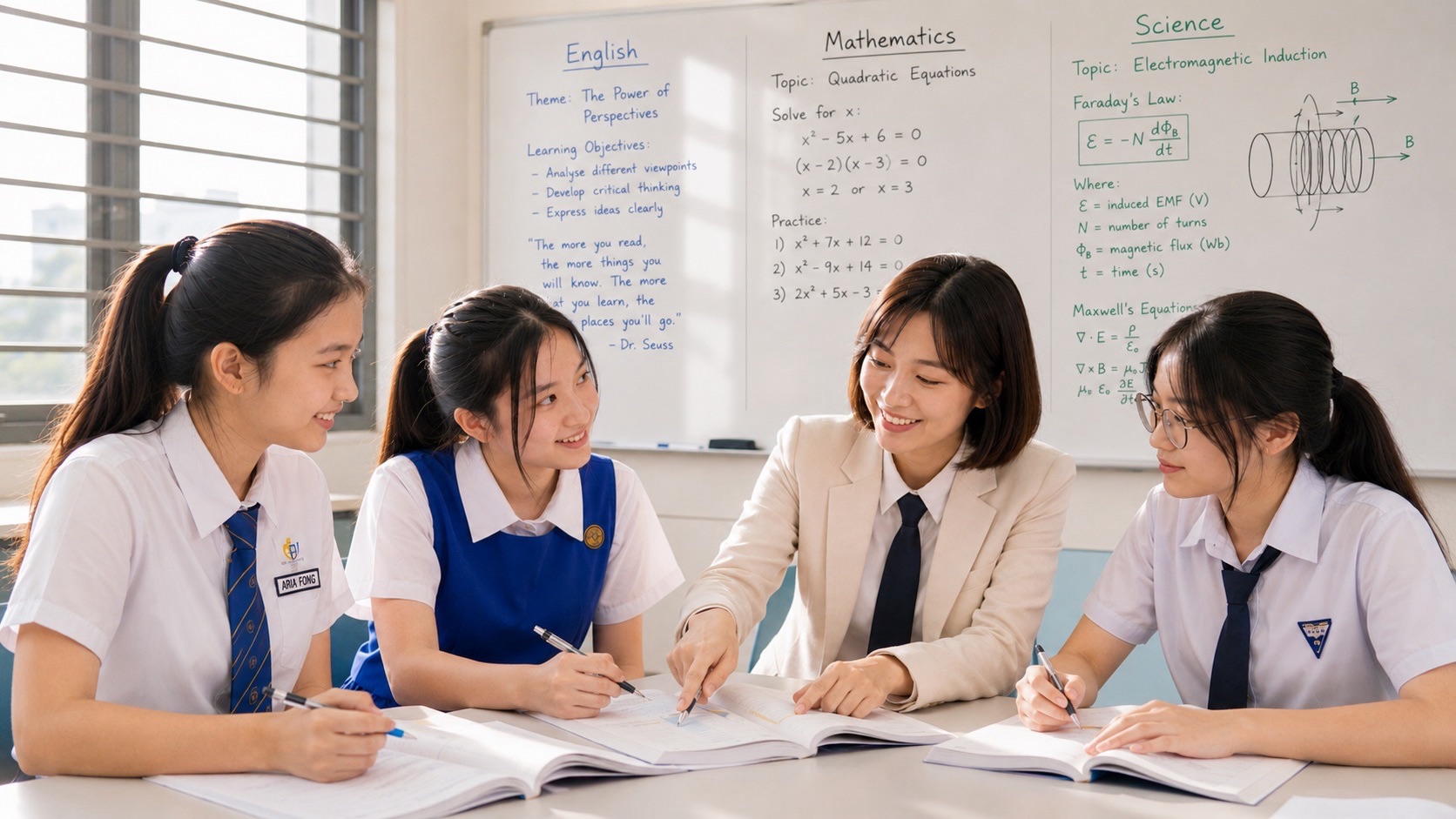
Secondary 3 is the year Mathematics becomes more connected, more demanding and far less forgiving of weak foundations. Our Punggol Secondary 3 E-Maths tuition provides calm, focused teaching in small groups of three students, helping each learner strengthen algebra, understand difficult topics, improve mathematical reasoning and prepare properly for Secondary 4.
At Secondary 3, students are not simply learning more Mathematics.
They are learning to manage a larger mathematical system.
Algebra begins to appear across graphs, coordinate geometry, trigonometry, mensuration, statistics and problem-solving. Questions become longer. Information may be presented through diagrams, tables, graphs or real-world situations. Students must decide which method to use before they can begin calculating.
This is why a student who managed reasonably well in Secondary 1 and Secondary 2 can suddenly find Secondary 3 E-Maths difficult.
The problem is not always intelligence.
Frequently, the student has reached a stage where earlier weaknesses can no longer remain hidden.
Our role as a Secondary 3 Mathematics tutor in Punggol is to identify those weaknesses early, repair them carefully and help the student move forward with greater accuracy, confidence and independence.
Secondary 3 Is the Year Mathematics Changes
Lower Secondary Mathematics usually feels more contained. A chapter is introduced, the student learns a method, and the class practises questions that are recognisably connected to that method.
Upper Secondary Mathematics is different.
A single question may require the student to:
- interpret a diagram;
- identify the relevant concept;
- form an equation;
- manipulate the algebra correctly;
- use a graph, formula or theorem;
- calculate accurately;
- present sufficient working; and
- interpret the final answer in context.
The difficulty is no longer found only inside individual topics.
It is found in the connections between them.
A student may understand trigonometry but lose marks because the equation was formed incorrectly. Another may know the quadratic formula but fail to recognise that the question requires a quadratic equation. A student may calculate correctly but lose marks because essential working was omitted.
Secondary 3 is therefore a foundation year for the eventual national examination. It is the year in which students must begin turning separate techniques into a dependable mathematical system.
What Does “E-Maths” Mean Under Full Subject-Based Banding?
Parents still commonly use the term E-Maths, or Elementary Mathematics, to distinguish the subject from Additional Mathematics.
Under Full Subject-Based Banding, however, students take subjects at the G1, G2 or G3 subject level. The old Express, Normal (Academic) and Normal (Technical) streams are being replaced by a more flexible structure in which students may take different subjects at different levels according to their strengths and learning needs. (Ministry of Education)
The first Secondary 1 cohort under Full Subject-Based Banding entered secondary school in 2024. These students are in Secondary 3 in 2026 and will be among the first to sit the Singapore-Cambridge Secondary Education Certificate examinations in 2027.
From 2027, the former N(T), N(A) and O-Level certificates will be combined into the Singapore-Cambridge Secondary Education Certificate, or SEC. Students will sit each subject at its respective G1, G2 or G3 level. SEAB has stated that the examination standards remain unchanged, with G3 continuing at the standard associated with the former O-Level examination. (SEAB)
This article focuses principally on Secondary 3 G3 Mathematics, which many parents and students will continue to recognise as E-Maths.
What Students Must Learn in Upper Secondary G3 Mathematics
The national G3 Mathematics syllabus is organised into three broad strands:
- Number and Algebra
- Geometry and Measurement
- Statistics and Probability
The syllabus also assesses reasoning, communication, application and the use of mathematical models. Mathematics is therefore not examined as a collection of isolated formulas. Students must understand concepts, choose suitable methods and connect ideas across topics. (Isomer User Content)
Schools may teach topics in different sequences, but important Upper Secondary areas include the following.
Algebraic Expressions and Formulae
Students work with expansion, factorisation, algebraic fractions, identities, formula manipulation and quadratic expressions.
This is one of the most important areas in Secondary 3 Mathematics because algebra appears throughout the rest of the syllabus.
When algebra is weak, the student may struggle with:
- quadratic equations;
- graphs;
- coordinate geometry;
- trigonometric equations;
- mensuration;
- vectors;
- statistics formulae; and
- multi-step problem-solving.
A student does not need merely to remember algebraic procedures. The procedures must become sufficiently fluent that they can be used accurately inside a more complicated question.
Functions and Graphs
Students encounter linear, quadratic, power and exponential functions. They need to understand gradients, intercepts, symmetry, maximum and minimum points, graph shapes and the relationship between equations and their visual representations.
Graphs are often difficult because students must move between several mathematical forms:
- an equation;
- a table of values;
- coordinates;
- a graph;
- a written description; and
- a real-world interpretation.
A student who has memorised how to draw a graph may still struggle when asked to interpret what the graph means.
Equations and Inequalities
Students solve linear, simultaneous, quadratic and fractional equations. They also formulate equations from word problems and represent inequalities correctly.
The important skill is not only solving an equation after it has been given.
Students must learn how to recognise the hidden equation inside a problem.
This requires reading, translation and method selection before any calculation begins.
Trigonometry
Upper Secondary trigonometry extends beyond basic right-angled triangles. Students may need to use:
- sine, cosine and tangent;
- the sine rule;
- the cosine rule;
- the area formula for a triangle;
- bearings;
- angles of elevation and depression; and
- two-dimensional or three-dimensional diagrams.
Many trigonometry mistakes begin before the calculator is used. Students may identify the wrong angle, match the wrong sides, select an unsuitable rule or misread the orientation of the diagram.
Circle Properties and Geometry
Circle theorems require both knowledge and reasoning.
Students must recognise the relevant property, apply it to the correct part of the diagram and communicate the reason clearly. Geometry questions may appear simple because there is little calculation, but they often expose whether a student can organise a logical mathematical argument.
Mensuration
Mensuration includes areas, volumes, surface areas, sectors, arcs, composite figures and composite solids.
These questions often test visual organisation.
Students must decide:
- what the figure is made of;
- which dimensions are relevant;
- whether a component should be added or subtracted;
- whether the answer requires area, volume or surface area;
- whether units must be converted; and
- what degree of accuracy is required.
Coordinate Geometry and Vectors
Coordinate geometry connects algebra with geometry. Students work with gradients, equations of straight lines, distances and geometric relationships on a coordinate plane.
Vectors require students to express movement and geometric relationships symbolically. Weak algebra or poor diagram reading can make vector questions unnecessarily difficult.
Statistics and Probability
Students study statistical representations, averages, cumulative frequency, box-and-whisker plots, standard deviation and probability involving combined events.
Statistics is not simply a calculator topic. Students must interpret data, compare distributions, evaluate representations and explain what the figures mean.
The published G3 syllabus includes this broad range of algebra, functions, equations, geometry, trigonometry, mensuration, coordinate geometry, vectors, data analysis and probability.
Why Practising More Questions Is Not Always the Answer
When results fall, the natural response is often to give the student more worksheets.
Sometimes this works.
Sometimes it only creates a larger pile of repeated mistakes.
Before assigning more practice, we need to understand why the marks are being lost.
A student may be struggling because:
- an earlier concept was never properly understood;
- algebraic manipulation is too slow or inaccurate;
- the student cannot recognise which method a question requires;
- information cannot be translated from words or diagrams into Mathematics;
- several topics cannot yet be connected;
- careless habits repeatedly damage otherwise correct solutions;
- working is incomplete or poorly organised;
- the calculator is used inaccurately;
- revision is too dependent on familiar chapter-based questions; or
- the student loses concentration during longer papers.
These are different problems.
They should not all receive the same solution.
A student with weak factorisation needs targeted algebra repair. A student who understands the concepts but cannot handle unfamiliar questions needs application and mixed-topic training. A student losing marks through presentation requires better working habits and checking routines.
Good tuition should make the problem clearer before attempting to solve it.
What the National Assessment Tells Us About Preparing Early
The published 2027 G3 Mathematics syllabus allocates approximately:
- 45% to the use and application of standard techniques;
- 40% to solving problems in different contexts; and
- 15% to mathematical reasoning and communication. (Isomer User Content)
This is an important signal for parents.
Knowing formulas and routine procedures remains essential, but it is not sufficient. More than half of the assessment emphasis involves problem-solving, interpretation, connection, reasoning or communication.
Students therefore need two forms of preparation.
First, they need dependable technical foundations.
Second, they must learn how to use those foundations when the question is unfamiliar, indirect or presented in a real-world context.
For the G3 national examination, the published assessment structure consists of two papers of 2 hours and 15 minutes each, with both papers carrying equal weighting. The final question in Paper 2 focuses specifically on applying Mathematics to a real-world scenario. Calculators may be used in both papers, but essential working must still be shown. (Isomer User Content)
This means examination preparation cannot be left entirely to Secondary 4.
The ability to sustain accurate working across a long paper must be developed gradually.
The Three Main Secondary 3 Mathematics Journeys
Not every student enters tuition for the same reason.
At Secondary 3, we commonly see three different journeys.
1. Repair After a Fall
The student may have been comfortable in Lower Secondary Mathematics but begins failing or scoring below expectations in Secondary 3.
This can happen because the pace has increased, the algebra is heavier or several topics are being tested together.
The first goal is not to rush ahead.
We identify the earliest weak point, repair the necessary foundation and help the student regain control of current schoolwork.
A student who has fallen does not need to feel permanently behind. However, the repair must be precise. Repeating everything from Secondary 1 is inefficient; ignoring the foundation is equally unhelpful.
2. Move From Average to Distinction
This student understands most lessons and can complete routine questions but remains around the middle of the class.
The lost marks often come from:
- unfamiliar questions;
- incomplete reasoning;
- inefficient methods;
- weak checking;
- mixed-topic questions; or
- inconsistent accuracy under time pressure.
The aim is to turn knowledge into performance.
This requires better question selection, cleaner working, stronger connections between topics and regular examination-style practice.
3. Move From Distinction to a Stronger Academic Pathway
A high-performing student may already be scoring well but wants greater consistency, stronger mathematical maturity or preparation for a demanding post-secondary route.
For this student, tuition should not simply produce more routine work.
The student needs:
- more challenging applications;
- deeper explanation;
- efficient methods;
- careful mathematical communication;
- strong paper management; and
- the ability to remain accurate when questions become unfamiliar.
The objective is not pressure for its own sake.
It is to ensure that strong results are supported by strong understanding.
What a Good Secondary 3 Mathematics Tutor Should Do
A good Sec 3 Mathematics tutor should be able to see beyond the final answer.
The tutor must examine how the student thinks.
Two students may produce the same wrong answer for completely different reasons. One may have selected the wrong formula. Another may have used the correct method but made an algebraic error. A third may understand the Mathematics but misread the question.
The correction should match the cause.
Rebuild the Necessary Foundation
When an earlier weakness is affecting current work, we repair that weakness directly.
This may include:
- expansion and factorisation;
- manipulation of fractions;
- solving equations;
- ratio and proportion;
- negative numbers;
- indices;
- graph interpretation; or
- geometric properties.
The purpose is not to send the student backwards.
It is to restore the missing support so the student can move forward.
Teach Method Selection
Many students know several methods but cannot decide which one to use.
We teach students to look for mathematical signals:
- What information has been given?
- What is the question asking for?
- Which topic or combination of topics is involved?
- Is an equation required?
- Is there a more efficient method?
- What form should the final answer take?
This decision-making process is central to Upper Secondary Mathematics.
Insist on Clear Working
Correct working is not only for the examiner.
It helps the student think.
Well-organised working makes it easier to:
- identify mistakes;
- check substitutions;
- track signs and units;
- return to an unfinished question;
- earn method marks; and
- reduce unnecessary mental load.
Students should not be trained to produce the shortest possible solution. They should be trained to produce the clearest efficient solution.
Use Mixed Practice
Chapter-based practice is useful when a topic is first introduced.
However, examinations do not always announce the topic.
Students eventually need mixed sets in which they must identify the appropriate method independently. Mixed practice develops recognition, connection and flexibility.
Correct Repeated Errors
A correction is not complete when the student merely copies the right answer.
The student should understand:
- where the solution went wrong;
- why the error occurred;
- what rule can prevent it; and
- whether the corrected method can be reproduced independently.
Repeated errors should be tracked until they stop repeating.
Punggol E-Maths Tuition in Small Groups of Three
Our Punggol Secondary 3 Mathematics tuition is conducted in small groups of up to three students.
This structure creates a useful balance.
Students receive the energy and interaction of a class, but the group remains small enough for the tutor to observe individual working closely.
In a large class, a quiet student can appear to understand simply by copying the board.
In a three-student class, it is much easier to see:
- whether the student can begin independently;
- where the solution starts to break down;
- whether the method is understood or memorised;
- which mistakes keep returning;
- how quickly corrections are absorbed; and
- whether the student is ready for more challenging work.
Each student may be working towards the same syllabus, but they do not necessarily need the same correction.
One may require foundation repair. Another may need greater speed. A third may need more demanding problem-solving.
The small-group format allows us to maintain a clear class direction while responding to those individual differences.
What Happens During a Secondary 3 E-Maths Lesson?
A productive Mathematics lesson should do more than complete a worksheet.
Depending on the student’s needs and the school’s current programme, a lesson may include several stages.
Review
We check recent schoolwork, tests, assignments or recurring errors.
This shows us whether an earlier correction has remained stable and whether new weaknesses have appeared.
Focused Teaching
A concept or method is explained clearly.
We do not assume that a student understands simply because the topic has already been taught in school. When necessary, the idea is rebuilt from a more fundamental starting point.
Guided Application
The tutor works through selected questions with the student, highlighting how to recognise the structure of each problem.
The aim is not to provide answers quickly. It is to make the decision process visible.
Independent Work
The student attempts questions without being led through every step.
This is essential. Understanding an explanation is not the same as being able to solve the question independently.
Correction and Consolidation
Mistakes are analysed and corrected. Important methods, warnings and checking rules are recorded so that the lesson produces a lasting improvement rather than a temporary answer.
Preparation for What Comes Next
Where appropriate, students are prepared slightly ahead of school.
This reduces the shock of a new topic and allows the school lesson to become a second exposure rather than the student’s first encounter with the material.
A Sensible Secondary 3 Mathematics Year
Mathematics improves more reliably when the year is planned rather than treated as a series of emergencies.
Term 1: Establish the Upper Secondary Foundation
The first priority is to understand the student’s starting point.
We look closely at algebra, equations, graphs and other prerequisite skills. Early school topics are taught properly so that the student does not begin Secondary 3 with unresolved confusion.
Term 2: Correct Weaknesses Before They Spread
By this stage, patterns become clearer.
We can see whether the student is struggling with knowledge, application, working habits, speed or consistency.
Corrections made during the first half of the year are valuable because there is still sufficient time for the new habits to settle.
June: Consolidate the First Half of the Year
The mid-year period is useful for bringing topics together.
Instead of merely completing more chapters, students should review weak areas, redo important mistakes and begin mixed-topic practice.
Term 3: Build Examination Fitness
As school assessments approach, attention shifts towards:
- mixed papers;
- time allocation;
- question selection;
- sustained concentration;
- checking;
- mathematical presentation; and
- recovery after a difficult question.
Students should learn how to complete a paper without allowing one unfamiliar question to damage the rest of their performance.
After the Secondary 3 Examinations: Prepare for Secondary 4
The end of Secondary 3 should not feel like the end of the journey.
It is an opportunity to correct the year’s remaining weaknesses and enter Secondary 4 with a stable foundation.
Secondary 4 moves quickly. Students who begin it with unresolved Secondary 3 gaps often spend the year trying to learn new topics while repairing old ones at the same time.
E-Maths and Additional Mathematics Must Be Managed Separately
Students taking Additional Mathematics may mistakenly assume that doing well in A-Maths will automatically produce a strong E-Maths result.
The two subjects support each other, but they are not interchangeable.
Strong E-Maths algebra helps students in Additional Mathematics. However, E-Maths also contains significant areas such as:
- statistics;
- probability;
- mensuration;
- vectors;
- circle properties;
- coordinate geometry;
- real-world applications; and
- data interpretation.
These areas need dedicated preparation.
Students should also avoid treating E-Maths as the easier subject and postponing revision until examinations are near. E-Maths questions can be lengthy, broad and highly sensitive to interpretation, working and accuracy.
A strong student respects both subjects.
When Should a Parent Consider Sec 3 Mathematics Tuition?
A student does not need to be failing before support becomes useful.
Parents may consider additional help when the student:
- understands lessons but cannot complete homework independently;
- repeatedly says, “I know this, but I do not know how to start”;
- performs well in chapter exercises but poorly in mixed tests;
- has become much slower in Secondary 3;
- makes frequent algebraic or sign errors;
- leaves large parts of examination papers unfinished;
- depends heavily on answer keys;
- cannot explain why a method works;
- is losing confidence despite spending more time studying;
- is taking both E-Maths and A-Maths and cannot manage the combined load;
- needs to move from an average grade towards a distinction; or
- wants stronger preparation before Secondary 4.
Early support is valuable because weaknesses in Mathematics tend to accumulate.
An algebra problem may later appear as a graph problem, a trigonometry problem or a coordinate geometry problem. Correcting the source is usually more effective than repeatedly correcting the symptoms.
How Parents Can Support Mathematics at Home
Parents do not need to reteach the syllabus.
A few simple habits can make a meaningful difference.
Ask About the Process, Not Only the Mark
Instead of asking only, “What did you score?”, try asking:
- Which questions were difficult?
- Where were the marks lost?
- Was the problem knowledge, time or carelessness?
- What will you do differently for the next test?
This helps the student treat a result as information rather than a final judgement.
Look for Repeated Mistakes
One careless mistake can happen to anyone.
The same mistake appearing repeatedly is no longer random. It is a habit that needs correction.
Encourage Complete Corrections
A correction should include a fresh solution completed without copying.
Reading the answer and understanding it momentarily does not guarantee that the student can reproduce the method later.
Protect Study Energy
Secondary students manage many subjects, assignments and activities.
A realistic study plan is more useful than an ambitious plan that cannot be sustained. Short, focused and regular Mathematics practice is often more effective than irregular last-minute sessions.
Avoid Comparing Students
The useful comparison is between the student’s previous and current performance.
Is the working clearer? Are fewer mistakes repeating? Can more questions be started independently? Is the student completing papers more calmly?
These are meaningful signs of progress.
Why Choose a Punggol Secondary 3 Mathematics Tutor?
For families living in Punggol and the surrounding North-East region, a nearby Mathematics class can reduce unnecessary travelling time and make weekly attendance easier to sustain.
This matters more than it may appear.
A secondary school student already has a full timetable. Long travel, late meals and rushed homework can consume the energy that should have been used for learning.
A suitable local tuition arrangement should fit naturally into the student’s week.
The objective is not to fill every free hour.
It is to create one dependable period in which Mathematics is taught clearly, mistakes are corrected properly and the student leaves knowing what to work on next.
Frequently Asked Questions
Is E-Maths Still Officially Called Elementary Mathematics?
Parents and students still commonly use the terms E-Maths and Elementary Mathematics. Under the current Full Subject-Based Banding and SEC structure, the official subject is Mathematics offered at the G1, G2 or G3 subject level.
This article principally refers to the G3 Mathematics route associated with the former O-Level Mathematics standard.
Is Your Punggol Mathematics Tuition Only for Students Who Are Failing?
No.
Students may join for foundation repair, stronger school performance, distinction preparation or greater consistency before Secondary 4.
The teaching should match the student’s present position and intended destination.
Can a Student Recover After Failing Secondary 3 Mathematics?
Yes, provided the source of the difficulty is identified and the student is willing to correct it consistently.
The first step is to determine whether the difficulty comes from weak foundations, current-topic understanding, application, working habits or examination management.
Recovery becomes more manageable when the problem is made specific.
Why Use a Three-Student Small Group?
A maximum of three students allows the tutor to observe each student’s working closely while preserving the interaction and momentum of a group lesson.
Students receive individual correction without being isolated from peers.
Do Students Receive Individual Attention in a Group?
Yes.
Students may share the same broad syllabus, but their errors, school pace and current readiness may differ. Questions and corrections can therefore be adjusted while the group continues working within a common lesson structure.
How Quickly Will Results Improve?
There is no responsible fixed answer.
A student with one clearly defined weakness may improve relatively quickly. A student with several years of accumulated gaps will require more time.
We look for progress in stages:
- clearer understanding;
- fewer repeated mistakes;
- better independent starts;
- more complete working;
- stronger accuracy;
- improved test performance; and
- greater consistency.
Is E-Maths Tuition Useful for Students Taking A-Maths?
Yes.
A-Maths students still need dedicated E-Maths preparation. Strong E-Maths algebra supports A-Maths, while E-Maths itself contains important geometry, mensuration, statistics, probability and application components that must be studied separately.
Should a Student Wait Until Secondary 4?
Waiting is possible, but it reduces the available correction time.
Secondary 4 is already a year of syllabus completion, revision, preliminary examinations and national examination preparation. Entering it with a stable Secondary 3 foundation makes the final year considerably more manageable.
Punggol E-Maths Tutorials for a Clearer Secondary 3 Journey
Secondary 3 Mathematics should not feel like a collection of disconnected formulas.
When taught properly, the subject becomes increasingly coherent.
Algebra supports graphs. Graphs connect with equations. Geometry connects with trigonometry. Data becomes interpretation. Working becomes communication. Individual chapters gradually form a complete examination subject.
Our Punggol Secondary 3 E-Maths tuition is designed to help students make those connections in a calm, structured environment.
In our three-student small groups, we look closely at how each learner works, identify the real cause of lost marks and build the skills needed for the next stage.
Some students need to recover after a fall.
Some are ready to move from average results towards a distinction.
Others are already doing well and want the consistency required for a more demanding academic pathway.
Each journey begins from a different point, but the direction is the same:
Understand clearly. Work accurately. Build steadily. Enter Secondary 4 with confidence.
Contact eduKate Singapore to discuss your child’s present Secondary 3 Mathematics position and whether our Punggol small-group E-Maths tuition is a suitable fit.