Punggol Secondary 2 Mathematics Tuition Centre | Sec 2 Maths Tutor in Punggol
Secondary 2 Mathematics is often the point at which a student’s mathematical foundation becomes visible.
In Secondary 1, a capable student may still manage through familiarity, memory and careful imitation. By Secondary 2, that approach becomes less reliable. Algebra grows more demanding. Questions require several connected steps. Graphs, equations, geometry, proportion and statistics begin to interact.
The student is no longer being asked only to perform a calculation.
The student must decide:
- What information matters?
- Which mathematical method should be used?
- How should the problem be represented?
- What sequence of steps will produce a complete solution?
- How can the final answer be checked?
This is why choosing the right Punggol Secondary 2 Mathematics tuition centre is not simply about finding more worksheets. It is about finding a tutor who can see how the student thinks, identify where understanding begins to weaken and rebuild the subject carefully before Secondary 3.
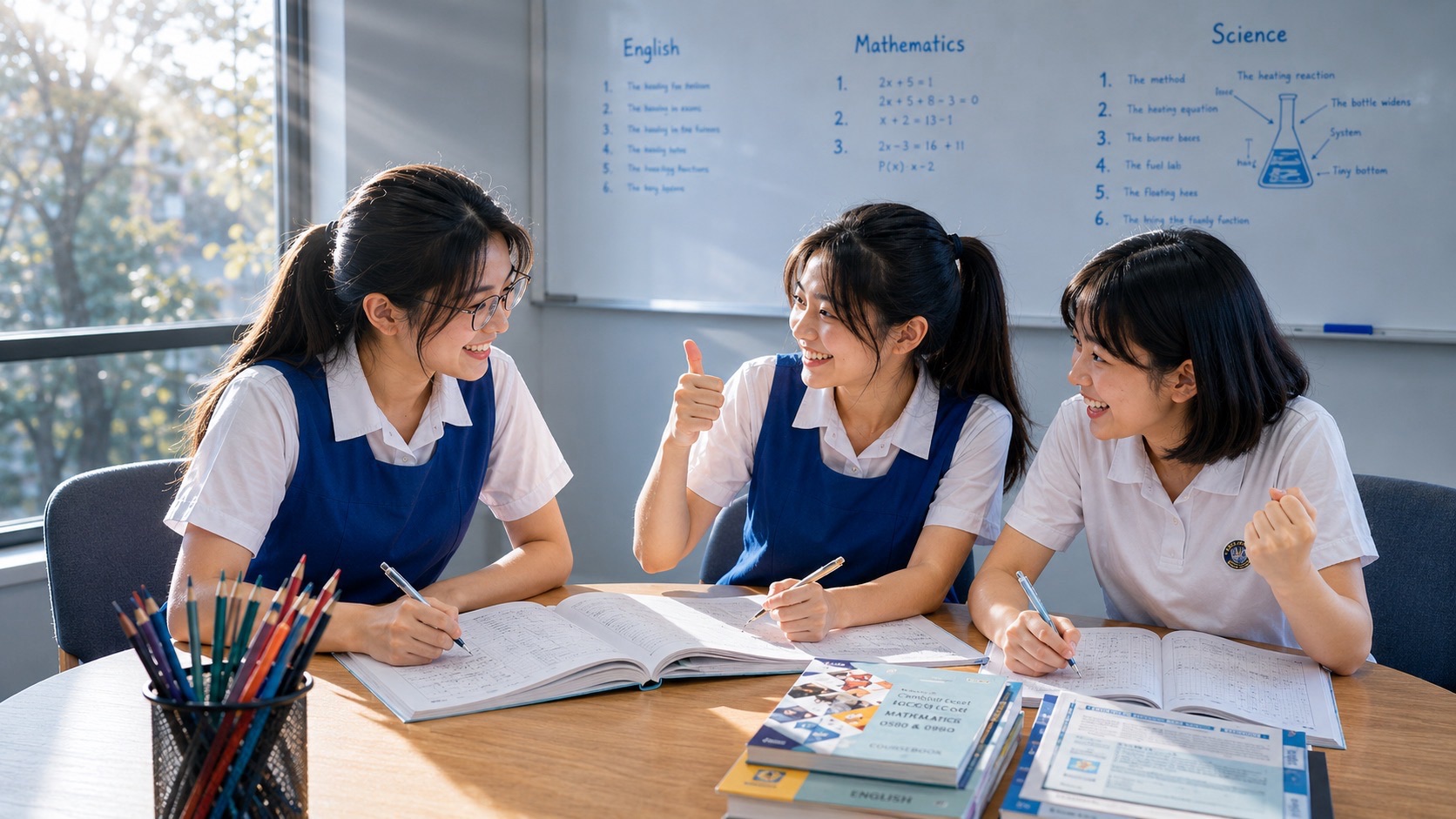
At eduKate Singapore, our Secondary 2 Maths tuition in Punggol is conducted in true small groups of up to three students. This gives each student room to think independently while allowing the tutor to observe, question, correct and guide closely.
The aim is calm, dependable progress: stronger foundations, clearer reasoning and the confidence to approach unfamiliar questions without becoming overwhelmed.
Why Secondary 2 Mathematics Matters
Secondary 2 is a corridor between lower-secondary learning and the more formal demands of upper-secondary Mathematics.
The year matters because several important developments are taking place at the same time.
Students are expected to become more independent. Their mathematical language must become more precise. Algebra begins to influence almost every part of the subject. Schools also start considering students’ upper-secondary subject combinations, including whether they are ready for more demanding Mathematics and Science pathways.
A student does not need to be perfect at the beginning of Secondary 2. However, weaknesses that remain hidden for too long become more expensive to repair later.
A small misunderstanding in algebra may affect:
- expansion and factorisation;
- algebraic fractions;
- simultaneous equations;
- quadratic equations;
- graphs;
- coordinate geometry;
- trigonometry;
- Additional Mathematics in Secondary 3.
This is why Secondary 2 should not be treated as a waiting year.
It is a preparation year.
A thoughtful Secondary 2 Maths tutor in Punggol should therefore do more than help the student complete the next school assignment. The tutor should also prepare the student for the mathematical demands that are approaching.
Secondary 2 Mathematics Under Full Subject-Based Banding
Singapore’s secondary-school system has changed.
Beginning with the 2024 Secondary 1 cohort, the former Express, Normal (Academic) and Normal (Technical) streams are being replaced by Full Subject-Based Banding. Students are posted through Posting Groups 1, 2 and 3 and may take individual subjects at G1, G2 or G3 level according to their strengths and readiness. (Ministry of Education)
For parents of a Secondary 2 student, the important point is simple:
The subject level matters, but the student’s actual foundation matters even more.
Two students may both be taking G3 Mathematics while having very different needs.
One may be fast and accurate but careless. Another may understand the concepts but become lost when a question contains several steps. A third may have memorised procedures without understanding when to use them.
Similarly, a student taking G2 Mathematics may be ready to improve steadily or work towards taking the subject at a more demanding level, depending on the school’s assessment and the student’s progress.
Our Punggol Secondary 2 Mathematics tuition begins by looking at the student, not merely the label attached to the class.
We examine:
- the student’s current school level;
- recent test and examination papers;
- algebraic fluency;
- calculation accuracy;
- quality of written working;
- ability to interpret questions;
- confidence with unfamiliar problems;
- study habits and correction habits.
This allows the tuition programme to be matched to the student’s actual learning position.
Preparing for the Singapore-Cambridge Secondary Education Certificate
From 2027, the GCE N(T), N(A) and O-Level examinations will be combined under the Singapore-Cambridge Secondary Education Certificate, commonly known as the SEC.
Students will sit for subjects at their respective G1, G2 or G3 levels and receive one certificate showing the subjects and levels taken. SEAB has stated that the overall examination standards will not be lowered by the change. (SEAB)
For a Secondary 2 student, the name of the final examination may appear distant. The habits required for it, however, are already being formed.
These include:
- reading mathematical questions accurately;
- selecting the right method;
- showing complete working;
- connecting concepts across chapters;
- managing time;
- detecting unreasonable answers;
- remaining composed when a question looks unfamiliar.
Strong upper-secondary performance is rarely created by last-minute revision alone. It is usually built from ordinary habits repeated carefully over several years.
Secondary 2 is an excellent time to establish those habits.
What Students Learn in Secondary 2 Mathematics
The precise sequence may differ from school to school, but the Secondary 2 Mathematics curriculum deepens work across number and algebra, geometry and measurement, statistics and probability.
For G3 Mathematics, the published curriculum includes direct and inverse proportion, algebraic expansion and factorisation, changing the subject of a formula, algebraic fractions, quadratic functions, inequalities, simultaneous equations and quadratic equations.
Students also encounter congruence and similarity, Pythagoras’ theorem, right-angled trigonometry, mensuration, statistical diagrams, averages and introductory probability.
These chapters may appear separate in a textbook, but they are not truly separate.
Algebra appears in geometry.
Ratio appears in similarity.
Graphs represent equations.
Trigonometry requires careful substitution and equation solving.
Statistics requires interpretation, not only calculation.
A good Punggol Secondary 2 Mathematics tutor helps the student see these connections. When the links become clear, Mathematics feels less like a collection of unrelated rules and more like one coherent language.
Why Algebra Becomes the Centre of Secondary 2 Mathematics
For many students, algebra is the defining challenge of Secondary 2.
The difficulty is not simply that there are more letters.
Algebra requires the student to think about quantities that may not yet be known. The student must follow rules precisely while keeping sight of the purpose of the calculation.
Consider the difference between these abilities:
- Expanding an expression when told to expand it.
- Recognising that expansion is needed inside a longer problem.
- Deciding whether expansion or factorisation is the more efficient approach.
- Using the result to solve an equation or interpret a graph.
- Checking whether the answer is mathematically and contextually sensible.
The first ability is procedural.
The later abilities require judgement.
Students often lose marks because they know a method but cannot identify when to use it. Others understand the question but make small errors with signs, brackets, fractions or transposition.
These are not random mistakes. They reveal specific weaknesses.
Our Sec 2 Maths tuition in Punggol pays close attention to:
- negative signs;
- bracket discipline;
- like and unlike terms;
- algebraic notation;
- common factors;
- quadratic factorisation;
- algebraic identities;
- denominator restrictions;
- substitution;
- rearrangement of formulae;
- equation-solving logic.
When these details are corrected early, the student’s later work becomes considerably more stable.
Common Reasons Secondary 2 Students Lose Marks
A student’s score does not always reveal the real problem.
Two students may both obtain 55 marks, yet need completely different forms of support.
The student understands but works too quickly
This student often says, “I knew how to do it.”
That may be true. However, knowing a method is not enough if signs are copied incorrectly, units are omitted or important steps are skipped.
The solution is not necessarily more difficult work. The student needs a reliable checking system and better control of written working.
The student memorises examples
This student performs well when a question resembles something recently practised. When the wording or layout changes, the student becomes uncertain.
The underlying issue is usually shallow understanding. The student has remembered the appearance of a solution without understanding its structure.
The remedy is to compare question types, explain why methods work and practise varied forms of the same concept.
The student has an earlier foundation gap
The current chapter may not be the true problem.
A student struggling with algebraic fractions may actually be weak in ordinary fractions, factorisation or lowest common multiples. A student struggling with trigonometry may have difficulty rearranging equations or using the calculator accurately.
Effective tuition finds the earliest weak link.
The student cannot begin unfamiliar questions
Some students are comfortable once a tutor shows the first step. The difficulty is deciding what to do before help is given.
This is a method-selection problem.
The student must learn to identify the chapter, recognise the mathematical relationship, organise the information and choose a sensible first move.
The student has lost confidence
Repeated difficulty changes behaviour.
The student may avoid homework, delay revision, leave questions blank or decide that Mathematics is simply not a personal strength.
Confidence should not be restored through empty praise. It should be rebuilt through visible competence: one concept understood, one question completed independently and one paper showing measurable improvement.
Mathematics Is More Than Remembering Formulae
The Ministry of Education places mathematical problem-solving at the centre of the curriculum, supported by concepts, skills, processes, metacognition and attitudes. Students are expected to reason, communicate, represent ideas, apply methods and model real situations—not merely recall procedures.
This explains why a student can complete a chapter worksheet successfully yet struggle in a school examination.
A worksheet may tell the student exactly what type of question is being attempted.
An examination does not always provide that comfort.
The student must identify the structure independently.
For this reason, our Punggol Secondary 2 Mathematics tuition develops four layers of competence.
1. Conceptual understanding
The student understands what the idea means.
For example, factorisation is not simply a collection of memorised patterns. It is the reverse of expansion and a way of rewriting an expression into an equivalent product.
2. Procedural fluency
The student can carry out the method accurately and efficiently.
Understanding without fluency creates slow, uncertain work. Fluency without understanding creates fragile work. Both are needed.
3. Method selection
The student recognises which mathematical tool is appropriate.
This is often the difference between ordinary practice and examination readiness.
4. Mathematical communication
The student presents a solution clearly enough for each step to be understood and awarded.
Neat working is not decoration. It protects marks, makes checking easier and reveals where an error has occurred.
How Our Punggol Secondary 2 Mathematics Tuition Works
Our approach is deliberate.
We do not begin by flooding the student with material. We first determine what is secure, what is uncertain and what has been misunderstood.
Step 1: Diagnose the present position
Recent school papers are useful because they show more than the final score.
We look for patterns:
- Are errors concentrated in algebra?
- Does the student understand questions but calculate inaccurately?
- Are marks lost because working is incomplete?
- Does the student struggle mainly with application questions?
- Are earlier Secondary 1 foundations still weak?
- Is the student spending too long on individual questions?
- Does performance fall sharply under examination conditions?
This produces a more accurate starting point.
Step 2: Repair the earliest important weakness
Mathematics is cumulative.
If a student cannot manipulate linear expressions confidently, introducing more difficult quadratic work will create additional confusion.
We therefore repair the prerequisite before demanding speed.
This may mean returning briefly to:
- fractions;
- negative numbers;
- ratio;
- basic algebra;
- linear equations;
- substitution;
- graph reading;
- calculator use.
Returning to an earlier skill is not moving backwards. It is securing the structure so that progress can continue.
Step 3: Teach the new concept clearly
A new chapter should begin with meaning.
The student needs to understand:
- what the concept represents;
- why the method works;
- how it connects to earlier learning;
- what common forms the question may take;
- what errors must be avoided.
Only then does practice become truly useful.
Step 4: Move from guided to independent work
At first, the tutor may model the reasoning and ask focused questions.
Next, the student completes part of the solution.
Finally, the student attempts the full question independently and explains the method used.
The goal is not for the student to follow the tutor forever. The goal is for the tutor’s thinking process to become part of the student’s own working habits.
Step 5: Correct errors properly
An error should not be erased and forgotten.
The student should understand:
- where the solution changed direction;
- why the step was incorrect;
- what should have been noticed;
- how to prevent the same mistake;
- whether the error appears elsewhere.
Proper correction turns a mistake into useful information.
Step 6: Build examination readiness
Closer to school assessments, students need mixed-topic work.
This trains them to move between algebra, graphs, geometry, proportion and statistics without being told which method to use.
We also work on:
- question selection;
- pacing;
- mark allocation;
- complete working;
- checking routines;
- calculator discipline;
- recovery after a difficult question.
True Three-Student Small-Group Mathematics Tuition
Class size changes what a tutor can see.
In a large class, it is possible for a student to copy notes, complete routine questions and remain quietly confused. The lesson may continue because the group appears to be keeping pace.
In a true three-student small group, the tutor has far more visibility.
We can observe how each student:
- reads the question;
- chooses a method;
- organises the page;
- handles algebra;
- responds to correction;
- explains an answer;
- manages uncertainty.
The student also receives more opportunities to ask questions without feeling that the entire class is waiting.
At the same time, a three-student group preserves a useful learning rhythm. Students see alternative approaches, learn from well-chosen questions and develop independence rather than depending on constant one-to-one prompting.
This balance is one of the reasons parents choose our small-group Secondary 2 Mathematics tuition in Punggol.
It is personal without becoming isolating, and structured without becoming impersonal.
Three Types of Secondary 2 Students We Commonly Support
The student who has started falling behind
This student may have been comfortable in Primary School or Secondary 1 but now appears increasingly uncertain.
Homework takes longer. Test scores fluctuate. Algebra is becoming difficult to follow.
The first priority is stability.
We identify the missing foundations, reduce confusion and establish a consistent weekly routine. Once the student can see a clear path through the subject, progress usually becomes less emotionally exhausting.
The student who remains around the middle
This student often understands lessons but cannot convert that understanding into stronger examination results.
The problem may be incomplete working, weak method selection, insufficient practice or a lack of correction discipline.
The aim is to turn partial competence into dependable performance.
This requires more than doing harder questions. The student must learn to recognise patterns, control errors and complete solutions under time pressure.
The student already aiming for distinctions
A high-performing student also needs careful teaching.
The goal is not endless acceleration.
It is greater precision, deeper understanding and better adaptability.
Strong students benefit from:
- non-routine questions;
- comparisons between methods;
- more efficient solution paths;
- rigorous algebra;
- explanation and justification;
- mixed-topic application;
- preparation for Secondary 3 Additional Mathematics where appropriate.
A distinction-level student should not merely be fast. The student should be mathematically composed.
Preparing for Secondary 3 Mathematics and Additional Mathematics
Secondary 3 changes the pace.
Students taking G3 Mathematics continue into a broader and more interconnected upper-secondary syllabus. Those offered Additional Mathematics encounter a second mathematical subject with a stronger emphasis on algebraic structure, functions, equations, trigonometry and, later, calculus.
A student entering Secondary 3 with weak algebra will often feel that several new problems are arriving at once.
In reality, many of those problems share the same root.
That is why our Secondary 2 programme places particular importance on:
- expansion and factorisation;
- algebraic fractions;
- formula manipulation;
- simultaneous equations;
- quadratic equations;
- graph interpretation;
- proportional reasoning;
- trigonometric accuracy;
- clear mathematical notation.
A strong Secondary 2 year does not guarantee that Secondary 3 will be effortless.
It makes Secondary 3 teachable.
The student has enough foundation to understand new ideas instead of using all available energy to repair old ones.
A Sensible Secondary 2 Mathematics Study Rhythm
Good progress does not require panic.
It requires enough time for understanding, practice, correction and consolidation.
During the first part of the year
The priority is to establish algebraic discipline and identify any unfinished Secondary 1 work.
Students should not wait for the first poor examination result before correcting foundational weaknesses.
During the middle of the year
New topics should be practised alongside earlier ones.
This prevents the common pattern where a student performs well immediately after learning a chapter but forgets it several weeks later.
During the second half of the year
Practice should become increasingly mixed.
Students need to identify question types without chapter labels and connect methods across topics.
Before the end-of-year examination
The focus shifts towards timed work, school-style papers, error analysis and efficient revision.
At this stage, the student should not merely collect more papers. Each paper should reveal what must be improved before the next one is attempted.
What Parents Can Look For at Home
Parents do not need to reteach the Mathematics syllabus.
A few simple observations can provide useful information.
Notice whether your child:
- begins homework promptly or repeatedly avoids it;
- can explain what was taught in class;
- shows complete working;
- corrects mistakes after receiving a paper;
- repeatedly makes the same type of error;
- becomes stuck only on difficult questions or even routine ones;
- studies Mathematics regularly or only before a test;
- says “I understand” but cannot complete a question independently.
The most important conversation is not always, “What mark did you get?”
A more useful question may be:
“Where did the paper become difficult for you?”
That opens the door to diagnosis rather than blame.
When Should a Student Start Secondary 2 Maths Tuition?
A student should begin when the need becomes clear enough to act on.
This may be at the beginning of Secondary 2, after the first common test, during the June holidays or when the student begins preparing for the end-of-year examination.
Earlier support offers more room to teach carefully. Later support can still help, but the programme may need to prioritise the most important weaknesses.
Parents should consider tuition when:
- Secondary 1 foundations remain uncertain;
- algebra is becoming a repeated source of difficulty;
- school results are falling despite effort;
- homework requires excessive help;
- the student cannot explain completed work;
- examination performance is significantly below classroom performance;
- the student is preparing for a demanding Secondary 3 subject combination;
- a capable student is aiming to move from average results towards distinctions.
The best time is before discouragement becomes the student’s normal relationship with Mathematics.
How to Choose a Secondary 2 Maths Tutor in Punggol
A suitable tutor should be able to do more than solve the question.
The tutor should be able to see why the student could not solve it.
Parents may wish to consider whether the tutor:
- understands the current Singapore secondary Mathematics curriculum;
- can teach both foundations and higher-level application;
- checks the student’s actual written working;
- explains concepts rather than providing answer patterns;
- adapts the lesson to the student’s present level;
- revisits prerequisite knowledge when necessary;
- teaches examination technique without replacing understanding;
- provides a clear plan for progress;
- maintains a class size small enough for meaningful correction.
A polished worksheet is useful.
A perceptive tutor is more important.
Frequently Asked Questions About Punggol Secondary 2 Mathematics Tuition
Is Secondary 2 Mathematics much harder than Secondary 1?
The increase may feel gradual at first, but the nature of the work changes. Algebra becomes more advanced, questions involve more connected steps and students must choose methods more independently. A weak Secondary 1 foundation therefore becomes more visible during Secondary 2.
Does your tuition cover G2 and G3 Mathematics?
Our teaching is based on the student’s current subject level, school requirements and individual readiness. The examples in this article focus largely on G3 Mathematics, but the same diagnostic and foundational approach can be applied to students taking G2 Mathematics.
Is this the same as Secondary 2 E-Maths tuition?
Many parents continue to use the term “E-Maths” when referring to mainstream Mathematics leading towards the former O-Level pathway. Under Full Subject-Based Banding and the SEC framework, subjects are described by G1, G2 and G3 levels. For most parents searching for Secondary 2 E-Maths tuition, the corresponding current subject is G3 Mathematics.
Can tuition help a student who is weak in algebra?
Yes, provided the algebra is taught from the correct starting point. We first determine whether the difficulty comes from signs, fractions, basic manipulation, factorisation, formulae or equation-solving. Repairing the exact weakness is more effective than simply assigning more algebra questions.
Can an average student work towards a distinction?
Many average students are not limited by ability. They may have incomplete foundations, inconsistent practice, poor correction habits or weak examination control. With enough time and disciplined training, substantial improvement is possible. The programme must be matched to the reason the student is currently losing marks.
Do students need to bring their school materials?
School worksheets, test papers and examination papers are useful because they show the school’s pace and the student’s actual mistakes. These can be used alongside our lesson materials and practice programme.
How much practice should a Secondary 2 student complete?
The quality and consistency of practice matter more than a large quantity completed carelessly. Students should practise often enough to retain methods, revisit earlier topics and correct recurring errors. The amount should also be realistic alongside schoolwork and other subjects.
Will the tutor help with school homework?
Schoolwork can be reviewed when it reveals an important learning issue. However, the purpose of tuition is not merely to finish homework. The deeper goal is to teach the student to complete similar work independently.
Is a three-student group suitable for a shy student?
A small group is often helpful for a quieter student because there is less pressure than in a large classroom and more opportunity for the tutor to notice uncertainty. The student can gradually become more comfortable asking questions and explaining methods.
Is Secondary 2 too early to prepare for Additional Mathematics?
Students do not need to study the full Additional Mathematics syllabus prematurely. However, Secondary 2 is the right time to strengthen the algebra, graphs, equations and trigonometry that will support Additional Mathematics later.
Punggol Secondary 2 Mathematics Tuition That Builds Forward
Parents often begin looking for tuition because of a visible problem: a disappointing score, difficult homework or a child who has started saying, “I cannot do Maths.”
The visible problem deserves attention.
The deeper task is to understand what sits beneath it.
Sometimes the student needs repair.
Sometimes the student needs better discipline.
Sometimes the student needs a clearer explanation.
Sometimes the student is ready to move from competence towards distinction.
Good Mathematics tuition does not treat every child as the same project. It finds the student’s present position and creates the next sensible step.
At eduKate Singapore, our Punggol Secondary 2 Mathematics tuition is conducted in true small groups of up to three students. We teach concepts carefully, strengthen algebraic foundations, correct working closely and prepare students for the transition into upper-secondary Mathematics.
The atmosphere is focused but calm.
The standards are high, but the student is not rushed past understanding.
The intention is simple: help each child become more accurate, more independent and more confident in the mathematical work ahead.
Book a Consultation for Secondary 2 Maths Tuition in Punggol
Speak with us about your child’s current Mathematics results, learning difficulties and Secondary 3 preparation.
Programme: Punggol Secondary 2 Mathematics Tuition
Class format: True small-group lessons with up to three students
Focus: G2 and G3 Mathematics foundations, algebra, problem-solving, examination skills and Secondary 3 preparation