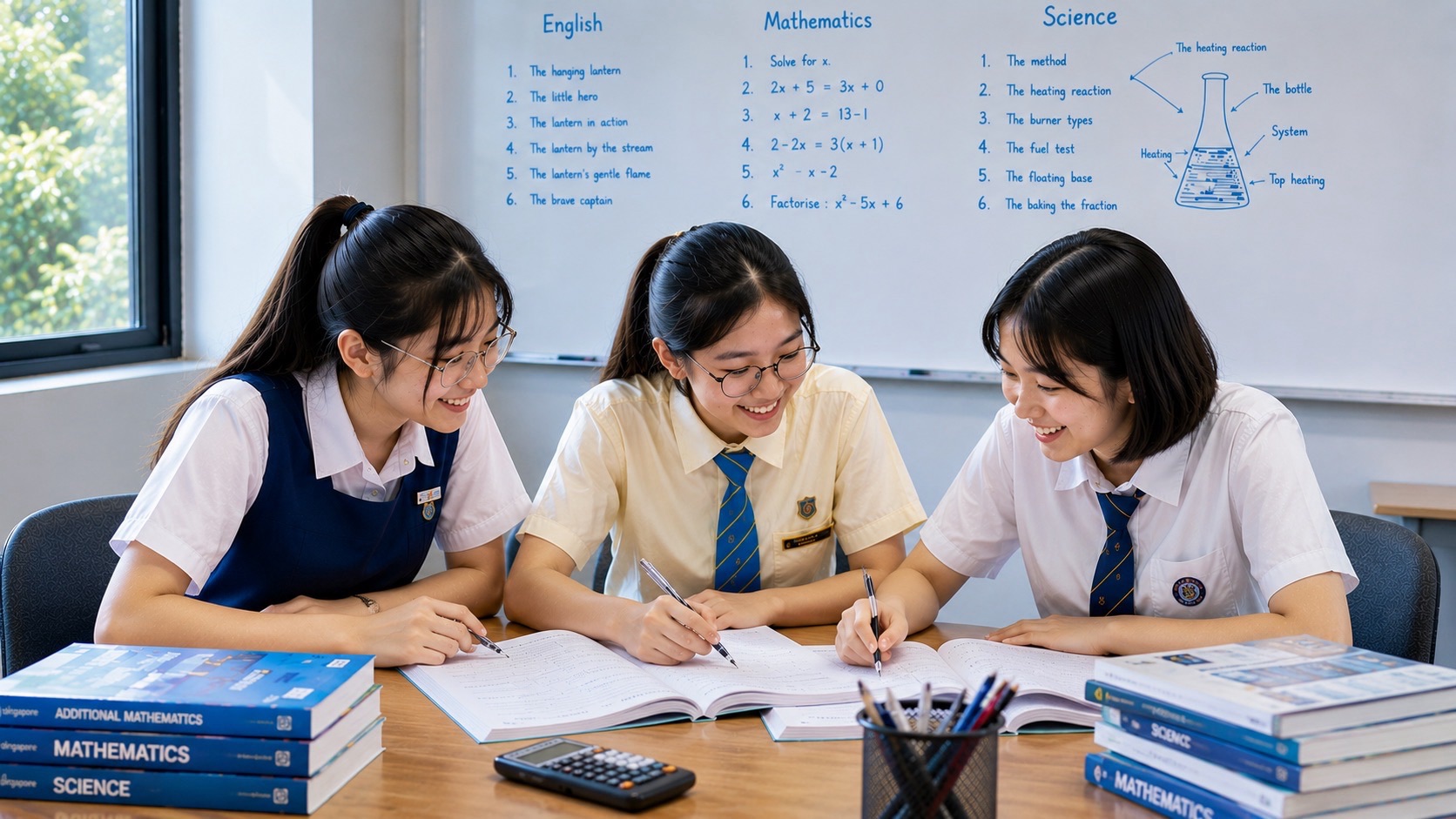
Peer discussion can improve English reasoning when students compare interpretations, evidence and language choices. It becomes unhelpful when one student supplies the answer and the others simply adopt it.
This page is for Yishun families considering small-group English tuition. Its distinct reader job is to explain when peer discussion improves reasoning—and when it becomes copying.
The preserved 2019 page was a generic Yishun tuition-centre page. Historic teacher, phone, school and “latest syllabus” claims are not carried forward. eduKate Singapore is an independent tuition provider and is not affiliated with MOE, SEAB or any school.
Peer Discussion Is Useful When Reasoning Is Visible
- “Which clue supports your answer?”
- “Why is this word better than the other one?”
- “What does this paragraph mainly do?”
- “Where does your interpretation become too strong?”
These questions require students to expose the path to the answer, not only the answer itself.
Peer Copying Often Looks Productive
All students may end with correct work, but only one learner may have generated the reasoning.
| Productive peer learning | Copying signal |
|---|---|
| Students explain different routes | One student always speaks first and others repeat |
| Answers are challenged with evidence | Group adopts the most confident answer |
| Students revise after discussion | Students copy wording verbatim |
| Independent retest follows | No individual check after group answer |
Use Think → Share → Rebuild
- Think: each student forms an answer independently.
- Share: compare reasoning.
- Rebuild: each student writes or states a final answer personally.
The independent first attempt prevents the strongest student from setting the group’s thinking before others engage.
Require Evidence Before Agreement
Students should not agree merely because another learner sounds certain.
- What passage clue supports that?
- What grammar relationship proves it?
- What alternative answer did you consider?
- What makes this composition choice more effective?
Disagreement Is Useful When It Is Bounded
Two interpretations can sometimes both be plausible. Students should compare which has stronger support. The tutor keeps disagreement attached to the text rather than turning it into personality or status.
Peer Discussion in Comprehension
Give two plausible answers and ask students to identify which has better evidence. Or ask each learner to localise the evidence before revealing the answer.
Peer Discussion in Vocabulary
Students can compare near synonyms by meaning, collocation, intensity and register. The value lies in defending the boundary between words.
Peer Discussion in Writing
Students can compare plot routes, paragraph functions, sentence versions or endings. The aim is not to choose one “best” story and reproduce it. Each learner should leave with an individual plan.
Use Delayed Independent Retest
The strongest test of peer learning is whether the student can perform later without the group.
- new passage;
- new vocabulary sentence;
- new writing prompt;
- reduced tutor help;
- delayed timing.
If the skill disappears when peers are absent, the discussion may have produced answer access rather than learning.
Rotate Who Speaks First
One practical safeguard is to rotate speaking order. Sometimes the quietest student should explain first. Sometimes written responses are collected before discussion.
This prevents permanent expert-and-follower roles.
The Tutor Must Verify Peer Explanations
Peers can explain incorrectly with confidence. The tutor remains responsible for checking the reasoning and clarifying limits. Peer discussion is a learning structure, not delegated teaching authority.
How a 3-Pax Format Uses Peer Reasoning
A maximum three-student group is small enough for every learner to contribute and for the tutor to track whose reasoning produced the final answer.
- individual first attempt;
- short comparison;
- evidence challenge;
- individual rebuilt answer;
- later fresh retest.
Current MOE English Context
The MOE Primary English Language Syllabus 2020 develops students’ ability to communicate, construct meaning and apply language strategies across contexts. Peer discussion supports this when each student remains an active thinker and communicator.
Signs Peer Discussion Is Working
- Every learner forms an initial view.
- Evidence is used to support claims.
- Students can disagree productively.
- Final answers are individually rebuilt.
- Delayed independent performance improves.
- Copying and repeated wording decrease.
Peer Reasoning: Almost-Code Summary
THINK:
    individual_answer()

SHARE:
    compare_reasoning()
    demand_evidence()

REBUILD:
    individual_final_answer()

VERIFY:
    tutor_checks_reasoning()

RETEST:
    fresh_independent_task()

OUTPUT:
    peer_reasoning_not_copying
    stronger_explanation
    better_independence