Secondary 3 English Tuition Singapore: Complexity, Argument and the Year Before Final Performance
Quick Read
- Secondary 3 is where English becomes a system for handling complexity rather than a collection of isolated language exercises.
- The central task is to synthesise: hold multiple ideas, perspectives and pieces of evidence at once, then build a controlled response.
- Students must move from having opinions to constructing arguments that survive questioning.
- Comprehension becomes more demanding because inference, tone, purpose, evidence and language effect often interact inside the same passage.
- Secondary 3 should build the full system before Secondary 4 compresses it under examination time.
One-sentence answer: Secondary 3 English is the year students learn to organise complexity into a defensible, precise and increasingly independent response.
Secondary 3 is not simply “harder Secondary 2”
The difference is not only the difficulty of individual questions. The number of moving parts increases. A student may need to understand a text, recognise the writer’s purpose, infer a position, select evidence, distinguish a counterpoint and express a judgement—all inside one task.
In writing, students may have to sustain an argument across several paragraphs rather than produce one developed point. In oral work, they need to extend an answer, respond to an alternative and remain coherent while thinking in real time. The English system is now being asked to operate under greater conceptual load.
This is why Secondary 3 is such an important construction year. There is still time to diagnose and rebuild, but the following year will demand greater speed, reliability and examination control.

The governing idea is complexity
Complexity means that several reasonable things can be true at once. Technology can increase access and create new dependency. Competition can motivate some students and damage others. Social media can connect people and distort attention. A character can make a harmful choice for understandable reasons.
Secondary 2 taught the student to separate perspectives. Secondary 3 asks the student to work with several of them without becoming confused. The job is to compare, weigh and organise—not merely to list both sides.
This is where language and thinking become tightly coupled. If the thinking is vague, the writing becomes vague. If the language cannot represent distinctions, the reasoning loses precision.
Argument is not opinion plus confidence
A strong argument contains a claim, but the claim is only the beginning. The student needs a reason, evidence or example, an explanation of why that evidence matters, and enough awareness of alternatives to show that the position has been tested rather than merely asserted.
We therefore teach students to ask several questions of every paragraph: What exactly am I claiming? What would count as support? Does my example really prove the point? What assumption am I making? What would someone on the other side say? Does acknowledging that weaken my argument, or make it more accurate?
A Secondary 3 paragraph should do intellectual work
At lower levels, a paragraph can sometimes survive because it contains a correct topic sentence and an example. By Secondary 3, stronger writing requires movement. The paragraph should change the reader’s understanding by the time it ends.
- Claim: make a bounded point.
- Reasoning: show why the claim makes sense.
- Evidence or example: give the reader something concrete to test.
- Analysis: connect the evidence back to the claim.
- Qualification: define the limits or conditions where necessary.
- Link: return the paragraph to the larger argument.
The sequence is not a rigid template to be copied mechanically. It is a checklist for whether the paragraph has completed its reasoning.
Evidence must survive pressure
Students often select evidence that feels related without checking whether it actually supports the claim. Secondary 3 is where we can apply more pressure. If this example disappeared, would the argument weaken? Is the evidence representative or exceptional? Does it show correlation, cause, possibility or merely coincidence?
This kind of questioning improves both comprehension and writing. The student learns that evidence has a shape and a limit. Good judgement respects both.
Counterarguments are not decorative “other sides”
A weak counterargument section often says, “However, some people may disagree,” then returns immediately to the original position. That does little intellectual work. A useful counterargument identifies the strongest reasonable challenge to the student’s position, treats it fairly and explains why the final judgement still holds—or why the original position should be modified.
This teaches a valuable habit: the purpose of argument is not to protect the first thought from attack. It is to improve the thought until it can withstand better questions.
Comprehension becomes multi-layer reconstruction
Secondary 3 passages may require students to track several layers simultaneously. What happened? What does the writer think about what happened? How is that attitude conveyed? What evidence supports the interpretation? Why was a particular phrase chosen? How does one paragraph change the meaning of another?
The student must therefore learn to move between local evidence and global meaning. A word matters because of the sentence around it; a sentence matters because of the paragraph; a paragraph matters because of the text’s larger purpose.
Summary and synthesis require compression without distortion
One of the most difficult language skills is making something shorter without damaging its meaning. Students need to decide what is essential, combine overlapping information and remove examples or decoration while preserving the core relationship between ideas.
This is not only an examination skill. It is a form of thinking. Compression reveals whether the student understands the structure well enough to know what can be removed and what must remain.
Vocabulary becomes a precision instrument
Secondary 3 students need vocabulary that allows them to distinguish causes, consequences, degrees of certainty, ethical positions, emotions and relationships. Sophisticated language is valuable when it increases precision. It is harmful when used only to sound impressive.
The test is simple: does the word make the meaning more exact? If a simpler word is more accurate, the simpler word is better. Mature writing is controlled, not decorated.
Oral communication becomes live argument
Secondary 3 oral practice should involve more than rehearsing polished answers. Students need to respond to follow-up questions, change direction when new information appears and defend a position without becoming rigid.
In a three-student group, this becomes especially useful. One student makes a claim, another challenges it, and the third may introduce a different example. The tutor can pause the exchange and inspect the reasoning: Which part is evidence? Which part is assumption? What answer changed after the challenge?
The student needs a system, not a collection of tricks
By Secondary 3, shortcuts begin expiring rapidly. Memorised introductions, fixed phrases and rigid essay templates can still help as temporary scaffolds, but they cannot carry every unfamiliar question. The examination increasingly rewards students who can recognise the situation and adapt.
We therefore want a student who can route the problem: Is this mainly a comprehension issue, an evidence issue, a structure issue, a vocabulary issue, a time issue or a judgement issue? The more accurately the student can identify the problem, the less dependent the student becomes on generic advice.
Diagnose the failure layer
| Observed result | Possible failure | Repair direction |
|---|---|---|
| Essay contains many points but feels shallow | Development and analysis | Reduce number of points; deepen claim → evidence → analysis |
| Argument is forceful but unconvincing | Evidence quality or overclaiming | Test assumptions and calibrate certainty |
| Comprehension answers are intelligent but unsupported | Evidence discipline | Require textual anchors before inference |
| Good untimed work collapses in tests | Load and performance | Timed retrieval, planning limits and progressive examination practice |
| Student repeats memorised structures regardless of prompt | Transfer failure | Use unfamiliar questions and force method selection |
Secondary 3 is where examination preparation should become structural
Examination practice matters, but a paper should be used as a diagnostic environment rather than a score-producing machine. After a paper, we want to know which failures are recurring, which disappear after correction and which only appear under time.
The aim is to enter Secondary 4 with the major system already installed. Secondary 4 should increasingly be about reliability, speed, selection and judgement under examination conditions—not discovering basic weaknesses for the first time.
A practical Secondary 3 learning loop
- Inspect: read the student’s actual work rather than guessing from the mark.
- Locate: identify whether the break is understanding, retrieval, structure, evidence, transfer or performance.
- Model: make the hidden method visible with a worked example or live explanation.
- Guide: let the student perform the method with support.
- Remove support: repeat with less prompting and a changed context.
- Load-test: add time, unfamiliarity and examination pressure only after the capability is stable.
What parents should look for in Secondary 3
Look for evidence of intellectual control. Can the student explain why an argument is strong or weak? Can they improve a paragraph without being told the exact sentence to write? Can they identify the evidence supporting a comprehension inference? Can they acknowledge an opposing view and still reach a clear judgement?
Also watch workload. Secondary 3 students carry more subjects and more complex work. A language method that only functions when unlimited time is available is not yet ready for Secondary 4. Reliability matters alongside depth.
Why three students works at this level
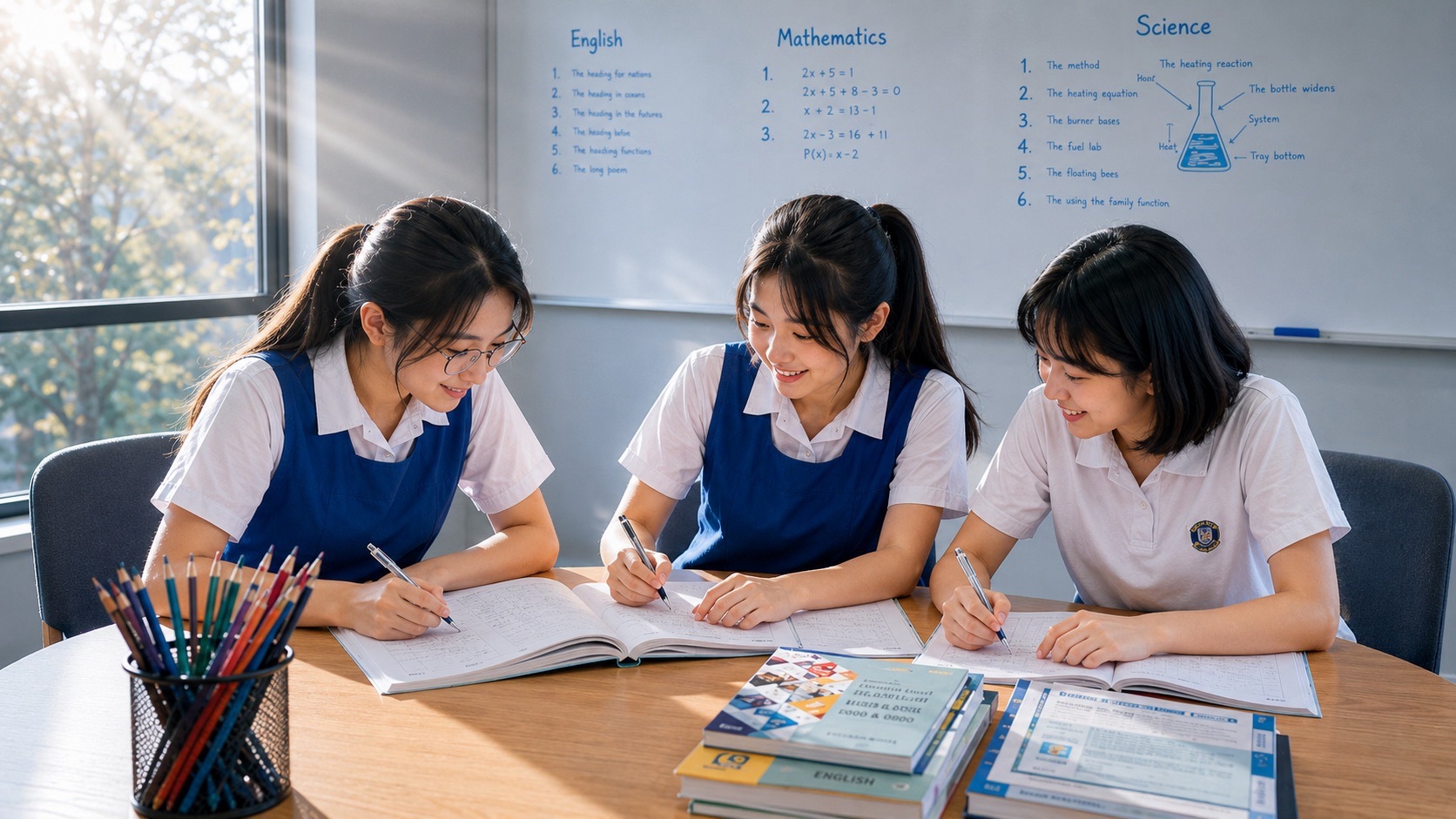
Secondary 3 English benefits from intellectual friction. Students need other answers to compare against their own, but the group must remain small enough for the tutor to inspect each person’s reasoning and writing closely.
Three students can generate multiple perspectives without turning the lesson into a lecture hall. The tutor can ask one student to defend a claim, another to challenge the evidence and the third to propose a stronger qualification. This turns discussion into deliberate practice for argument and judgement.
Secondary 3 should end with a student ready to compress
Secondary 4 will add urgency. The student must make decisions faster and perform reliably under a fixed paper. Therefore, the best Secondary 3 preparation is not to imitate final-year panic early. It is to build enough depth that later compression is possible.
You cannot safely make a complex process faster if the process is not yet correct. Build first. Then automate. Then load-test.
Frequently Asked Questions
Why is Secondary 3 such an important year for English?
It is the last full construction year before final-year examination pressure becomes dominant. There is time to diagnose deep weaknesses and build argument, comprehension and independent judgement properly.
Should Secondary 3 focus mainly on practice papers?
No. Papers are useful, but they should reveal which capability needs work. A student who repeatedly makes the same structural mistake does not need ten more full papers before the mistake is repaired.
How do students improve argumentative writing?
By improving the chain between claim, reasoning, evidence, analysis and qualification—and by testing the argument against genuine counterpositions.
What separates a strong Sec 3 student from a merely fluent writer?
Judgement. Fluency helps language move, but strong students also select relevant ideas, respect evidence boundaries, adapt to audience and revise conclusions when the reasoning demands it.
What should be ready before Secondary 4?
The student should have a reliable method for reading, evidence selection, paragraph development, argument, editing and oral response. Secondary 4 can then focus on performance, timing and refinement rather than emergency rebuilding.
Secondary 3 English Tuition Strategies PDF
Students and parents can also use our existing Secondary 3 English Tuition Strategies PDF as a supplementary reference.
The larger idea: complexity is not solved by making the world simple
As students grow older, English cannot protect them from ambiguity by pretending that every issue has one clean side. Mature language does something more useful: it gives them the ability to hold complexity without losing structure.
A Secondary 3 student should be able to encounter several perspectives, identify what each one sees, examine the evidence, detect the assumptions and still make a decision. That decision may be qualified rather than absolute, but it should be clearer because it has survived comparison.
This is the work immediately before final performance. Secondary 1 developed the independent sender. Secondary 2 divided perspective from evidence and interpretation. Secondary 3 recombines those parts into judgement capable of handling a more complicated world.
Learn more about eduKate Singapore Secondary English small-group tuition.