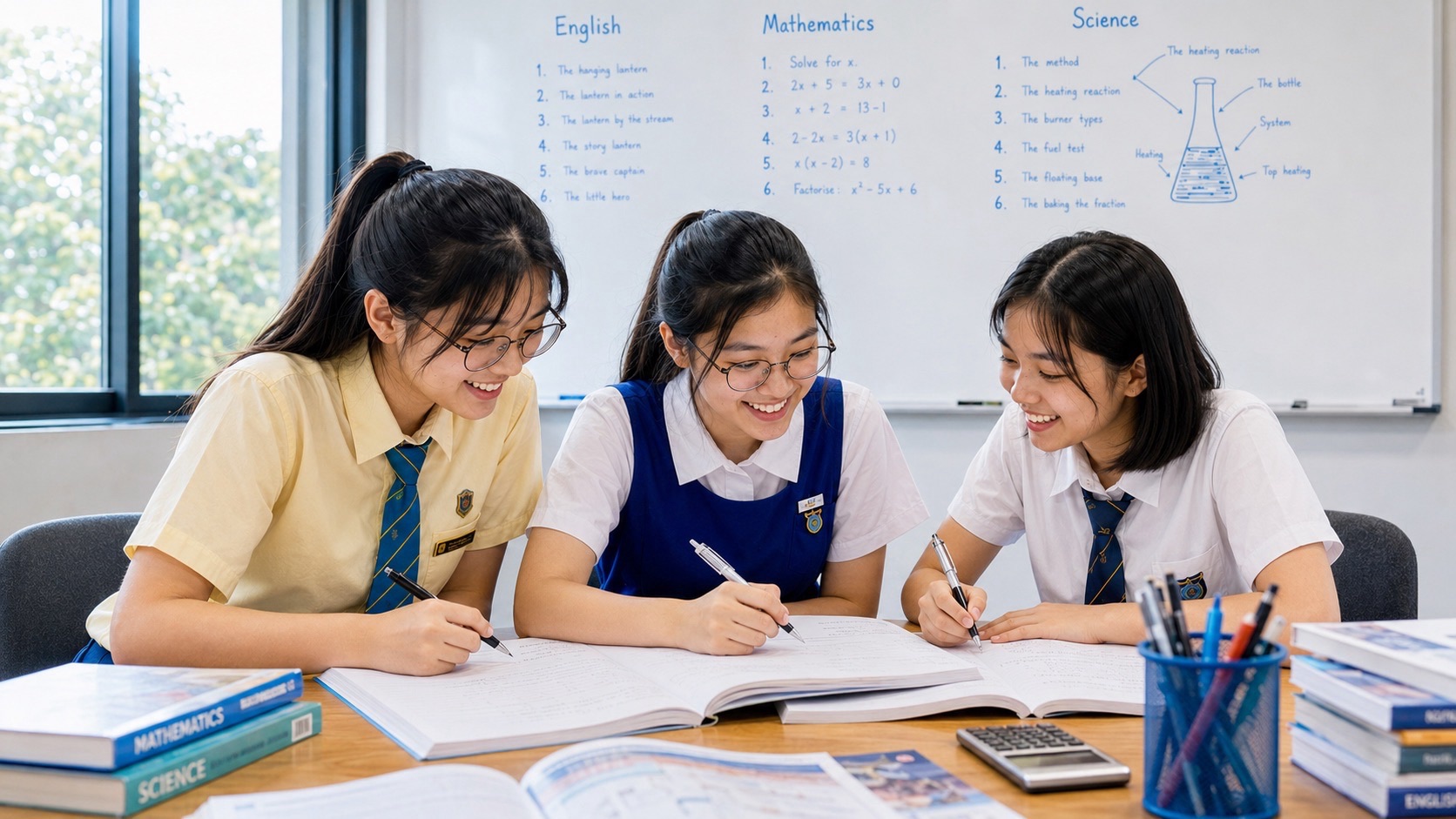

Secondary tuition: deliberate practice, deeper understanding and growing independence
Secondary students need to carry more abstraction, more mixed-topic reasoning and more responsibility for their own revision while learning to perform reliably under examination conditions.
We use deliberate practice to strengthen a specific capability, not simply to accumulate question volume. The sequence is: understand the relationship, practise it cleanly, vary the surface, mix it with neighbouring topics, retrieve it later and finally apply it under realistic paper conditions.
Current examination boundary: the GCE O-Level remains part of the 2026 system for students offering G3 subjects. From the 2027 graduating cohort, the Singapore-Cambridge Secondary Education Certificate (SEC) replaces the existing N-/O-Level structure, with subjects examined at G1, G2 or G3 as appropriate. We therefore teach to the student’s actual current syllabus and subject level rather than relying on an outdated label.

English as a language for understanding, argument and independent thought
Secondary English
Secondary English develops beyond sentence accuracy. Students need to read for purpose, infer meaning, compare viewpoints, select evidence, organise arguments and communicate a defensible position clearly.
- comprehension, inference and evidence
- vocabulary for precision rather than display
- argument structure and paragraph control
- writing, editing and language accuracy
- oral and communication confidence where relevant
- current-affairs and general-knowledge context when it genuinely strengthens understanding
For students sitting 2026 examinations, we prepare against the current GCE requirements for their subject level. For the 2027 graduating cohort onward, the examination framework changes to the SEC; the teaching objective remains durable English capability that transfers across formats.

Mathematics: concept, representation, method, verification and examination use
Secondary Mathematics
E-Mathematics and A-Mathematics become difficult when symbolic work outruns understanding. We therefore connect the mathematical relationship to its representation, choose a justified method, practise it deliberately and verify the result rather than teaching a sequence of shortcuts detached from meaning.
- 1.5-hour small-group sessions, typically 3 students
- algebraic fluency and equation structure
- functions, graphs, geometry and trigonometric reasoning
- multi-step problem solving and representation
- mixed-topic transfer
- checking, pacing and examination execution
- past-paper use after enough content and method stability are in place
We help students work towards strong results, including distinction-level performance where appropriate, but we do not treat any grade as guaranteed. In 2026, current GCE O-Level requirements remain relevant to G3 candidates; from the 2027 graduating cohort, SEC subject levels G1, G2 and G3 become the national framework.
“Highly recommended. Small group of only 3 students. I scored an A1 for my E Maths GCE O levels after attending 2-3 years of their tutorials. Lessons are organized to help me understand as I am average in Math but they helped me to tackle the syllabi’s requirements.
Highly detailed and careful tutors. Only problem is they are result oriented so I have to make sure I don’t miss their lessons and the next lesson is a level up.”

Build strong Secondary performance for the syllabus and subject level you actually sit.
Current GCE requirements remain relevant in 2026; the SEC framework begins with the 2027 graduating cohort. Our teaching follows the learner’s actual examination route.
QUICK READ · SECONDARY TUITION DEVELOPMENT
Secondary tuition should help the student carry more abstraction, more responsibility and more examination load without losing understanding.
The transition from Primary to Secondary school is not just “harder work”. Subjects become more abstract, questions become less explicit, revision becomes more self-managed and examination performance depends increasingly on selecting the right method under pressure.
That means a Secondary student can know a topic yet still struggle because the real weak point is elsewhere: algebraic fluency, reading precision, working-memory load, transfer, revision structure, time control or confidence after a difficult question. Effective tuition should identify the earliest useful weak edge and strengthen it without turning the learner into a permanent passenger.
One-sentence answer: Secondary tuition should deepen subject understanding, improve deliberate practice and examination craft, and progressively transfer study responsibility to the student.
The first transition: Primary methods become Secondary systems
Primary school gives students many of the building blocks needed later, but Secondary school compresses those ideas into more powerful representations. Arithmetic becomes algebraic structure. Ratio develops into gradient, proportion and functions. Reading comprehension expands into argument, inference and synthesis. Scientific facts increasingly sit inside larger causal systems.
| Primary capability | Secondary extension | Typical weak signal |
|---|---|---|
| Arithmetic relationships | Algebra and equations | The student remembers symbolic rules but cannot explain the preserved relationship. |
| Ratio and rate | Gradient, proportion and functions | The learner compares additively when the problem is multiplicative. |
| Reading for meaning | Inference, argument and synthesis | The student quotes text without explaining its relevance. |
| Scientific observation | Systems and causal explanation | Keywords are memorised but not connected to mechanism. |
When a Secondary topic repeatedly fails, the repair may therefore need to reconnect the new representation to an older relationship rather than simply assign more of the current chapter.
Lower Secondary: stabilise abstraction and study habits
Secondary 1 and 2 often expose students who previously succeeded through familiarity, memory or strong adult support. The subject load grows and the student must begin organising revision across more teachers, more chapters and more abstract notation.
- Mathematics: stabilise algebra, proportional reasoning, graphs, geometry and accurate multi-step work.
- English: move from answering isolated questions towards analysing meaning, organising ideas and communicating a defensible view.
- Study: develop a repeatable revision cycle rather than relying on last-minute rescue.
- Independence: learn to recognise confusion, ask a specific question and use corrections constructively.
At this stage, the tutor may still provide substantial structure, but the student should increasingly know what is being practised and why.
Upper Secondary: subject mastery must survive mixed examination conditions
By Secondary 3 and 4, the student is no longer dealing only with isolated topics. E-Math and A-Math require earlier algebra, functions, geometry and trigonometry to cooperate. English demands sustained comprehension, argument and writing control. Examination performance adds time, mark allocation, question selection and recovery to the subject itself.
- Recognise what a question is testing before beginning the method.
- Choose an efficient representation or technique.
- Carry longer chains of work without losing signs, units, logic or structure.
- Verify answers through substitution, estimation, graph behaviour, textual evidence or another independent route.
- Move on after a difficult question and return strategically rather than allowing one item to consume the paper.
This is examination craft: not a substitute for subject knowledge, but the ability to make subject knowledge available under examination conditions.
Deliberate practice: repeat the capability, not merely the surface
Practice becomes more effective when the student knows what feature is being strengthened. Ten questions that all look identical can build local fluency while leaving transfer weak. We therefore want practice to evolve.
- Clean practice. Isolate the new concept or method.
- Variation. Change coefficients, wording, diagrams or context.
- Reversal. Solve backwards where the subject allows it—factorise after expanding, verify after solving, reconstruct an argument from evidence.
- Mixing. Place the idea among neighbouring topics so the student must select it.
- Delay. Return later and see whether the capability can still be retrieved.
- Pressure. Add realistic timing only when accuracy and method selection are sufficiently stable.
That progression turns practice from repetition into preparation for independence.
Secondary Mathematics: concept → representation → method → verification
In Mathematics, later difficulties often arise because symbolic work becomes detached from meaning. A student may know how to manipulate an equation but not recognise what the transformation preserves, or may differentiate correctly without understanding what the derivative says about the graph.
- Concept: what mathematical relationship is present?
- Representation: equation, graph, diagram, table, vector or verbal description?
- Method: which operation or theorem is justified?
- Verification: can the result be checked by another route?
This is particularly important for A-Math, where earlier algebraic weakness can consume so much attention that a student appears weak in a later topic even when the newer concept is understood.
Secondary English: from language accuracy to thinking with language
Secondary English asks students to do more than avoid grammar mistakes. They need to infer, compare viewpoints, evaluate claims, organise arguments and communicate a position clearly. Vocabulary is valuable because it increases precision, not because difficult words are impressive.
- Read for the writer’s purpose as well as literal meaning.
- Separate claim, evidence and inference.
- Build paragraphs around a clear controlling idea.
- Use examples because they support the argument, not because they were memorised.
- Edit for meaning, structure and grammar rather than proofreading only for spelling.
The long-term goal is a student who can use English to think, learn and communicate independently across subjects.
Diagnosis before remediation
A low mark should generate questions, not a permanent label. Two students can both score 50% for different reasons. One may lack core concepts. Another may know the content but lose marks through execution. Another may be unable to transfer familiar methods into mixed questions.
| Observed problem | Possible earlier cause | Useful next check |
|---|---|---|
| Algebra breaks in long questions | Symbolic load or weak factorisation | Compare isolated algebra with the same algebra inside a mixed problem. |
| Comprehension answers are vague | Inference or evidence selection | Ask the student to identify the exact line supporting the claim and explain the link. |
| Good homework, weak tests | Retrieval, pacing or examination execution | Compare untimed mixed work with timed sections. |
The purpose is to choose a better next teaching action, not to create a more sophisticated-sounding diagnosis.
How support should transfer from tutor to student
| Stage | Tutor contribution | Student responsibility |
|---|---|---|
| Early repair | Explain, model, prompt and organise. | Understand and attempt. |
| Practice | Observe, question and correct. | Execute and explain. |
| Transfer | Change surface and reduce cues. | Recognise and select. |
| Revision | Help prioritise evidence from performance. | Plan and retrieve. |
| Examination readiness | Calibrate pacing and strategy. | Run the paper independently. |
A student who becomes stronger should gradually require less external control over familiar work. That transfer is a feature of successful tuition, not a threat to it.
What parents can look for
- The student can state what is weak more precisely than “I don’t understand.”
- Corrections are used in later work rather than forgotten after the worksheet.
- Revision begins earlier and is organised by evidence of weakness.
- Mixed-question performance catches up with chapter practice.
- The learner can verify answers or claims independently.
- Time pressure causes fewer avoidable collapses.
- The student asks for help on a specific step instead of outsourcing the whole task.
Grades remain important, but these behaviours are often the mechanisms that make stronger grades more stable.
A responsible results boundary
Tuition can improve teaching access, feedback, practice quality and examination preparation, but no tutor can responsibly guarantee a particular grade for every student. Starting point, attendance, practice, school demands, wellbeing and examination conditions all matter. We can control the quality of the educational process and keep adapting it when performance evidence shows that a different repair is needed.
Frequently asked questions
Why can Secondary 1 feel difficult even for a strong PSLE student?
The workload is broader and more abstract, and students must manage more of their own revision. A strong Primary foundation helps, but the new representations and routines still need to be learned.
Should a weak Secondary student redo whole previous-year syllabuses?
Not by default. Identify the specific earlier dependencies limiting current work, repair those and reconnect them to the present syllabus as quickly as possible.
When should examination papers become a major part of practice?
When the student has enough syllabus coverage and method stability for the paper to train integration, pacing and examination judgement rather than merely expose missing content.
How do we know learning has transferred?
The student can recognise the capability inside an unfamiliar question, select it without being told, execute it with less help and retrieve it again later.
The long arc: Secondary tuition should prepare the student to become their own study manager.
At the beginning of Secondary school, the tutor may still organise much of the learning environment. By the end, the student should increasingly be able to diagnose a weak area, plan practice, retrieve knowledge, select methods, check work and respond to an examination without waiting for constant instruction.
That is the deeper transition behind good Secondary tuition: not only stronger performance in the next test, but a learner who is becoming capable of carrying more of the educational system personally.