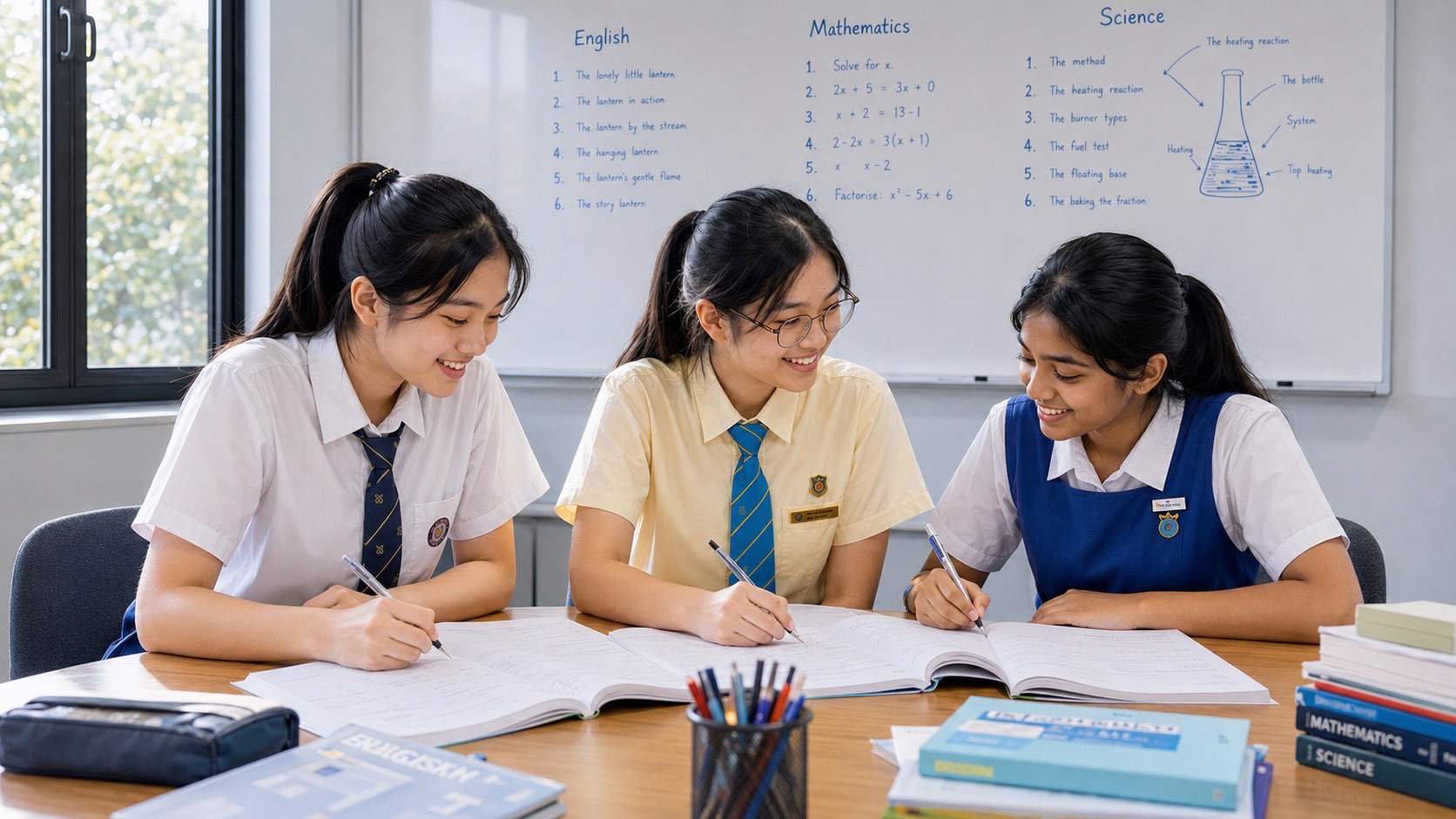

We teach for understanding first, then build practice, transfer and examination readiness.
How eduKate lessons change as the learner grows
The lesson should match the developmental job: foundations first, then coordination, transfer, examination readiness and increasing independence.
Lower Primary, Upper Primary and Secondary students should not be taught as though they are simply doing larger versions of the same worksheet. The balance of explanation, practice, challenge and independence needs to change as the learner’s knowledge and responsibilities grow.
- Lower Primary: secure language, number, attention, confidence and basic learning routines.
- Upper Primary: coordinate more ideas, manage multi-step work and prepare for PSLE without reducing the subject to exam technique alone.
- Secondary: handle abstraction, mixed-topic transfer, more independent revision and the examination demands appropriate to the student’s subject level.
Across all stages, marked work matters because it tells us what to teach next. We look for the earliest meaningful weak point, repair it, and then check whether the learner can use the improvement independently.

Lower Primary
Lower Primary is where we build the habits that make later learning easier: reading carefully, understanding instructions, representing quantities, explaining simple reasoning, checking work and asking useful questions. English and Mathematics begin here; Science enters from Primary 3.
The priority is not workload for its own sake. We increase challenge only when the child is ready to carry more of the task independently.

Upper Primary
Upper Primary adds heavier coordination: denser reading, multi-step Mathematics, more precise Science explanations and the real demands of PSLE preparation. Examination technique matters, but it should sit on top of secure subject understanding rather than replace it.
We use schoolwork, corrections and paper practice to locate what still limits performance, then target that weak point before returning to mixed and timed work.

Secondary
Secondary learning asks students to manage more abstraction, longer chains of reasoning, mixed-topic transfer and increasingly independent revision. We strengthen subject understanding first, then use deliberate practice and examination work to build reliable performance under realistic conditions.
For current examination requirements, the exact paper and subject level matter. Our teaching follows the student’s present syllabus and adjusts as national examination structures evolve.
“Tuition with quite high tech teaching. The place is fully loaded with technology from the future.
Recommended by a friend who had good results for her daughter, I finally got a slot after waiting for 5 months.
Both son and daughter are with them for Secondary Mathematics and English.
Prices are high but I am a firm believer as my son went from E8 to A1 after two years with them.
Hardworking, understanding and connect well with their students. Well recommended.“

Build stronger learning skills with eduKate.
QUICK READ · HOW AN EDUKATE TUTORIAL WORKS
A tutorial should move a student from being shown what to do towards being able to do it independently.
Our lesson structure is built around a simple progression: locate the learner’s starting point, teach the idea clearly, practise with guidance, reduce support, verify understanding, reconnect the skill to schoolwork and examinations, then repeat the cycle at a higher level.
This matters because students do not arrive with identical needs. One learner may be missing a concept. Another may understand the concept but make repeated procedural errors. A third may work accurately in a calm exercise yet struggle when several topics are mixed together. Good tuition should therefore do more than deliver content. It should identify what is limiting performance and change the lesson accordingly.
One-sentence answer: eduKate tutorials are designed to turn explanation into usable, increasingly independent school performance.
1. Locate the learner’s current starting point
The first job is not to assume that the current chapter is the true problem. A student who struggles with Secondary algebra may actually be carrying a weakness in arithmetic structure, fractions or equality. A Primary learner who avoids word problems may understand the operations but struggle to represent the situation. We therefore pay attention to working, explanations, repeated errors and the conditions under which a student succeeds or fails.
- Concept: does the learner understand the mathematical or language idea?
- Method: can the learner execute the process reliably?
- Representation: can the learner move between words, diagrams, symbols, tables or models?
- Load: does performance collapse when several steps must be coordinated?
- Transfer: can the learner recognise the same idea when the question looks different?
- Examination use: can the learner retrieve and apply the skill under realistic paper conditions?
The purpose of this diagnosis is practical: identify the earliest useful repair rather than reteach everything.
2. Teach the relationship, not only the answer
Once the weak edge is clear, teaching should make the underlying relationship visible. In Mathematics, that may mean showing why an operation preserves equality, why a ratio scales multiplicatively or how a graph represents a function. In English, it may mean showing how vocabulary, grammar, inference and paragraph structure cooperate to communicate meaning. In Science, it may mean connecting a keyword to the system, process or evidence that gives the word meaning.
We use worked examples, questioning, diagrams, comparison and explanation where they reduce confusion. The goal is not for the student to admire a tutor’s solution. The goal is for the student to reconstruct the reasoning personally.
3. Guided practice turns explanation into action
Understanding a demonstration is not yet mastery. Students need to attempt the work themselves while the tutor can still intervene early enough to prevent a mistaken method from becoming habitual.
- Begin with a clean example that isolates the target idea.
- Ask the student to explain the decision before carrying it out.
- Increase complexity gradually.
- Change numbers, wording, diagrams or context so the student cannot rely on one surface pattern.
- Correct the earliest wrong step rather than only the final answer.
This is the point where small-group teaching is especially useful. The tutor can observe individual working while students still benefit from hearing alternative questions and explanations from their classmates.
4. Support should reduce as capability grows
A scaffold is useful only if the learner eventually needs less of it. Prompting, worked examples, model answers, formula reminders and tutor questions should gradually fade when the student can carry the same reasoning independently.
| Stage | Tutor role | Student role |
|---|---|---|
| Explain | Make the idea and method clear. | Attend, question and connect. |
| Guide | Prompt and correct early errors. | Attempt with support. |
| Fade | Reduce prompts and examples. | Reconstruct the method. |
| Verify | Change the question surface. | Recognise and apply independently. |
| Transfer | Mix topics and conditions. | Select the method without being told. |
5. Correction is part of learning, not an afterthought
A wrong answer is useful when it reveals where reasoning stopped being reliable. Correction should therefore identify the cause, repair the relationship and give the learner another opportunity to use the idea correctly.
- Was the question misunderstood?
- Was the correct concept selected?
- Was a known method executed inaccurately?
- Was a representation misread?
- Did the learner lose track under a longer chain of work?
- Could the student recognise the error independently after being asked to check?
The long-term aim is a student who begins to detect and repair personal errors before the tutor needs to intervene.
6. Mixed practice tests whether the skill is portable
Chapter worksheets make the required method obvious. School tests and national examinations do not always do that. Once a topic is stable, students need mixed work where the first challenge is deciding what kind of problem they are looking at.
That transition—from “I can do this when the topic is announced” to “I can recognise when this idea is useful”—is a major part of independent learning.
7. Examination preparation comes after learning, not instead of it
Past-year papers are valuable because they expose students to authentic combinations of content, time pressure, mark allocation and question design. But papers work best after the learner has enough subject knowledge and method control to learn from them.
- First: understand the syllabus content.
- Then: practise deliberately until the method becomes reliable.
- Then: mix topics and remove obvious cues.
- Then: use examination papers to build pacing, selection, checking and recovery.
Paper practice should reveal what still needs repair. It should not become a substitute for repairing it.
How the lesson emphasis changes with age
| Stage | Main developmental job | Typical tutorial emphasis |
|---|---|---|
| Lower Primary | Build secure foundations and positive learning routines. | Meaning, language, number, simple representation, confidence and accuracy. |
| Upper Primary | Coordinate multiple ideas and prepare for PSLE demands. | Multi-step reasoning, stronger recall, subject vocabulary, paper interpretation and checking. |
| Lower Secondary | Adapt to increased abstraction and independent study. | Algebraic/symbolic thinking, deeper reading, structured revision and topic connections. |
| Upper Secondary | Integrate subject knowledge with examination craft. | Transfer, mixed questions, speed, accuracy, sustained writing/reasoning and paper strategy. |
What parents should expect to see improving
- The child needs fewer reminders to begin a familiar task.
- Explanations become clearer and more precise.
- Repeated mistakes reduce rather than simply change form.
- The learner can handle changed-looking questions.
- Homework and revision become more organised.
- The student can explain what went wrong and how to repair it.
- Examination performance becomes more stable as pressure increases.
Marks matter, but they are most useful when they are read together with the capabilities producing them.
A boundary worth keeping clear
No responsible tuition programme can promise a particular grade for every learner. School starting point, attendance, practice, health, motivation, examination conditions and many other factors affect outcomes. Our job is to improve the quality of teaching, diagnosis, practice and preparation available to the student, then keep adjusting when the evidence shows something is not working.
Frequently asked questions
Why teach ahead?
Teaching ahead can reduce pressure when the same topic appears in school, but only when the student understands rather than merely previews procedures. The purpose is to create familiarity and processing time, not to race through the syllabus.
Why use small groups?
Small groups allow the tutor to inspect individual work closely while students still benefit from peer questions, explanation and a shared learning rhythm.
When should past-year papers begin?
When enough of the underlying syllabus is stable that the paper can teach examination use rather than simply expose missing content.
How do we know a topic is really learned?
The student can use it with less help, on a changed-looking question, after some delay and inside mixed work where the method is not announced.
The long arc: the tutor should become less necessary as the learner becomes more capable.
Early in a difficult topic, the tutor may carry much of the structure: selecting the example, naming the method, asking the next question and checking the result. Over time, those responsibilities should move to the student.
That transfer is the deeper purpose of a tutorial. The lesson is successful not only when the student can work with us, but when the student can later recognise, retrieve, apply, check and improve the Mathematics, English or Science independently.