Quick answer: Primary 6 Science tuition should convert years of Primary Science learning into reliable PSLE performance. The student must retrieve concepts without chapter cues, discriminate among plausible MCQ options, read diagrams and data carefully, explain mechanisms in structured answers, manage 1 hour 45 minutes across a 100-mark paper, and recover after difficult questions without losing the rest of the examination.
This page is the eduKate Primary 6 Science → PSLE conversion and conditioning owner. It complements the Primary 5 Science pages, which focus more on foundation and integration. Here the operating question is different: how do we take a learner who has covered the syllabus and make the whole Science system perform reliably under mixed, timed and unfamiliar conditions?
eduKate’s current small-group model is typically three students, with lessons typically 1.5 hours. For current placement and availability, use the eduKate contact page.
The Current 2026 PSLE Science Format
SEAB’s 2026 Standard Science paper is one written examination made up of two booklets. Booklet A contains 30 multiple-choice questions worth 60 marks. Booklet B contains 10–11 structured questions worth 40 marks. Candidates answer all questions, and the total duration is 1 hour 45 minutes.
| Booklet | Item type | Questions | Marks | Main performance demand |
|---|---|---|---|---|
| A | Multiple-choice | 30 | 60 | recognition, discrimination, application, speed |
| B | Structured | 10–11 | 40 | evidence, explanation, inquiry, communication |
Official reference: SEAB 2026 PSLE Science syllabus.
The 2023 Primary Science Syllabus Is Integrated, Not Five Separate Boxes
MOE’s current Primary Science syllabus organises content around five themes: Diversity, Cycles, Systems, Energy and Interactions. It also explicitly warns against treating the themes as compartmentalised blocks of knowledge.
That matters enormously in Primary 6. Full-paper questions can require a learner to connect ideas learned years apart. The student must stop thinking only in chapter labels and start seeing relationships:
- structure ↔ function;
- energy ↔ change;
- system ↔ component interaction;
- cycle ↔ repeated process;
- force ↔ motion/change;
- environment ↔ organism interaction;
- evidence ↔ conclusion.
Official reference: MOE 2023 Primary Science syllabus.
Primary 6 Is a Conversion Year
By Primary 6, most learners have already encountered a large part of the content. The challenge is converting that coverage into five kinds of reliability:
- retrieval reliability: the concept returns without notes or chapter cues;
- recognition reliability: the student knows which concept applies;
- reasoning reliability: evidence is connected to mechanism correctly;
- communication reliability: the answer says enough, but not more than the evidence supports;
- exam reliability: all of the above survive timing, fatigue and unfamiliar questions.
This is why Primary 6 tuition should gradually look less like chapter teaching and more like system integration.
The Three-Pax PSLE Science Advantage
Three students can complete the same mixed paper and expose three different failures.
- Student A: conceptually strong, but loses MCQs through rushed option comparison.
- Student B: strong MCQs, but structured answers omit the mechanism.
- Student C: strong untimed performance, but leaves Booklet B rushed after spending too long on difficult MCQs.
A generic “do another paper” response wastes information. In a three-pax setting, the tutor can preserve the shared examination object while assigning different repairs and conditioning work.
The P6 Science Conversion Loop
- Measure: use a mixed section or paper.
- Locate: find the first meaningful failure.
- Classify: concept, recognition, evidence, inquiry, language, timing or recovery.
- Repair: isolate the failing relationship.
- Transfer: use a changed question.
- Interleave: hide the repaired concept among neighbours.
- Delay: return later.
- Condition: put the repair back under exam constraints.
- Verify: check whether it survives the next paper.
The purpose of the next paper is not to generate another score. It is to test whether the previous repair compiled into behaviour.
Booklet A: 60 Marks of Discrimination
Booklet A is large enough that small repeated errors matter. Multiple-choice questions are not merely recall. The student must often discriminate among several options that each look scientifically plausible.
After each wrong MCQ, do not stop at “B is correct”. Ask:
- Why did my chosen option look plausible?
- Which condition did I overlook?
- What scientific relationship makes the correct option fit?
- Which misconception does each wrong option represent?
- How would the question need to change for another option to become correct?
This turns the distractors into teaching material.
MCQ Error Types
| Error | What happened | Repair |
|---|---|---|
| concept gap | relationship not understood | rebuild concept |
| recognition gap | concept known but not selected | mixed discrimination |
| condition miss | important word/data ignored | condition-marking routine |
| representation miss | diagram/graph read incorrectly | representation translation |
| premature choice | first plausible option selected | compare all options deliberately |
| overthinking | simple syllabus relation replaced by invented complexity | return to evidence and syllabus-level model |
| time pressure | quality falls late in booklet | timed section conditioning |
Booklet B: The Scientific Reasoning Must Become Visible
Structured questions reveal whether the learner can make the reasoning legible. The student may need to describe a pattern, explain a mechanism, compare systems, predict an outcome, justify a conclusion or evaluate an investigation.
A useful response architecture is:
question job → relevant evidence → scientific relationship → causal link → answer.
The exact wording changes by question. The invariant is that the answer should preserve both the evidence and the mechanism.
Condition → Mechanism → Outcome
For explanation questions, a compact scaffold is:
given condition → scientific mechanism → observed outcome.
Students should not memorise one fixed sentence. They should learn what each part is doing.
If the answer merely repeats the observation, the mechanism is missing. If it gives a textbook fact unrelated to the setup, application is missing. If it adds unsupported claims, the evidence boundary is broken.
Describe, Explain, Compare, Predict, Suggest
| Command | What to do | Common P6 failure |
|---|---|---|
| describe | state pattern or observation | adds an unsupported cause |
| explain | give scientific reason/mechanism | only restates pattern |
| compare | use the same dimension on both sides | describes one side only |
| predict | use relationship + condition | guesses from intuition |
| suggest | propose a scientifically plausible answer within context | gives unrelated fact |
Command-word discrimination can recover marks quickly because it changes the answer job before content is written.
Data and Graphs: Read Before Explaining
Strong students sometimes lose marks because they recognise the topic and rush into a remembered explanation before reading the actual data.
Use a data pass:
- What is on each axis?
- What units are used?
- What increases, decreases or stays stable?
- Where does the pattern change?
- Are we comparing rate, total amount or final value?
- What conclusion is supported?
- What remains unknown?
Evidence first. Explanation second.
Experimental Design: Control Alternative Explanations
Variables matter because scientific comparisons need interpretability.
- changed variable: what is deliberately altered;
- measured variable: what outcome is observed or measured;
- controlled variables: other relevant factors kept similar enough that they do not become competing causes.
Ask the causal question: If two relevant conditions changed together, could we still know which one produced the result?
This is stronger than memorising variable labels.
P6 Topic Retrieval: Stop Studying Only by Chapter
By Primary 6, study should increasingly mix the five syllabus themes and their topics. The student needs to recognise a relationship when the chapter title is absent.
Use mixed prompts such as:
- Which system is being changed?
- Where is energy transferred or converted?
- Which force explains the motion?
- What cycle is interrupted?
- Which interaction between organisms/environment matters?
- Which earlier P3–P5 concept is required before the P6 concept can work?
The PSLE paper is integrated. Revision eventually needs to be integrated too.
Spaced Retrieval: Old Topics Must Remain Alive
A concept understood in January but unavailable in September is not exam-ready. Build return paths:
- same week: near transfer;
- one week later: mixed retrieval;
- one month later: different context;
- later term: full-paper appearance;
- prelim period: timed integrated return.
The purpose of spacing is to discover what survives after familiarity fades.
The P6 Science Error Ledger
After a mixed paper, record only what changes future practice:
- question number/topic relation;
- first wrong decision;
- error class;
- correct distinction;
- one near-transfer question;
- one delayed retest date;
- whether the correction survived.
Do not create a giant correction scrapbook that no one revisits.
The P6 Science Error Taxonomy
| Error | Signal | Next move |
|---|---|---|
| knowledge | fact/concept missing | relearn |
| recognition | knows concept when named, not in mixed problem | interleave |
| evidence | ignores graph/diagram | extract before answering |
| inquiry | variables/method unclear | experiment-design clinic |
| communication | idea right, explanation incomplete | causal-chain scaffold |
| overclaim | answer stronger than data | claim-evidence boundary |
| timing | late-paper quality drops | timed sections |
| recovery | one hard item disrupts later work | navigation/reset practice |
Full Papers: Measurement, Not Medicine
A full paper is excellent for measuring integrated performance. It is inefficient for repairing one narrow misconception.
Use full papers to test:
- retrieval across the whole syllabus;
- topic switching;
- time allocation;
- fatigue;
- navigation;
- recovery;
- checking discipline.
Then leave the full paper and repair the high-value errors with shorter targeted work.
The Six-Pass Paper Cycle
- Sit: complete under the intended condition.
- Mark: identify incorrect and uncertain items.
- Classify: assign error types.
- Repair: relearn only what actually failed.
- Retest: solve changed questions.
- Return: revisit after a delay.
Without Passes 4–6, paper practice risks becoming repeated measurement.
Timing: 1 Hour 45 Minutes Is a Resource Allocation Problem
Time management does not mean “work faster”. It means using limited time without allowing one question to consume disproportionate attention.
Train:
- steady Booklet A pace;
- recognition of questions that require longer thought;
- moving on without emotional collapse;
- protecting enough time for Booklet B;
- returning to flagged items where possible;
- preserving a checking margin.
The exact time allocation is learner-dependent and should be tested in practice rather than imposed as a rigid universal formula.
Recovery: One Hard Question Must Not Become Ten Lost Marks
Some learners know the Science but lose performance after one unfamiliar problem. Recovery is trainable.
- mark the question;
- take the best-supported step available;
- move on when the time cost becomes unreasonable;
- treat the next question as a fresh state;
- return later if possible;
- analyse after the paper whether moving on was the right call.
This is exam conditioning, not avoidance.
Do Not Market Worksheets as an Anxiety Treatment
Preparation can reduce some uncertainty because the child knows the format, has practised mixed work and understands recovery routines. But tuition and practice papers are not clinical treatments for anxiety.
If a learner is distressed because of a specific preparation gap, repair the gap. If distress is persistent, severe or extends well beyond ordinary exam pressure, parents should use appropriate support rather than assuming more Science papers are the answer.
From Fail to Pass: Repair the High-Traffic Concepts
A weak P6 learner may feel the entire syllabus is broken. Often several visible errors share a smaller set of roots:
- weak reading of experimental conditions;
- confusion between observation and explanation;
- weak energy/system relationships;
- poor graph interpretation;
- missing scientific vocabulary;
- question-command confusion;
- inability to write causal chains.
Repair the shared dependency before attempting to “cover everything again”.
From AL3/AL2 to AL1: Reduce Variance
Stronger students often know the Science. Their issue is inconsistency.
- one repeated MCQ misconception;
- one command-word habit;
- open-ended answers that omit the final causal link;
- late-paper time pressure;
- premature choice among MCQ distractors;
- occasional overclaim from data;
- poor checking of units or comparison dimensions.
At higher performance levels, the goal is often not more content. It is lower error variance.
A 12-Week PSLE Science Conditioning Cycle
| Weeks | Main job | Evidence |
|---|---|---|
| 1–2 | whole-syllabus diagnosis | concept/error map |
| 3–4 | repair highest-cost weak links | near-transfer success |
| 5–6 | mixed MCQ and structured clusters | recognition without chapter cues |
| 7–8 | timed booklet sections | accuracy under pace |
| 9–10 | full-paper cycle | integration + recovery |
| 11–12 | delayed retest and simplification | repeat errors falling |
The learner can move backward whenever a component fails. Conditioning should never prevent repair.
A Typical 90-Minute P6 Three-Pax Lesson
| Phase | Typical job |
|---|---|
| 10–15 min | delayed retrieval from older errors |
| 20 min | shared mixed Science set |
| 20 min | individual error diagnosis and repair |
| 20 min | structured-answer / inquiry reasoning |
| 10–15 min | timed transfer or MCQ discrimination |
| 5 min | exit route: repair, stabilise or condition |
The ratio changes as PSLE approaches. A learner with a serious concept gap may need more teaching; a stable learner may need more timed integration.
Parent Dashboard for P6 Science
| Signal | Question |
|---|---|
| Retrieval | Can older topics be explained without notes? |
| Recognition | Can the correct concept be selected in mixed questions? |
| MCQ | Are distractor errors repeating? |
| Booklet B | Do explanations include mechanism? |
| Inquiry | Can variables and evidence be interpreted? |
| Timing | Does quality collapse late? |
| Recovery | Can the learner reset after a hard question? |
| Return | Do corrections survive the next paper? |
What to Bring for a P6 Science Diagnosis
- recent school Science papers;
- Booklet B answers with teacher markings;
- MCQ papers where the child can identify uncertain questions;
- worksheets from repeated weak areas;
- prelim or timed-paper results if available;
- current exam timeline.
The working and answer wording are often more useful than the final score alone.
Legacy eduKate Classroom Archive
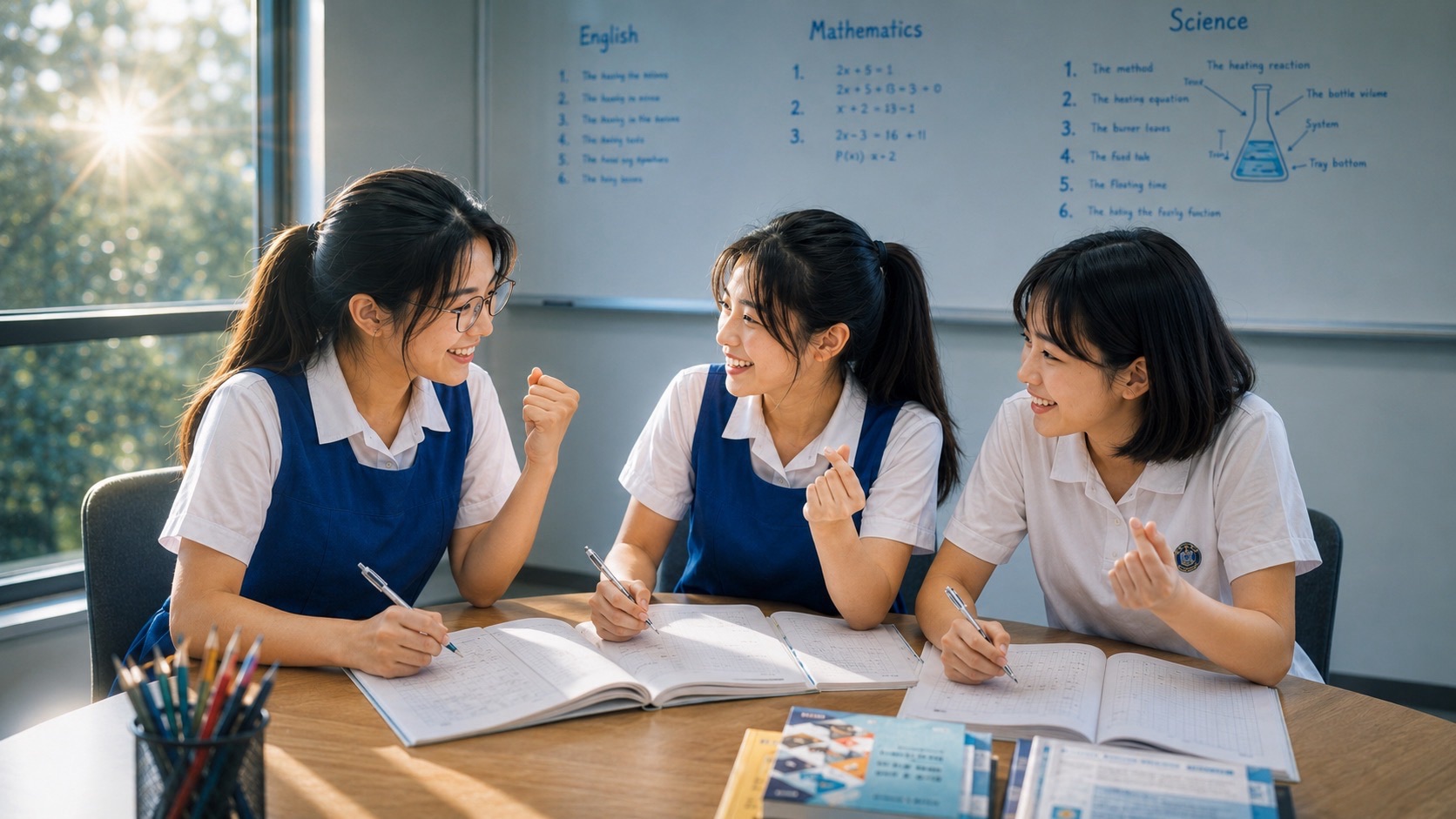
The original 2023 page included this eduKate small-group classroom image. It remains as part of the page archive.

Frequently Asked Questions
What is the 2026 PSLE Science format?
Standard Science has one 1-hour-45-minute paper: Booklet A has 30 MCQs worth 60 marks, and Booklet B has 10–11 structured questions worth 40 marks.
Should P6 students do a full paper every day?
No universal rule supports that. Full papers are useful for integrated measurement and conditioning, but targeted repair is usually more efficient when one specific weakness has been identified.
How many students are in eduKate’s P6 Science small group?
The current model is typically three students, subject to placement and availability.
How long is a lesson?
Lessons are typically 1.5 hours, subject to current programme arrangements.
Should students memorise model Booklet B answers?
Use model answers to identify the required scientific relationship and language, then close the model and reconstruct the reasoning in a changed problem.
Can Science tuition reduce exam anxiety?
Better preparation can reduce some uncertainty, but tuition is not a clinical treatment for anxiety. Persistent or severe distress deserves appropriate support in its own right.
Current Routes
Use the Primary Science Specialist Library for free Science resources. For current P6 Science small-group placement, use the eduKate contact page.
The Main Principle
Primary 6 Science is no longer only about whether the child has learned the chapters. It is about whether the whole scientific system can return on demand: retrieve the concept, recognise the relationship, use the evidence, explain the mechanism, allocate the time and recover when the paper becomes difficult.
Coverage gets the learner to Primary 6. Conversion and conditioning get the learning back out when the PSLE asks for it.