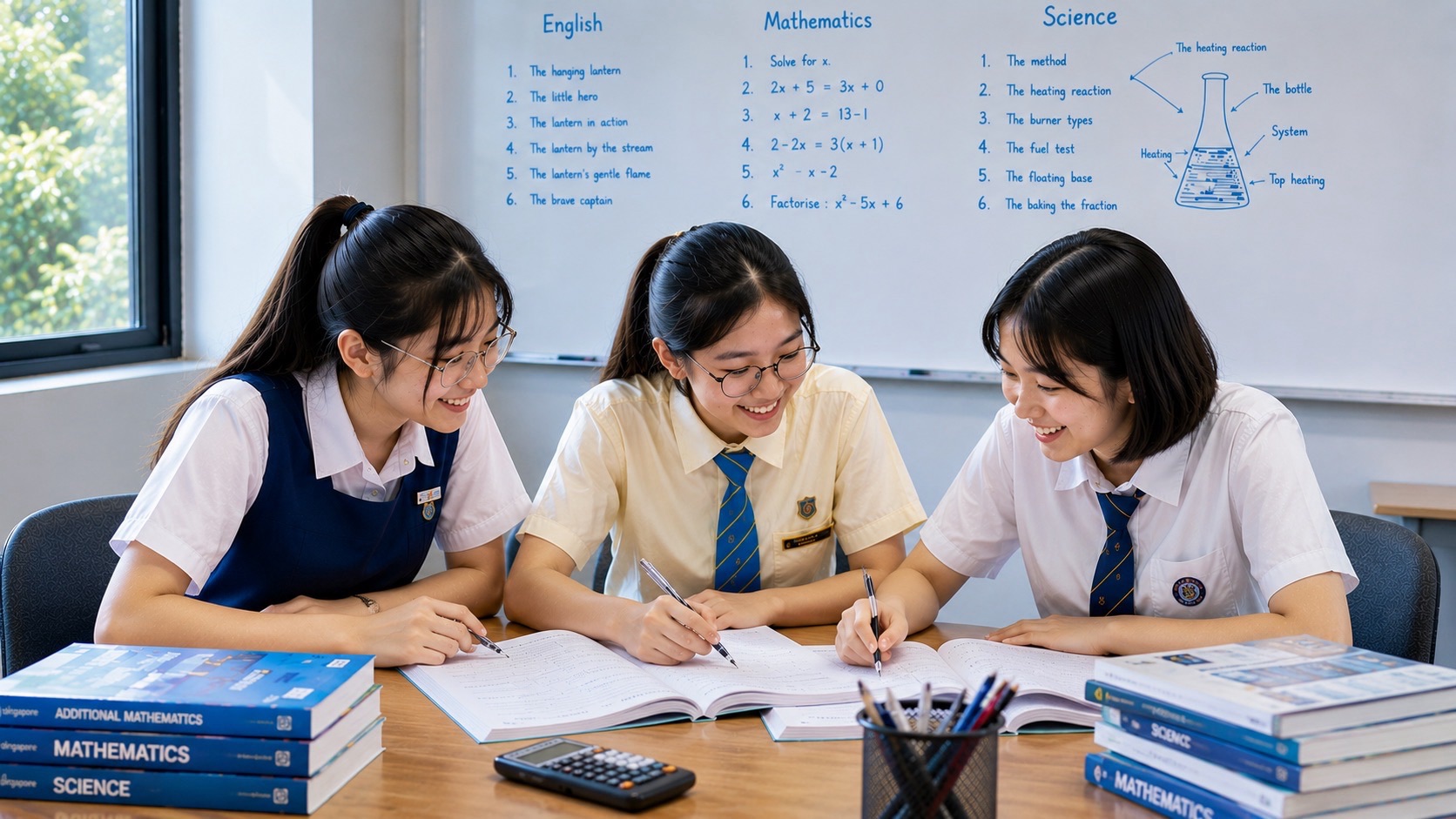
Additional Mathematics becomes difficult when the student is trying to learn A-Math while still repairing the Mathematics foundations that A-Math quietly assumes. Algebraic manipulation, equations, graphs, number sense and mathematical communication do not disappear when the subject becomes more advanced. They become infrastructure.
This page is for Yishun families considering Secondary Mathematics tuition. Its distinct job is to map the dependency from core Mathematics foundations to Additional Mathematics readiness, so a student does not treat every A-Math struggle as an A-Math-only problem.
The preserved URL originated as a 2019 Yishun A-Math commercial page with historic programme, teacher and centre claims. Those claims are not carried forward. eduKate Singapore is an independent tuition provider and is not affiliated with MOE, SEAB or any school.
The Current 2026 Examination Boundary
For 2026 Singapore-Cambridge GCE O-Level school candidates, SEAB lists Mathematics 4052 and Additional Mathematics 4049. The official 4049 Additional Mathematics syllabus explicitly states that knowledge of the O-Level Mathematics syllabus is assumed and may be required indirectly in A-Math questions.
Families should use SEAB’s current 2026 O-Level syllabus page for the examination-year boundary. Singapore is also transitioning to the Secondary Education Certificate from 2027 for the first Full SBB cohort, so future candidates should always check their own cohort’s current subject-level syllabus rather than rely on an older O-Level page.
A-Math Readiness Is a Dependency Graph
A-Math topics sit on earlier mathematical controls. If a lower dependency is weak, the visible error may appear in the advanced topic while the root cause sits below it.
| A-Math demand | Foundation it depends on | What weakness looks like |
|---|---|---|
| Quadratic functions | Algebra, graphs, equations | Expansion/factorisation errors hide function reasoning |
| Inequalities | Number-line logic, algebraic manipulation | Signs and interval meaning become confused |
| Indices and surds | Exponent laws, fractions, exact form | Rule manipulation becomes memorised and brittle |
| Coordinate geometry | Gradient, equations, algebra, geometry | Correct formulas used with wrong geometric meaning |
| Trigonometry | Ratio, angle sense, algebra | Equation solving becomes bottleneck |
| Calculus | Functions, algebra, graph behaviour | Differentiation rules known but application fails |
The correct repair is therefore often prerequisite-first.
Dependency One: Algebraic Fluency
Algebra is the transport layer of A-Math. The student should be able to rearrange, expand, factorise, substitute and simplify without consuming all available attention.
When algebraic fluency is weak, advanced concepts become difficult to see because the learner is constantly fighting the notation.
- Signs change incorrectly.
- Fractions are mishandled.
- Common factors are missed.
- Substitution loses brackets.
- Equivalent forms are not recognised.
These are not “small careless errors” when they repeatedly destroy later reasoning. They are infrastructure failures.
Dependency Two: Equations as Relationships, Not Procedures
Students often learn equation solving as “move this to the other side”. That language can work until the algebra becomes more complex.
A stronger representation is balance and equivalence: whatever transformation is applied must preserve the solution set under valid operations.
This matters later for:
- quadratic equations;
- simultaneous equations;
- trigonometric equations;
- equations involving indices or logarithms;
- calculus applications.
Dependency Three: Functions
Functions connect algebra to graphs and change. Students should understand that a function maps inputs to outputs according to a rule, and that different representations can describe the same relationship.
- symbolic rule;
- table of values;
- graph;
- verbal description;
- equation involving variables.
If the student treats these as separate chapters, later work on quadratic functions, exponential/logarithmic functions and calculus becomes more fragmented.
Dependency Four: Graph Reading
A graph is not merely a picture generated after algebra. It encodes a relationship.
- intercepts;
- turning points;
- gradient;
- increasing/decreasing behaviour;
- intersection of functions;
- domain and relevant ranges;
Students should move between symbolic and graphical reasoning. This becomes particularly important when calculus later describes rates of change and stationary behaviour.
Dependency Five: Fraction and Ratio Control
Weak fraction control can damage algebra silently. Rational expressions, gradients, trigonometric ratios and exact-form manipulation all depend on reliable fraction reasoning.
If students avoid fractions by converting everything into decimals too early, they may lose exact relationships or create unnecessary approximation.
Dependency Six: Mathematical Language
A-Math questions require students to interpret mathematical verbs and conditions precisely.
- show that;
- hence;
- solve;
- find the range;
- deduce;
- express in terms of;
- maximum/minimum;
- stationary point;
- exact value.
Misreading the instruction can produce correct mathematics that answers the wrong question.
Dependency Seven: Working Discipline
As solutions become longer, working becomes a memory aid and error-control system.
- one meaningful transformation per line;
- clear brackets;
- consistent variable notation;
- retain exact form until approximation is required;
- mark substitutions clearly;
- check whether each result answers the stated quantity.
Good working is not cosmetic. It lowers cognitive load and makes error recovery possible.
Dependency Eight: Error Localisation
When an answer is wrong, students should learn to identify the first invalid step rather than restart everything automatically.
- Check the problem representation.
- Check the equation formed.
- Check each algebraic transformation.
- Check substitution.
- Check arithmetic.
- Check final form and units where applicable.
This creates faster correction and reveals whether the error is conceptual or procedural.
Quadratics: A Dependency Example
Quadratic questions can expose several foundations at once:
- factorisation;
- completing the square;
- equation solving;
- graph shape;
- discriminant reasoning;
- maximum/minimum interpretation.
If the student can explain the graph but repeatedly expands incorrectly, repair algebraic fluency. If algebra is strong but the learner cannot connect the discriminant to roots and graph intersection, repair conceptual representation.
Trigonometry: Another Dependency Example
Trigonometry involves ratio, angle relationships, algebraic manipulation, graph understanding and equation solving. A student who knows identities but cannot solve the resulting equation has an algebra dependency problem.
Tuition should therefore ask which layer actually failed instead of assigning more trigonometry questions automatically.
Calculus: Why Function Understanding Matters First
Differentiation rules can be memorised. Application requires function sense: what is changing, what the derivative represents, where stationary points occur and how algebraic results connect to graph behaviour.
If the student treats differentiation as symbol manipulation only, optimisation and rate-of-change questions become fragile.
An A-Math Readiness Diagnostic
| Foundation | Ready signal | Repair signal |
|---|---|---|
| Algebra | Manipulation mostly automatic and explainable | Frequent sign/fraction/bracket failures |
| Equations | Transformations preserve meaning | “Move across” rules used blindly |
| Functions | Moves among rule, table and graph | Representations feel unrelated |
| Graphs | Interprets features, not only plots points | Visual reading is superficial |
| Working | Errors can be localised | Dense or missing steps make checking impossible |
| Transfer | Handles unfamiliar wording | Needs identical worked example |
How a 3-Pax Mathematics Class Uses the Dependency Map
In a maximum three-student group, students can work on the same A-Math topic while the tutor tracks different prerequisites. One learner may need algebra repair, another function interpretation and another examination pacing.
The tutor can ask students to compare solutions and identify where different representations become equivalent. This makes mathematical reasoning visible rather than reducing tuition to copying model methods.
When to Repair E-Math Foundations During A-Math Tuition
Repair a foundation when it repeatedly blocks the advanced topic. Do not reopen every lower-secondary chapter pre-emptively.
- Find the recurring prerequisite error.
- Isolate it briefly.
- Repair with focused examples.
- Return immediately to the A-Math context.
- Retest in a changed question.
This keeps prerequisite repair relevant and efficient.
What Parents Can Bring
- recent Mathematics and A-Math papers;
- school worksheets showing repeated errors;
- teacher comments;
- examples of questions where the child “doesn’t know how to start”;
- information about time pressure.
Comparing core Mathematics and A-Math work can reveal whether the visible A-Math problem is actually inherited from a lower dependency.
Signs A-Math Readiness Is Improving
- Algebra consumes less attention.
- Students can explain equations rather than follow memorised moves.
- Graphs and symbolic forms connect.
- Exact forms are handled more confidently.
- Errors can be localised.
- Changed questions cause less freezing.
- Advanced topics feel conceptually difficult rather than mechanically chaotic.
Questions Parents Often Ask
Should a student be perfect at E-Math before taking A-Math?
No. But core algebra, equations, graphs and number relationships should be sufficiently stable that they do not consume all available attention during A-Math learning.
Why does my child understand A-Math in class but make many algebra errors?
The concept may be understood while the algebraic transport layer remains unstable. Repair the repeated algebra error, then retest the A-Math concept without changing the whole programme.
Should we learn A-Math ahead?
Teaching ahead can be useful when foundations are secure and the goal is deeper preparation. Racing ahead while algebra and functions remain fragile often creates more future repair.
E-Math → A-Math Dependency Map: Almost-Code Summary
A_MATH_TOPIC:
    identify_visible_error()

TRACE_DEPENDENCIES:
    algebra
    equations
    functions
    graphs
    fractions_ratio
    mathematical_language
    working_discipline

IF prerequisite_failure:
    isolate_foundation()
    repair()
    return_to_A_Math()

IF concept_failure:
    rebuild_representation()

TRANSFER:
    changed_question()
    reduced_prompt()

CURRENT_BOUNDARY_2026:
    Mathematics = 4052
    Additional_Mathematics = 4049

OUTPUT:
    stronger_A_Math_readiness
    fewer_inherited_errors
    clearer_mathematical_reasoning