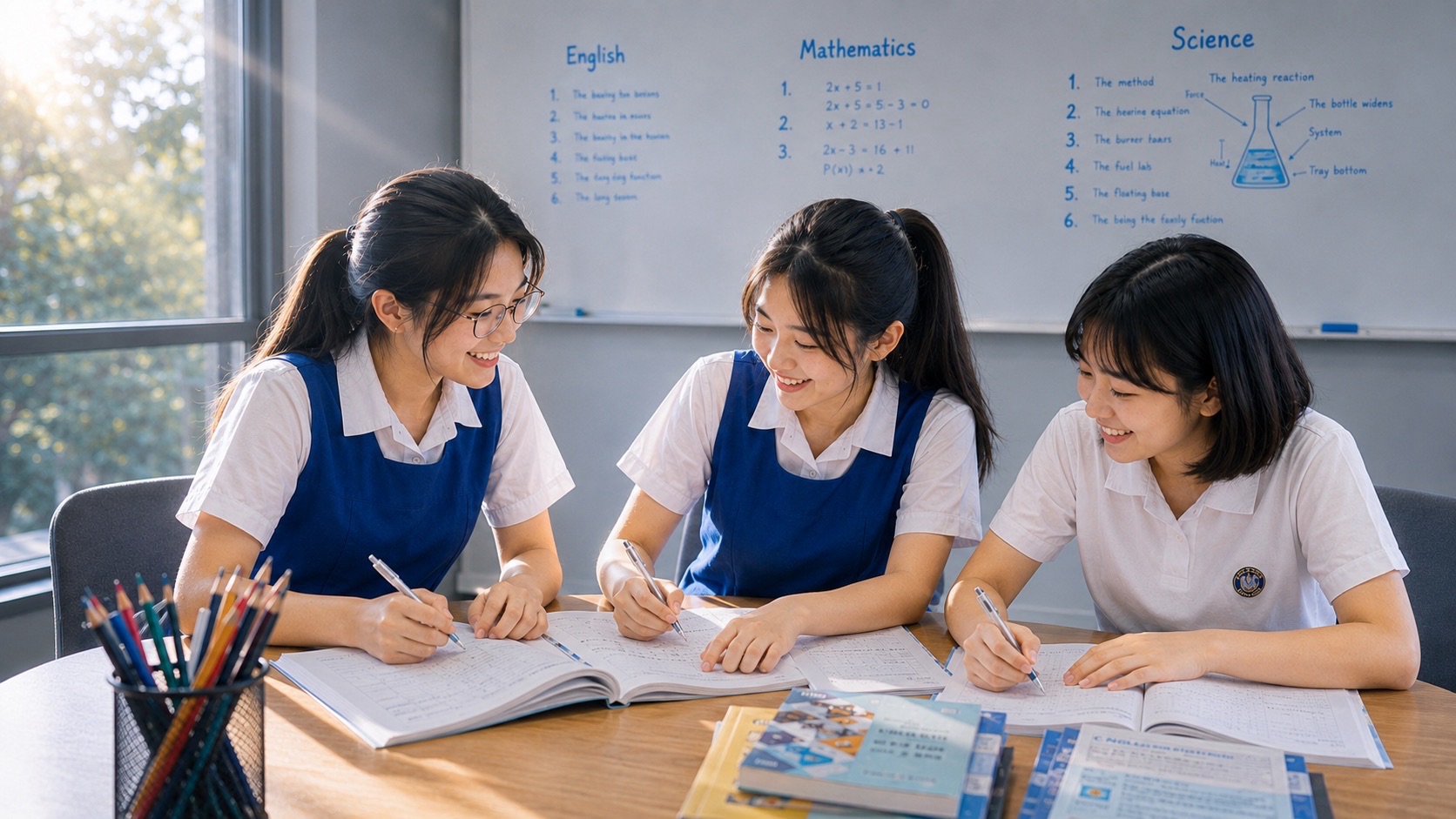
The Role of Discussion in Improving PSLE English Oral Skills
QUICK READ · DISCUSSION → LIVE THINKING → ORAL TRANSFER
Discussion helps PSLE Oral Communication when it forces a student to listen, think, retrieve language, explain a position and adapt to an unexpected follow-up. Simply talking more is not enough.
One-sentence answer: use discussion as deliberate practice for relevance, elaboration, listening and flexibility, then verify those capabilities on unfamiliar oral prompts.

Where discussion fits in the 2026 PSLE English Oral examination
SEAB’s 2026 PSLE English Language syllabus lists Paper 4 Oral Communication as two parts: Reading Aloud and Stimulus-based Conversation. Discussion practice is most directly useful for the second part because the student must engage in a conversation based on a photo stimulus and respond to the examiner in real time.
Discussion does not replace Reading Aloud practice. It develops a different cluster of abilities: understanding the question, generating a relevant idea, supporting it, listening to what comes next and adjusting the response.
Why discussion works: it removes the safety of a script
A memorised oral answer can sound fluent while hiding weak thinking. Genuine discussion creates variation. The other person may ask for evidence, introduce a different viewpoint, change the direction of the conversation or ask the learner to clarify an assumption. The student therefore has to construct language while the conversation is moving.
- Listening: understand what the other person actually said.
- Selection: decide which idea is most relevant.
- Retrieval: find suitable vocabulary and sentence structures quickly.
- Elaboration: explain a reason, example or consequence.
- Adaptation: modify the answer when the next question changes the frame.
Discussion is not the same as debate
Debate can be useful, but PSLE Stimulus-based Conversation is not primarily a competition to defeat an opposing side. A learner needs to communicate clearly and appropriately, express personal opinions and experiences, and engage the listener. Cooperative discussion is therefore at least as important as formal argument.
| Activity | Main learning value | Risk if overused |
|---|---|---|
| Everyday discussion | Natural explanation and follow-up | May stay too familiar or casual |
| Debate | Claim, reasons, counterargument | Can reward winning over listening |
| Picture discussion | Observation → interpretation → personal response | Can become formulaic if prompts repeat |
| Role-play | Perspective and spontaneous response | May become theatrical rather than precise |
| Exam simulation | Integration under realistic conditions | Weak for teaching a skill from scratch |
The discussion chain
- Receive. Listen to the question fully.
- Interpret. Identify what the question is actually asking.
- Select. Choose one useful response route.
- State. Give a clear position or answer.
- Develop. Add a reason, example, experience or consequence.
- Listen again. Take in the examiner’s follow-up rather than continuing the prepared answer.
- Adapt. Extend, qualify, compare or revise the response.
When a child struggles, locate the earliest failed step. A student who misunderstood the question does not need a more sophisticated vocabulary list. A student with good ideas but one-word answers needs elaboration practice.
Five discussion moves that improve oral reasoning
- “What makes you think that?” forces a reason.
- “Can you give me an example?” moves from abstract to concrete.
- “What might someone else say?” introduces perspective.
- “What could happen next?” develops consequence and prediction.
- “Would your answer change if…?” tests flexibility.
These prompts are useful because they require thinking rather than a longer memorised speech.
A photo is a starting point, not the whole conversation
In Stimulus-based Conversation, students should be able to move from what is visible to a wider idea without inventing facts. A useful progression is:
- Observe: what is actually visible?
- Interpret: what reasonable idea does the stimulus suggest?
- Connect: what personal experience, school example or broader issue relates?
- Evaluate: what do you think and why?
- Extend: what consequence, alternative or solution follows?
The distinction between observation and interpretation matters. It prevents confident-sounding invention.
How discussion builds vocabulary without turning into a vocabulary lesson
Conversation creates retrieval pressure. A student may recognise a word while reading but fail to retrieve it when speaking. Discussion exposes that gap. After the conversation, teach only the vocabulary that would have materially improved the response, then use it again in a different topic later.
The sequence is stronger than giving a large topic list in advance: attempt → notice missing language → teach → retrieve → reuse elsewhere.
How discussion improves listening
In a real conversation, the next question depends partly on what has already been said. The learner therefore has to keep enough information active to respond appropriately. This can strengthen conversational listening, turn-taking and clarification.
Do not confuse this with Paper 3 Listening Comprehension. Paper 3 assesses comprehension of recorded spoken texts. Discussion is a stronger match for two-way oral interaction. For Paper 3, see PSLE English Listening Comprehension.
Diagnose the discussion failure
| What you observe | Likely problem | Repair |
|---|---|---|
| Long pause before every response | Question interpretation or idea generation | Practise identifying the question job and producing two possible ideas quickly |
| Good opening, then nothing | Elaboration | Reason → example → consequence practice |
| Answers a different question | Listening or relevance | Paraphrase the question before answering |
| Repeats memorised phrases | Script dependence | Use unfamiliar prompts and unpredictable follow-ups |
| Ideas are strong but language breaks | Formulation under load | Shorter responses, useful sentence frames, then fade support |
| Collapses when challenged | Adaptation | Practise agreeing partly, qualifying and giving alternatives |
Small-group discussion: the useful condition is participation, not merely group size
A small group can provide repeated opportunities to hear different responses and speak in turn. The value comes from active participation and feedback. A learner who remains silent while two confident peers dominate gains much less.
- Give every learner a first response.
- Rotate who asks the follow-up.
- Ask students to summarise another person’s view before adding their own.
- Require evidence or examples, not only agreement.
- Revisit the same reasoning move on a different topic.
A 10-minute home discussion routine
- Choose one ordinary topic from a book, school experience, public issue or family life.
- Ask one open question.
- Let the child finish the first answer without correcting every grammar error.
- Ask for one reason.
- Ask for one example or experience.
- Offer one different viewpoint.
- Ask the child to respond to that viewpoint.
- Finish by asking the child to summarise their current position in two or three sentences.
This keeps the practice short enough to remain sustainable while still exercising the full conversation chain.
When correction should happen
Correcting every grammar or pronunciation issue in real time can destroy fluency and discourage risk-taking. Ignoring every error is also weak teaching. Separate the conversation from the review.
- During discussion, intervene only when meaning breaks down or the same error prevents communication.
- After the response, select one or two high-value language issues.
- Ask the learner to produce the corrected form.
- Return the repaired form in a later conversation so it must be retrieved again.
What discussion cannot fix by itself
Discussion is not a universal treatment for Oral Communication. A child with weak decoding needs Reading Aloud support. A child with severe vocabulary gaps needs sustained language input. A child who cannot organise an idea may need temporary structure. A child who becomes highly distressed in assessment settings may need support beyond ordinary oral practice.
The correct intervention follows the bottleneck.
AI and discussion practice
AI can generate fresh prompts and follow-up questions, which makes it useful for variation. It should not write a polished answer for the child before the child attempts the question. The student must remain the source of the reasoning.
A useful sequence is: learner answers → AI asks one follow-up → learner responds → learner identifies what was difficult → adult or teacher checks one important issue → fresh prompt verifies transfer.
Frequently asked questions
Does discussion directly guarantee higher oral marks?
No. Discussion is useful when it develops capabilities that the learner can later demonstrate independently in Oral Communication. Quality, feedback and transfer matter more than raw talking time.
Should parents correct grammar immediately?
Not every time. Protect meaning and conversational flow first, then review a small number of recurring errors after the response.
Are debates necessary?
No. They can build reasoning and counterargument, but ordinary discussion, picture-based conversation and explanation tasks can develop the same oral foundations more naturally.
What if my child is quiet?
Quietness alone is not the diagnosis. Check whether the learner lacks ideas, language, processing time, confidence or simply prefers to think before speaking. Reduce the task and identify the real constraint.
Long arc: discussion is successful when a student becomes better at receiving another person’s meaning, forming a response, supporting it and adapting as new information arrives. That is useful for PSLE Oral Communication, but it is also the beginning of classroom participation, collaboration, interviews and adult conversation.
Related routes: PSLE English Oral Skills, Confidence for PSLE English Oral, Active Listening for PSLE English and English Primary Overview.