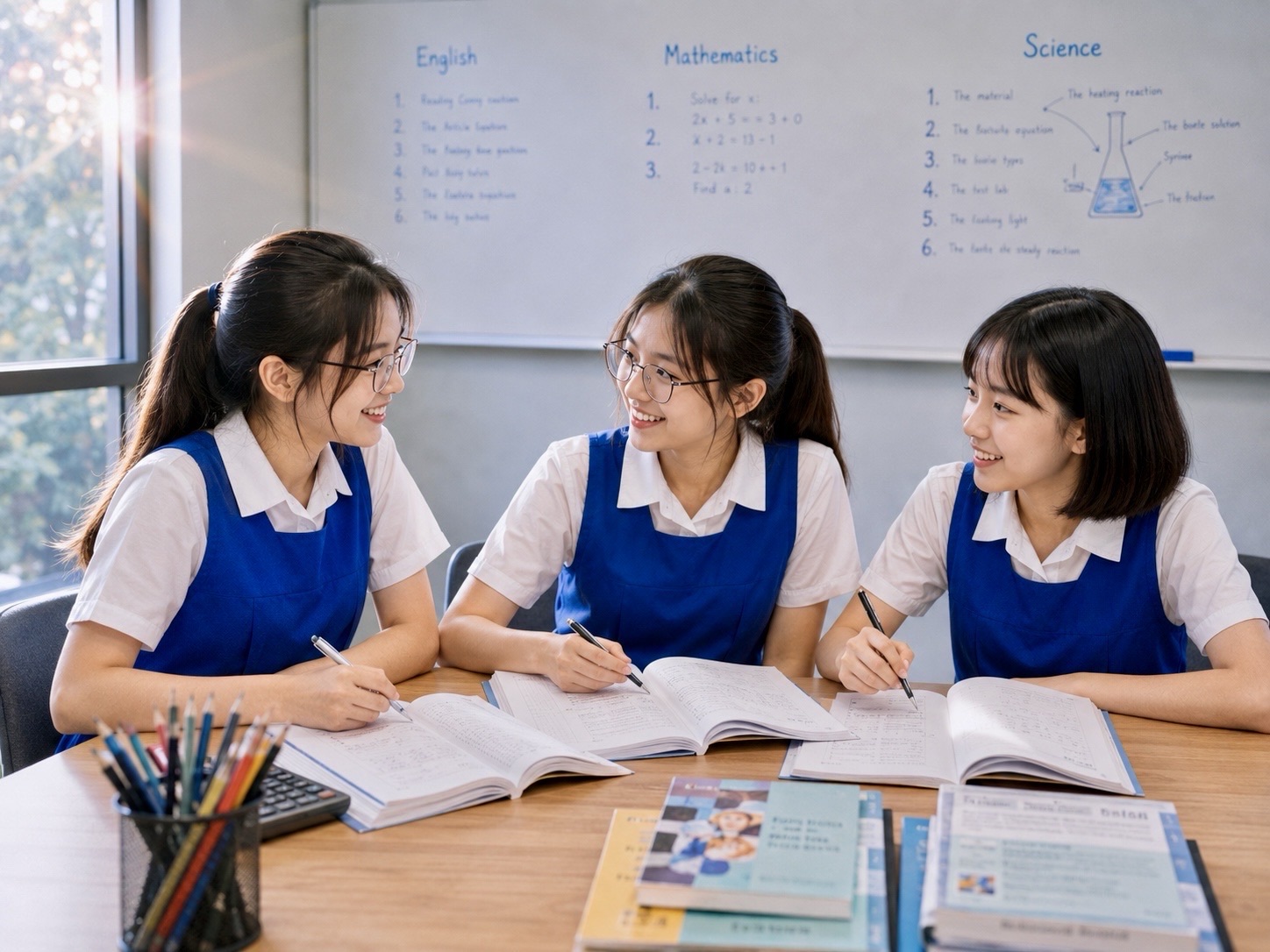
Punggol Secondary 4 Mathematics Tutor
This eduKateSingapore page is a retained educational and routing gateway for Punggol Secondary 4 Mathematics; it is not the current local Punggol programme owner. For the live local programme route, class fit and present-day Punggol teaching context, use Punggol Secondary 4 Mathematics Tutor on eduKatePunggol. Use this page for the examination-year Mathematics system, paper-level performance and library routes below.
Capability → selection → execution → timing → recovery → marks.
A student may know algebra, trigonometry, geometry, graphs, statistics and probability separately, yet still struggle inside a full paper. The examination removes chapter labels, mixes topics, imposes time limits and rewards working that an examiner can follow.
Who this programme is for
- Students who have fallen behind and need the smallest high-impact repair before time becomes scarce.
- Students who understand in class but cannot reproduce the Mathematics independently.
- Students who perform well topically but deteriorate in mixed or full-paper conditions.
- Students who are passing but repeatedly lose marks through method selection, working, accuracy or timing.
- Strong students who need to convert an A-range capability into a more dependable examination result.
- Students also taking Additional Mathematics who need the two examination systems coordinated rather than allowed to compete for all available study time.
The 2026 examination environment
For the 2026 Singapore-Cambridge O-Level Mathematics examination, syllabus 4052 uses two written papers. Each paper is 2 hours 15 minutes and contributes 50% of the result. Essential working matters, and Paper 2 ends with a question focused on applying Mathematics to a real-world scenario.
The practical consequence is important: Secondary 4 preparation cannot be reduced to remembering formulas. Students must recognise structure, select methods, communicate working and remain functional across a long paper.
Official 2026 SEAB Mathematics syllabus 4052.
The Secondary 4 teaching sequence
- Repair — fix inherited weaknesses that are still costing marks.
- Complete — install remaining syllabus content securely.
- Connect — move from chapter practice into mixed Mathematics.
- Retrieve — keep older topics active while new work continues.
- Time — introduce increasing examination load without sacrificing accuracy.
- Convert — train paper strategy, communication, recovery and mark capture.
The aim is not more worksheets. It is a smaller, evidence-driven list of what must change before the next examination.
A paper becomes diagnostic evidence
After a test or prelim, we do not treat the final grade as the diagnosis. Lost marks are classified.
- knowledge missing;
- method not recognised;
- method recognised but executed incorrectly;
- working too compressed;
- question misread;
- time allocation failure;
- calculator or notation error;
- correct route abandoned too early;
- final answer not checked or not expressed as required.
Each category produces a different next action. This is why three carefully corrected papers can be more useful than ten papers completed without analysis.
The year has phases
- Term 1: repair inherited weaknesses and secure current school work.
- Term 2: complete, connect and increase mixed practice.
- Mid-year: consolidate the full system while substantial repair is still possible.
- Prelims: convert knowledge into paper-level performance.
- After prelims: classify lost marks and make the final high-value corrections.
Why three students matters in the examination year
A maximum of three students lets the tutor inspect actual working, identify where time is being lost, compare different valid routes and intervene at the first broken step. At the same time, the tutor can deliberately withdraw support so the student must operate independently.
Read Why Three Students Work in the Examination Year for the full mechanism.
The Secondary 4 Mathematics Library
- How Secondary 3 Mathematics Works — the incoming expansion state.
- How Secondary 4 Mathematics Works — the examination-conversion runtime.
- Secondary 4 G3 Mathematics — Repair → Precision → Timing → Examination Control.
- Why Three Students Work in the Examination Year — the teaching architecture.
- How Full-Paper Mathematics Works — the paper runtime.
- Punggol Secondary 4 Additional Mathematics Tutor — the A-Math programme gateway.
- Secondary 4 G3 Additional Mathematics — the A-Math intervention route.
- How Full-Paper Additional Mathematics Works — the A-Math paper runtime.
Consultation before placement
For a current Punggol placement decision, eduKatePunggol’s Secondary 4 Mathematics Tutor route can establish the student’s subject level, recent-paper evidence, remaining syllabus gaps, timing profile, Additional Mathematics load, class suitability and present availability before a local programme decision is made.
The question is not simply, “How much tuition does this student need?” It is, “What is the smallest justified change that can still alter the examination outcome?”
