Punggol Sec 3 A Maths Small Group Tutoring: A Comprehensive Guide
Welcome to your one-stop guide for Sec 3 Additional Maths tutoring in Punggol. Our focus is to create a dynamic learning environment that fosters deep understanding and problem-solving capabilities.
Punggol Sec 3 A Maths Small Group Tutoring: Key Points
- Follows the GCE O Level’s Additional Mathematics syllabus.
- Syllabus evaluates Punggol Sec 3 A Maths students’ abilities across three key areas:
- Use and Apply Standard Techniques (AO1)
- Solve Problems in a Variety of Contexts (AO2)
- Reason and Communicate Mathematically (AO3)
- AO1, AO2, and AO3 have weightages of 35%, 50%, and 15% respectively in the overall assessment.
- The examination scheme consists of two papers, each of 2 hours 15 minutes, carrying 50% of the overall weightage.
- Essential mathematical working should not be omitted to avoid loss of marks.
- The syllabus content covers Algebra, Geometry and Trigonometry, and Calculus.
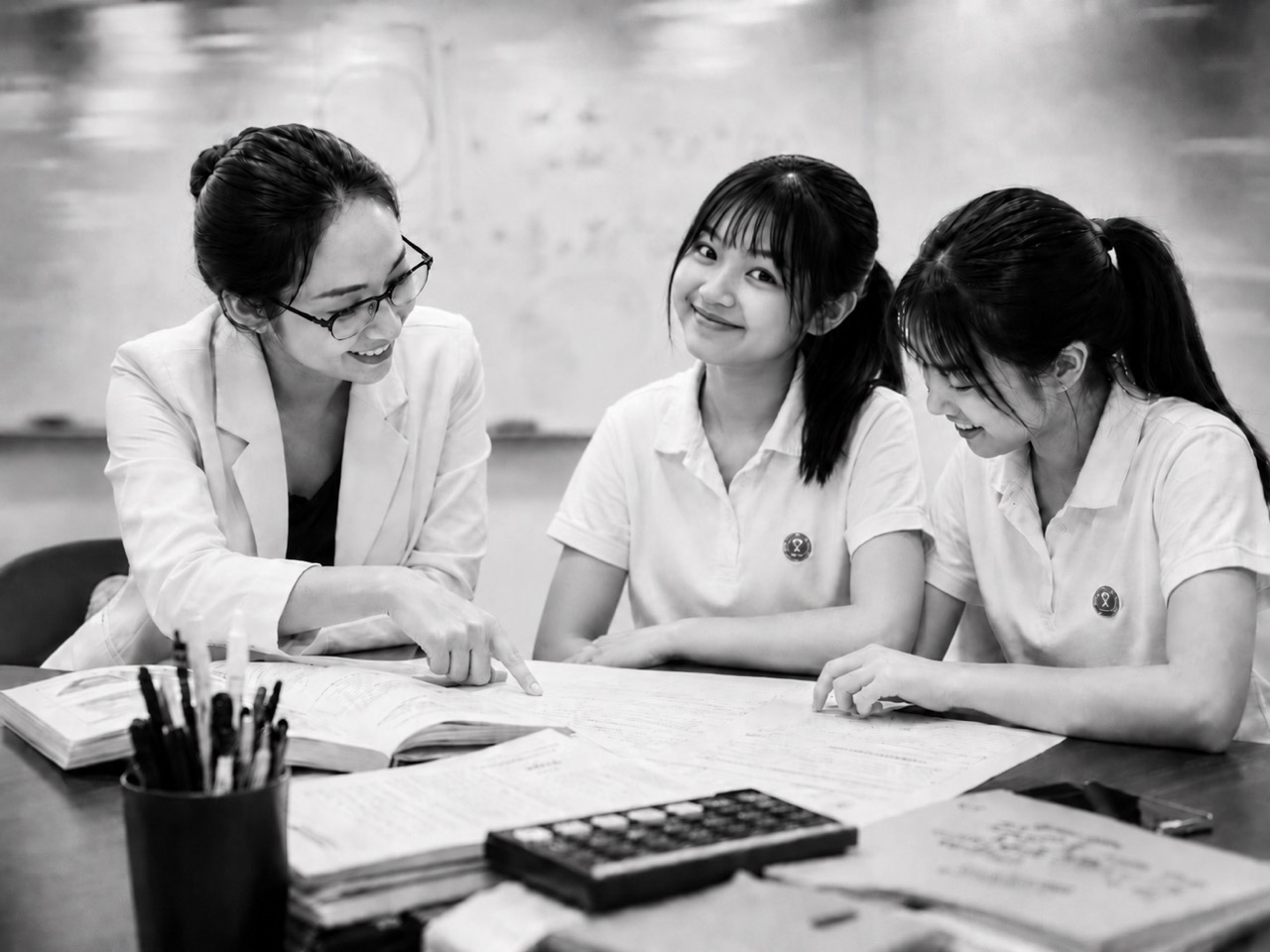
- Punggol Sec 3 A Maths Small Groups focus on breaking down complex concepts into simple, understandable lessons.
- The Punggol Sec 3 A Maths tutors provide hands-on problem-solving exercises.
- Punggol Sec 3 A Maths Classes are small to ensure personalised attention to each student.
- Punggol Sec 3 A Maths Tutors guide students on strategic study planning, prioritizing topics, and effective time allocation.
- Punggol Sec 3 A Maths Students are encouraged to reason and communicate mathematically, a vital part of the syllabus.
GCE O Level’s Additional Mathematics Syllabus
In Punggol Sec 3 A Maths , the GCE O Level’s Additional Mathematics syllabus is followed. This syllabus has been designed to evaluate Punggol Sec 3 A Maths students’ abilities across three key areas:
- Use and Apply Standard Techniques (AO1): Involves the recall and application of facts, terminology and notation, ability to read and use information from tables, graphs, diagrams and texts, and perform routine mathematical procedures. Weighted at 35% in the overall assessment.
- Solving Problems in a Variety of Contexts (AO2): This aspect tests Punggol Sec 3 A Maths students’ ability to interpret information to identify the correct mathematical concept, rule or formula, translate information from one form to another, formulate problems mathematically, analyse and select relevant information and solve problems using appropriate mathematical techniques. It is the most significant part of the syllabus, accounting for 50% of the overall marks.
- Reason and Communicate Mathematically (AO3): Punggol Sec 3 A Maths Students are expected to justify mathematical statements, provide explanations, and write mathematical arguments and proofs. This aspect of the syllabus carries a 15% weight.
Examination Scheme
The examination comprises two papers, both of which are 2 hours 15 minutes long. Each paper carries 50% of the overall weightage. It is important to note that relevant mathematical formulae will be provided for the candidates. However, omission of essential working may lead to loss of marks.
Latest SEAB O levels Syllabus click here.
Subject Content
The syllabus covers a range of topics across Algebra, Geometry and Trigonometry, and Calculus.
Algebra
Algebra forms the foundation of Additional Mathematics. In Sec 3 A Maths, Punggol Sec 3 A Maths students will delve into Quadratic Functions, Equations and Inequalities, Surds, Polynomials and Partial Fractions, and Binomial Expansions. Our tutors ensure students are comfortable with these concepts, as they form the basis for understanding more advanced topics.
Geometry and Trigonometry
Geometry and Trigonometry in the Additional Mathematics syllabus covers Trigonometric Functions, Identities and Equations, as well as Coordinate Geometry in two dimensions and Proofs in Plane Geometry. The understanding of these concepts allows students to interpret and solve problems involving spatial relationships.
Calculus
Lastly, the syllabus delves into Calculus, focusing on Differentiation and Integration. These concepts are the core of many mathematical and scientific computations. With these skills, students will learn how to determine the rate of change of quantities and solve complex equations, among other capabilities.
The Punggol Sec 3 A Maths Small Groups Tutoring Approach
At our Punggol Sec 3 A Maths Small Groups, we tailor our Add Maths lessons according to the syllabus’s learning objectives. We also pay close attention to the examination scheme, ensuring our students are well-prepared to tackle the different types of problems in the exams.
Our Punggol Sec 3 A Maths tutors break down complex concepts into simple, digestible lessons and provide hands-on problem-solving exercises. By maintaining small class sizes, we ensure personalised attention to each student’s needs.
Additionally, we emphasise strategic study planning. Our Punggol Sec 3 A Maths tutors guide students on how to prioritise topics, allocate study time effectively, and ensure all areas in the syllabus are covered. Understanding the syllabus and the examination scheme is crucial to strategic study planning, and we place a significant emphasis on this.
Summary
The Punggol Sec 3 A Maths Small Group Tutoring program is designed to cater to the needs of Sec 3 Additional Mathematics students in Punggol. Following the GCE O Level’s Additional Mathematics syllabus, the program seeks to equip students with the essential knowledge and skills in key areas including Algebra, Geometry and Trigonometry, and Calculus. The Punggol Sec 3 A Maths tutors focus on simplifying complex concepts, providing problem-solving exercises, and guiding strategic study planning. With a small class size, the Punggol Sec 3 A Maths program ensures personalized attention and guidance to every student, fostering a conducive learning environment. Through this comprehensive approach, Punggol Sec 3 A Maths Small Group Tutoring aims to prepare students thoroughly for their exams, ultimately achieving academic success in Additional Mathematics.
Learn more about our Additional Mathematics Small Groups Tutorials here
Striving for excellence?
